Showing posts with label j. g. ballard. Show all posts

10 Jun 2026

Notes on Mark Fisher's Flatline Constructs (2025): Chapter Two

Zer0 Books (2025) [a] 
Cover design by Rebecca Wright / charcoalstudio.co.uk 
Reimagined by Stephen Alexander (2026)
 
'Body Image Fading Down Corridors of Television Sky ...'
 
 
I. 
 
Fisher tells us that chapter two of Flatline Constructs opposes a cyberpunk concept of the body - i.e., one sans organes - to the body as encountered in traditional works of science fiction which are complicit in the false idea that technology is simply an extension of the flesh [b]. 
 
He writes:
 
"Gothic Materialism understands cyberpunk not as the dialectical fusion of Horror and Science Fiction, but as the materialist critique of Science Fiction from hypernaturalist horror. What is at stake is a - new - account of the body, abstract, cybernetic and denaturalised." (84)
 
Fisher continues:
 
"Ironically, given all the discourse of disembodiment that often surrounds the technical apparatus with which cyberpunk texts have typically been obsessed - virtual reality machines, simulators, cyberspace decks - cyberpunk constitutes an earthing of Science Fiction's 'traditional' ideal, or non-physical body. But the outlines of the body it emphasises are not defined by the limits of the organism." (84-85)  
 
In order to illustrate his point, he analyses two works that have posed a challenge to old school sci-fi: David Cronenberg's Videodrome (1983) and J. G. Ballard's The Atrocity Exhibition (1970) - a novel which Fisher prefers over Ballard's better-known text, Crash, published three years later. 
 
For Fisher, Ballard in particular points the way to the key Gothic Materialist idea of anorganic continua.  
 
 
II.  
 
I can't remember who said it - or if I'm remembering it accurately - but a book of quotations once introduced me to the idea that nothing is more tiresome than being assaulted by old ideas conquered long ago
 
Unfortunately, that is exactly how I feel when confronted with the Body without Organs (or even the body without image). It belongs to a lost era of decoded flows and the schizo-implosion of subjectivity. Does anyone still think in these terms today? 
 
The fact is, it has been thirty years since Mark Fisher began his thesis, over fifty since Deleuze and Guattari borrowed the BwO from Artaud to critique capitalism, and eighty since Artaud himself decided to have done with the judgment of God.

Granted, theoretical concepts mutate; the BwO can be recontextualised to map algorithmic data streams or track how large language models unfold beyond human organisation. But Deleuze-Guattarian studies are now so heavily institutionalised that one can hardly bear to hear about the BwO, or planes of immanence, or becoming this, that, or the other.
 
When these concepts exploded in the 1990s via the CCRU (Cybernetic Culture Research Unit), they were genuinely radical and capable of destabilising old and orthodox ways of thinking. But today, a schizoanalytic philosophy designed to evade capture has been completely assimilated, reducing the BwO to just another tedious topic for endless discussion in peer-reviewed journals by academics who still think it's a metaphor. 
   
 
III. 

Apologies, dear reader, for this slight digression. But I felt I had to say something and say it in the main body of the post for fear it may be overlooked if consigned to the notes. Having said it, we can now return to Fisher's book ...
 
Horror, says Fisher, is not simply horrifying and horrific, it is also kind of sexy and Gothic Materialism "apprehends horror not merely negatively but also as [...] an abstract erotics whose programme is the opening up of the organism into desiring-circuits: the production of what Cronenberg calls 'New Flesh'" (79). 
 
Thus, the BwO is both terrifying and desirable. It is also without an image; you can represent the organism, but not the body and its potential, "which is always abstract and unknowable" (80). 
 
That is to say, nobody knows what a body can do - and nobody knows what a body looks like; least of all those staring at pornographic images, a point made powerfully by D. H. Lawrence who condemns porn as a self-conscious "flaunting of the body in its non-physical, merely optical aspect" [c].
 
Fisher, I'm told, did not like Lawrence - despite the fact that Lawrence was, according to Deleuze, one of the four great heirs to Spinoza [d]. And that's a pity, because Lawrence was attacking the organism (or what he termed the corpse-body) and seeking ways to free the body from its automatic reactions, long before Artaud.
 
The key point, however - on which I think all are agreed - is that the body is not a container of mind or spirit; the organism, however, is the container of the flesh (what we might term a body bag). It is thus never a question of liberating the subject from their body, no matter what certain idealists and religious teachers think, but of exploring the body as a site of depersonalised potential
 
 
IV.
 
Section 2.5 of Flatline Constructs is about something that some commentators - such as Steven Connor, for example - regard as modern man's most human aspect and the subject of endless fascination among many well-known critical and cultural theorists: skin [e].
 
Fisher, however, is interested in how technology essentially flays mankind; that is to say, transforms the body into an open, mediatised circuit by eliminating the boundary once formed by skin, thereby dissolving still further the idea of interiority and allowing human consciousness to circulate within digital networks.  
 
In fact, he seems more than merely interested in this; seems to be positively in favour of such an epidermal crisis and to delight in the fact that "the skin is no longer a secure marker of organic integrity" (88) and that man, in an age of cybernetic hyperconnectivity, is no longer self-contained.
 
For Fisher, as a Gothic Materialist, being skinned alive or, essentially, turned inside out (everted)is not a horrific trauma to be avoided, but to be welcomed. However, whilst I understand where he's coming from, I do have certain reservations. 
 
Indeed, if we follow Deleuze and Guattari's actual instructions for constructing a BwO, they explicitly warn against this kind of wild, unprecautious destratification [f]. To violently blow apart the strata and fling oneself into digital networks risks producing not a site of joyous potential, but a suicidal collapse.
 
Perhaps Lawrence is right after all, and the secret to achieving what the Greeks termed εὐδαιμονία is "remaining inside your own skin, and living inside your own skin, and not pretending you're any bigger than you are" [g].
 
 
V. 

Sometimes, when reading Fisher back in his CCRU days and under the sway of Nick Land, I come over a bit Bill Grundyish and feel like putting to him the question that the latter put to the Sex Pistols back on that fateful day in December 1976: Are you serious, or are you just trying to make me laugh? [h]
 
Actually, I suspect despite a certain dark humour, Fisher was being (un)deadly serious in Flatline Constructs and not just looking to provoke or outrage his examiners. In fact, there are times when Fisher is a little overearnest for my tastes. Nevertheless, he does write some immensely interesting stuff - including the material on numbness, narcissism and schizophrenia in section 2.6.
 
Referencing the work of, among others, McLuhan and Baudrillard, Fisher examines how alienation gives way to integration; i.e., man's becoming one with his own circuits, networks, and screens and how this results in the loss of both public and private spaces: "'The one is no longer a spectacle, the other is no longer private'", as Baudrillard says (quoted here on p. 93). 
 
That has many consequences, including the fact that there is now nowhere to hide; hence the obscenity of pornified postmodern culture and the move from narcissism to schizophrenia - for what's unfolding is no longer about self-love, but, rather, the "inability to distinguish self from other" (94) or from the digital environment. 
 
Fisher writes:
 
"The concern, in postmodern theory, with schizophrenia, is, in large part, a registering of this cybernetic account of subjectivity, a sense that the self can no longer be properly distinguished from the multiplicity of circuits that traverse it." (95)
 
It's all too much: we are literally overwhelmed (which was always likely to be the outcome of shedding our skin); the schizophrenic experience can be defined (philosophically, rather than clinically) as "a surfeit, rather than a paucity, of reality" (96). On this, Baudrillard is in complete agreement with Deleuze and Guattari. 
 
If you thought simulation was the only thing you had to worry about, think again; overstimulation is at least as great an issue. And William Gibson even coins the handy term simstim to describe what underlies all the latest technological innovations. 
 
Today, our perception has been decoded into a set of triggerable stimulations capable of simulating any possible experience, and this "simulation of particular affective states by direct neuronic stimulation" (98) is one of the great themes of cyberpunk fiction and cinema (it's central, of course, to Cronenberg's Videodrome).   
   
Fisher concludes:
 
"Hence the relation between the human organism and its technical environment becomes understood not any longer in terms of organic extensions, but of dependence-circuitries." (99)
 
We are hooked to (and on) our machines and the stimuli they supply [i].   

 
VI.
 
When Cronenberg's Videodrome was released in UK cinemas in November 1983, it was given an 18 certificate by the British Board of Film Classification as it contained scenes of strong sex and violence. As Fisher would have only been fifteen at the time, I doubt he saw it until some time later [j]. 
 
I went with my on-off girlfriend Gillian Hall to see the film in March of the following year, at the ABC in Leeds city centre (£2.30 for admission). Gillian was much more a fan of body horror than me and I suspect I only went along because Debbie Harry (as kinky therapist Nicki Brand) featured in a number of nude scenes.   
 
Anyway, I was not impressed: 
 
The film - despite rave reviews and some amusing special effects - was shit. Neither one thing nor another; not quite a psychosexual thriller; not quite a sci-fi horror story. Just a lot of stuff and nonsense. [k]   
  
Fisher, however, LOVES the film:
 
"Cronenberg's Videodrome has achieved its 'canonic' status because of its almost emblematic staging of the convergence of cybernetic and Gothic themes [...] as it passes across the so-called animate and inanimate [...] making the distinction between organic and inorganic increasingly untenable. In particular, it focuses on media - especially the so-called postmodern media of TV and video, and the still nascent technologies of Virtual Reality - as assemblages which reconfigure the body in new ways, opening it up to desiring-trajectories that have as their corollary a new - cybernetic - account of power." (100)
 
Videodrome, says Fisher, perfectly illustrates what happens when a body is not extended by technology, but invaginated and "literally overwhelmed by an unimaginable quantity of stimuli" (100).   
 
I suppose that's a rather more insightful - certainly more receptive - commentary than mine (to be fair, I was writing in a diary having just turned twenty-one and not in a doctoral thesis approaching thirty - although, having said that, I was completing a degree in sociology and media, so might have been expected to say something a bit more than this).  
 
 
VII. 
 
Still discussing Videodrome, Fisher argues that what makes the film "fit so closely with Baudrillard's theorisations" (101) is the fact that it emphasises the tactile over the optical and reveals the world of communications technology to be all about obscene closeness
 
Ultimately, nothing is more unheimlich than a TV set; "a disturbing presence in the heart of the domestic scene" (106). You think you're watching it, but actually it's ravishing your very being; you think the set is plugged into the wall, but actually it's you who's plugged in to the network.
 
Desire is captured by images and the body is "slaved into idiotic compulsive-repetitive behaviours" (109-110) by the triggering of these images - which could, of course, serve as the very definition of pornography. It's "a cybernetic (re)engineering of the body, rather than a simple matter of optical stimulation" (111).
 
 
VIII. 
 
As I said in an earlier post in this series on Flatline Constructs, I'm not a fan of William Burroughs - but I do like Ballard and so was interested to see what Fisher had to say about the latter in relation to his Gothic Materialism ...
 
In sum, he positions Ballard's The Atrocity Exhibition (1970) as a foundational, hypernaturalist precursor to cyberpunk that demonstrates how modern technology and human 'psychology' collapse into a singular cybernetic system and how life today unfolds in a media landscape whose violent images act directly upon the nervous system, causing a schizophrenic loss of agency. 
 
If that sounds traumatic, it's because it is traumatic. But - and this is important - Ballard generalises the concept: "Rather than treating trauma as something with which the organism is affected only contingently, Ballard implies that trauma is a general condition [...] across a culture [...]" (120-121), propagated by media. 
 
Trauma, in other words, is now the "very mode of experience itself" (122) and Ballard seems happy to "hunt out and obsessively pore over trauma" (126).  
 
 
IX. 
 
Fisher also shows how Ballard's novel also illustrates his notion of the Gothic flatline; a plane of immanence cutting across vitalism and mechanism. Ballard is highly skilled at, on the one hand, treating human bodies with a cold, geometric objecthood, whilst, on the other hand, allowing inanimate things such as billboards and motor cars to possess strange, intensive agencies. 
 
Drawing a lineage that connects Ballard to his favourite theorists, Fisher notes that The Atrocity Exhibition captures our overstimulated era. However, unlike Baudrillard - whom Fisher criticises for a loss of nerve and a fall into neo-primitivism and nostalgia - Fisher argues that Ballard dares to fully embrace the world as a dynamic - but flat - landscape in which it is impossible to distinguish figures from background.  
 
Ballard's fictions - "anti-organcist and cybernetic" (115) - basically serve as instruction manuals for decoding this spinal landscape [l]. And The Atrocity Exhibition in particular offers the "most sustained theory-fictional account of contemporary media culture in terms of the spinal landscape" (118). It's thus a radically new type of work - Science Fiction without any of the usual tropes or clichés of SF.   
 
It's also a new type of work which, like Videodrome, displaces bio-sexuality: "The novel performs a decoding of sex into a matter of stimuli that are not themselves sexual [...]" (127). Baudrillard, writing of Crash, will speak of a "deterritorialised and disorganicised eroticism; a cyberotics" (127). 
 
Fisher explains: this is not a matter of "simply substituting technical machines for biological sexual objects, but of decoding sexuality into a matter of abstract stimulus" (127), nor of "selling commodities by associating them with sex" (127). It is, rather, a question of a "generalised libidinisation in which bio-sex is no longer the privileged referent" (127).          
  
Writing in The Atrocity Exhibition, Ballard obliges us to ask: "' in what way is intercourse per vagina more stimulating than with this ashtray, say, or with the angle between two walls'" (quoted by Fisher on p. 127). Farewell and fuck off to all those old-school erogeneous zones, says Baudrillard with a laugh, whilst Fisher closes his chapter on a rather more serious note concerning the deterritorialisation of sexuality and the emergence of new desires
   
"One could theorise these either as a hypersexuality - a sexuality that has escaped genital, even biotic reference, or as a post- or anti-sexuality - desires that it no longer makes any sense to describe in sexual terms." (128)   
 
Fisher's following chapter in Flatline Constructs (chapter three), is not so much concerned with cyberotics, however, but with the question of how on earth do bodies without sexual organs reproduce themselves ...
 
 
Notes
 
[a] All page numbers given in the post refer to this edition of Flatline Constructs.   
 
[b] This is an idea Fisher traces back to Freud, who famously says that with every tool, "man is perfecting his own organs [...] or removing the limits to their functioning'" (87).  
 
[c] D. H. Lawrence, 'Men Must Work and Women as Well', in Late Essays and Articles, ed. James T. Boulton (Cambridge University Press, 2004), p. 282. 
      According to Lawrence, the less individuals receive and transmit the flow of desire, the more desperately do they expose their flesh and obsess over their body image. However, in or out of her knickers makes very little difference to the desirability of the modern woman, says Lawrence, because she's "an assertive conscious entity, cut off like a doll from any mystery. And her nudity is as interesting as a doll's." See '...... Love Was Once a Little Boy', in Reflections on the Death of a Porcupine and Other Essays, ed. Michael Herbert (Cambridge University Press, 1988), p. 346. 
      I explore all this in Outside the Gate (University of Warwick, 2000) - the doctoral thesis I was completing in the philosophy department whilst Fisher was working on Flatline Constructs. See part one of chapter four - or, if referring to the Blind Cupid Press book (2010), see chapter 11 in part four (pp. 211-232).      
 
[d] Matt Colquhoun confirmed to me in a recent email (7 May 2026) that Fisher hated Lawrence. 
      Deleuze, however, was a huge fan of Eastwood's favourite son and, as indicated, named Lawrence along with Nietzsche, Kafka and Artaud as one of the four great heirs to Spinoza; see the essay 'To Have Done with Judgement', in Gilles Deleuze, Essays Critical and Clinical, trans. Daniel W. Smith and Michael E. Greco (Verso, 1998), pp. 126-135. And see also my post on this idea dated 10 Jan 2026: click here
 
[e] In The Book of Skin (Cornell University, 2004), pp. 9-10, Connor writes: 
      "The skin asserts itself in the erotics of texture, tissue and tegument played out through the work of Roland Barthes; in the concern of Emmanuel Levinas with the exposed skin of the face, as the sign of essential ethical nudity before the other [...] the extraordinary elaborations of the play of bodily surfaces, volumes and membranes in Derrida's concepts of double invagination [...] the concept of the fold in the rethinking of subjective and philosophical depth in the work of Gilles Deleuze; the fascination with the intrigues of the surface in the work of Baudrillard; and the abiding presence of skin in the work of Jean-François Lyotard, from the arresting evocation of the opened out skin of the planar body at the beginning of his Libidinal Economy through to the Levinsian emphasis on the annunciatory powers of skin at moments through The Inhuman. Most strikingly of all [...] there has been the prominence of the skin in the meditations on place, shape and the 'mixed body' of Michel Serres. Across all this work, as ubiquitously in modern experience, the skin insists." 
     
[f] See Deleuze and Guattari writing in A Thousand Plateaus, trans. Brian Massumi (The Athlone Press, 1988), pp. 150 and 160-161.  
      When building a BwO, they explicitly advocate the injection of small doses of caution as crucial to what is, after all, a highly experimental practice; one that can easily result in "a dreary parade of sucked-dry, catatonicized, vitrified, sewn-up bodies" rather than bodies full of "gaiety, ecstasy, and dance".
      Deleuze and Guattari insist dismantling the organism has nothing to do with the death drive: "You have to keep enough of the organism for it to reform each dawn [...] and you have to keep small rations of subjectivity in sufficient quantity to enable you to respond to the dominant reality. [...] You don't reach the BwO, and its plane of consistency, by wildly destratifying." 
      The knack is to "patiently and momentarily dismantle the organization of the organs we call the organism" - don't just empty out your organs or flay yourself. If you do that - "if you blow apart the strata without taking precautions", then bad things will happen. "Staying stratified - organized, signified, subjected - is not the worst that can happen; the worst that can happen is if you throw the strata into demented or suicidal collapse, which brings them back down on us heavier than ever." 
       
[g] D. H. Lawrence, 'Education of the People', in Reflections on the Death of a Porcupine and Other Essays, ed. Michael Herbert, (Cambridge University Press, 1988), p. 161.
 
[h] Bill Grundy interviewed the Sex Pistols on the Today programme on 1 December 1976. It didn't quite go to plan and resulted in a fury of tabloid headlines and national outrage. A transcript of the interview can be read here. And the actual interview can be watched here.  
 
[i] This part of Fisher's 1999 thesis has held up very well - in fact, is probably truer now than then; our algorithmic landscape is precisely an overwhelming dependence-circuitry designed to trigger affective states via direct neuronic feedback loops (endless notifications, doomscrolling, etc.).  
 
[j] It could be, of course, that Fisher first saw Videodrome on home video and not at the cinema. The original VHS release (1987), however, was a cut version of the original film; the distributors (CIC Video) responding to pressure to remove some of the more graphic material (the UK at this time was in a state of moral panic over so-called video nasties). The uncut version wasn't available on video until the re-release in August 1990.  

[k] Entry in The Von Hell Diaries dated Thurs 29 March 1984. 

[l] As Fisher notes: "Like much of Ballard's most important imagery, the concept of the spinal landscape is derived from surrealism." (118)

 
For other posts in this series on Fisher's Flatline Constructs, click here.  


29 Apr 2026

CRA5 H26 (A Brief Note on Serendipity, Synchronicity, and Coincidence)

CRA5 H26 (SA/2026)
 
'I believe in my own obsessions, in the beauty of the car crash ...' [1]
 
 
I. 
 
How odd that after reading a k-punk post discussing J. G. Ballard's novel Crash (1973) - a post in which Fisher describes the work as deeply indebted to the imagery of Helmut Newton and "a perverse counterpart to Kant's kingdom of ends" [2] - I should go for a walk and immediately encounter the above vehicle ...
 
Some might say this is serendipitous; others may see it as evidence of synchronicity; personally, however, I think the term coincidence covers it. 
 
But it's worth perhaps briefly considering these three distinct concepts separated by ideas of agency, meaning, and causality ...
 
 
II.
   
Serendipity involves the random occurrence of fortunate or pleasant events; i.e., unintentionally coming across things or finding oneself in unexpected situations that have some kind of positive value. I suppose we might see it as an elevated form of good luck and as something that allows happy accidents to become opportunities. 
 
The term was coined by Horace Walpole in 1754, inspired by the Persian fairy tale The Three Princes of Serendip (1557). For philosophers, serendipity requires sagacity - i.e., the active intelligence to recognise the value of an unexpected finding. 
 
Synchronicity is a bit spookier and refers to an acausal connecting principle bridging internal and external events; i.e., human psychology and the material world. Jung, who coined the term, described events that are connected in this rather special way as meaningful coincidences. For those who love to grant significance and structure to the universe and believe that their dreams really can come true, synchronicity is not only explanatory but evidence that these things exist. 
 
Coincidence, meanwhile, is purely a statistical phenomenon with nothing spooky, meaningful, or necessarily fortunate about it. It's all about probability, baby! And the Law of Truly Large Numbers, which teaches that if enough independent variables interact over time, highly improbable intersections will occur purely by chance, carrying no inherent meaning or cosmic intent.
 
To put all that in a nutshell: while all three concepts involve intersecting timelines, serendipity requires you to be on the ball; synchronicity requires you to be prone to mysticism; and to understand the nature of coincidence requires an ability to do the math.  
 
 
Notes
 
[1] J. G. Ballard, 'What I Believe', a prose poem originally published in the French magazine Science Fiction, Issue 1 (Jan 1984): click here to read on BJA Samuel's website.    
 
[2] Mark Fisher, 'let me be your fantasy', posted on his k-punk blog on 27/08/2006, and included in k-punk: The Collected and Unpublished Writings of Mark Fisher (2004 - 2016), ed. Darren Ambrose (Repeater Books, 2018), pp. 44-48. The line quoted from is on p. 47. 


12 Dec 2025

Jean Baudrillard: Notes on a Biography by Emmanuelle Fantin and Bran Nicol (Part Four)

Baudrillard's grave (Cimetière du Montparnasse)
Photo from Jean Baudrillard by Emmanuelle Fantin and Bran Nicol
(Reaktion Books, 2025)
 
'One way of dying is to make your death alter the state of things in such a way that you no longer 
have any reason to be a part of it. Thus death can have the effect of a prophetic disappearance.' 
 
 
I. 
 
Late period Baudrillard produced some great works; not least his collection of essays - or, rather, theory-fictions - on extreme phenomenona [a]The Transparency of Evil (1990); which was book-length, but far from being a conventional academic text as "there was no progressive synthesis of ideas, no patiently developed overall thesis" [116] [b]
 
Obviously, the content interests and is of import, but it's the style of writing that matters most; the speed at which ideas appear and disappear that counts (Baudrillard liked to work quickly and without preparatory notes; editing was kept to a minimum and involved the removal of lines, but never the addition of new material.)  
 
 
II.
 
Sometimes, it's hard to keep up with Baudrillard. 
 
It's not just the breathless pace of his books, it's the fact that he constantly redescribes his own thinking using new terms. He "loved the fact that words had a life of their own" [117] and that re-labelling a concept "invigorated it by revealing it from a different vantage point" [117].
 
But this wasn't just something fanciful; "he also felt his vocabulary needed to be renewed" [119] in the face of a volatile world that was accelerating towards (and beyond) its own end point. 
 
Thus one possible answer to the question what are you doing after the orgy? is inventing a new language ... one in which the word evil plays a central role. 
 
For Baudrillard, evil "was neither moral category nor theological principle" [120], so should not be confused "with any religious understanding of this term" [120]. What he means by evil is something "that can radically contradict the operationalization of the world" [120] - something that perverts and seduces and shines through as a ghostly form (a trans-apparition).   
  
 
III. 
 
La vie domestique ...
 
Baudrillard and his wife Marine enjoyed "a contented life in Montparnasse" [126] and didn't see many people. 
 
Fantin and Nicol continue: 
 
"Baudrillard enjoyed playing table tennis. He would read, and go watch the sunset. At weekends, [he and Marine] would go on bike rides in the Forêt de Compiègne [...] where they had a small house. Although he tended to think and write at speed, he was given to moderation in most things, including drinking. He would watch TV [...] and listen to the radio, though not much." [126]   
 
 
IV. 
 
La vie politique ...
 
"It became something of a commonplace in the 1990s to accuse Baudrillard of lacking political commitment or, worse, being a reactionary. [c] [...] Baudrillard rejected the criticism, reasoning that it was founded upon an old-fashioned and in fact conservative understanding of the social. He remained scornful of the moral petitioning his intellectual contemporaries pretended was true political engagement." [128-129] 
 
 
V. 
 
Le crime parfait ...
 
Baudrillard's 1995 work, trans. into English by Chris Turner as The Perfect Crime (1996), is about the murder of reality and the attempts to cover it up by eliminating all signs of otherness and making everything appear the same (as normal): Nothing to see here, move along ...
 
Unfortunately for the perpetrators of this dastardly deed, "the extermination of the world is not undetectable" [130]; there are clues - signs of simulation and traces of imperfection - left at the scene of the crime and Baudrillard, like Sherlock Holmes, is a great detective. 
 
Speaking of crimes ... It's difficult to overlook Baudrillard's response to 9/11; an event which "from the perspective of social and political theory" [137] was as if made for him in heaven. For it illustrated perfectly his idea of a primitive (and terroristic) challenge to modernity in the form of a gift to which it cannot fully respond.   
 
Baudrillard's reading of 9/11 in terms of potlatch and his "apparent lack of empathy for the victims" [138] caused outrage and again brought a lot of abuse his way:
 
"Yet once again he brushed off the opprobrium, resolute in his determination not to compromise his writing by slipping into a sentimental or depressive intellectual position. In interviews he patiently acknowledged [...] that it would be 'idiotic' to praise murderous attacks. But he refused to back away from his conviction that there was nevertheless a symbolic meaning to the catastrophe, one that went way beyond any intention that the attackers may have had." [139] [d]
 
Ultimately, for Baudrillard, if it is to bring chance into play then an artwork, an event, or a crime must be a challenge to someone or something ...
 
 
VI. 
 
As well as a pataphysician and a situationist and a hundred other things, Baudrillard was a thanatologist; i.e., someone for whom death was an important trope in their thinking; someone who wishes to give death back its power and challenge.
 
After his own passing, in March 2007, Chris Kraus gave one of the most insightful descriptions of him as an artist-philosopher; that is to say, one who understands "' in a profound [...] way that one speaks always through masks and [the] elusions of personae that make up what's known as identity'" [143]
  
And I agree also with J. G. Ballard's assessment of him as "'the most important French thinker of the last twenty years'" [144]. Or, at any rate, the most amusing. 
 
I'm told by some that Baudrillard's work is now passé and that we can do without his irony and indifference in this new age of sincerity. But, actually, like everything that disappears, his ideas continue to "'lead a clandestine existence and exert an occult influence'" [150]
 
Or as Fantin and Nicol say, they are still active, "lingering like the disembodied grin of the Cheshire Cat" [151] and Baudrillard's ghost continues to haunt "conventional academic pretension" [151].    
 
His biographers close their book with this final assessment: 
 
"Baudrillard's unique and uncompromising critical life was dedicated to writing not as a means of resistance [...] but as a way to construct an alternative kind of world [...] It is this need to build something different, something singular, which explains his determination to remain outside intellectual movements or academic systems [...] His writing reminds those who read it that orthodoxy and power can always be countered by irony, seduction, art or surprise." [152-153]
 
 
Notes
 
[a] By extreme phenomena Baudrillard referred to things, events, situations, or individuals that pushed categories beyond the limit; pornography, for example, is an extreme phenomenon that forces sex outside the limits and collapses its meaning - just as terrorism does to violence. 
 
[b] Emmanuelle Fantin and Bran Nicol, Jean Baudrillard (Reaktion Books, 2025), p. 116. Future page references to this work will be given directly in the post.  
 
[c] Susan Sontag described Baudrillard as a political idiot and maybe "a moral idiot too". 
      See Evans Chan, 'Against Postmodernism, etcetera - A Conversation with Susan Sontag', in Postmodern Culture, Issue 901 (John Hopkins University Press, 2001): click here
      Fantin and Nicol quote from this interview in Jean Baudrillard, p. 129. 
 
[d] Similarly, the war porn produced by members of the US military at the Abu Ghraib prison in Iraq had terrible symbolic meaning beyond what the perpetrators intended; the images were obscene not just in the ordinary sense, but in a Baudrillardian sense too. 
      See Baudrillard, The Spirit of Terrorism and Other Essays, trans. Chris Turner (Verso, 2002) and the essay 'War Porn', which can be found in The Conspiracy of Art: Manifestos, Interviews, Essays, trans. Ames Hodges (Semiotext[e], 2005). 


To read part one of this post: click here
 
To read part two of this post: click here.
 
To read part three of this post: click here


24 Nov 2025

Behold the Sausage (Or Incipit Parodia): A Foolish Response to Simon Solomon

The Three Jokers (SA/2025)
 
'I have a terrible fear I shall one day be pronounced holy ... 
I do not want to be a saint, rather even a buffoon ... Perhaps I am a buffoon ...' [1]
 
  
I. 
 
According to Simon Solomon, Nietzsche's final book, Ecce Homo (1908) [2], is an embarrassing catastrophe resulting from his tragic inability to reconcile free-spirited sincerity with his desire to consummate nihilism. As a consequence, says Solomon, he falls into the abyss and we are left with a work which is "rightly regarded as the catastrophic car-crash of his philosophical career" [3]
 
This last line makes one think of Ballard's famous 1973 novel and imagine Nietzsche as the nightmare angel of the philosophical highway, looking to develop not so much a new and perverse sexuality, but a Dionysian philosophy [4]
 
Only, of course, Ecce Homo is not a car crash and nor should it be read as a cautionary tale of psychopathology. And Nietzsche doesn't fall into the abyss so much as voluntarily leap into the absurd, becoming the clown or comedian he always wanted to be. 
 
In this respect, Nietzsche is more like Arthur Fleck than he is Robert Vaughan and whilst the subtitle of Ecce Homo is apt and memorable - Wie man wird, was man ist - it could also have been: I used to think that my life was a tragedy, but now I realise it's a fucking comedy [5]
 
 
II. 
 
Of course, whilst Nietzsche is more Fleck than Vaughan, he is also far more of a silly sausage than the mentally ill clown played by Joaquin Phoenix. And by that I mean he has more in common with Hans Wurst [6] than Joker ...  
 
A popular comic character in Germany with a complex, multifaceted personality, Hans Wurst often featured in rural carnival celebrations during the 16th and 17th centuries. His humour was often coarse - lots of sexual innuendo and scatalogical references - and it certainly wasn't popular with everyone. Indeed, in the 1730s there were attempts to banish Hans from the German stage in order to improve the quality of comedy writing and protect public morality.  
 
This was initially met with resistance, however, German theatre gradually moved away from popular, improvised performances to the modern bourgeois artform we know today. And Hans Wurst morphed into the far more respectable stock character of the Harlequin; or, if he did appear, it was in puppet form as a German equivalent of Mr Punch.  
 
By the close of the 18th century, Emperor Joseph II had banned all buffoonery and burlesque and instructed theatre producers to concentrate on staging shows suitable for all to enjoy. However, Wurst's name lived on and he retained his place in the cultural imagination.     
 
 
III. 
 
So what has all this to do with Nietzsche? 
 
Well, in Ecce Homo Nietzsche says it's preferable to be thought of as Hans Wurst than as any kind of guru or holy figure: see the line quoted at the top of this post. 
 
Christine Battersby writes: 
 
"In his so-called 'late' period, Nietzsche denies that there is any underlying or sublime 'truth' that is covered over - and healed - by art. Instead, we are left with a play of surfaces, and with the affirmation of life as the new ideal. Indeed, in Ecce Homo Nietzsche takes an additional step as he aligns himself with the Hanswurst: with a mode of the ridiculous, the crude and the all-too-human - with that which is, above all, not elevated, self-denying or sublime in the Schopenhauerian sense." [7]
 
In sum: for Nietzsche, playfulness - not sincerity or systematicity - is the essential precondition of greatness. And so whilst other philosophers sing in praise of wisdom or mature reason, he sings in praise of childlike innocence and pure folly
 
But he also sings in praise of human baseness: for in adopting the persona of Hans Wurst in Ecce Homo, Nietzsche is "aligning himself not only with a mode of the ridiculous that is cut off from the sublime, but also with that which is morally repellent" [8].  
 
 
Notes 
 
[1] Nietzsche, Ecce Homo, trans. R. J. Hollingdale (Penguin Books, 1979), p. 126. 
 
[2] Although written in 1888, Ecce Homo was not published until eight years after Nietzsche's death in 1908. The subtitle of the work reveals its autobiographical aspect: How One Becomes What One Is.  
      As well as assessing his own life and contribution to philosophy, Nietzsche attempts to give us a new image of the philosopher; one who mocks the ascetic ideal that has hitherto dominated philosophy (i.e., a set of values that are a fundamental denial of life and which teach that meaning is to be found not in joy, but in suffering).
 
[3] See the comments left by Solomon on the posts 'Waxing Philosophical on Insincerity' (9 July 2018) - click here - and 'Haddaway, Man! An Open Letter to Peter Wolfendale' (22 November 2025): click here
      I fear that Solomon has a rather old-fashioned view of Ecce Homo; one that buys into the idea that it is the product "of a mind no longer master of its fantasies" and that it should be regarded as a work of insanity. The line quoted is from the Introduction to R. J. Hollingdale's translation (Penguin Books, 1979), p. 7. 
      Far from being the car crash he says it is, I see it as Nietzsche's most fun book and, as Hollingdale concedes, despite its "obvious failings and shortcomings", when "considered purely as an essay in the art of writing, it is among the most beautiful books in German" (ibid., p. 8). 
      See my post of 15 October 2013: 'Ecce Homo: How One Becomes as Queer as One Is' - click here. And see also my essay of this title (also known as Carry On Nietzsche) in Visions of Excess and Other Essays (Blind Cupid Press, 2009), pp. 255-280.   
 
[4] I'm referring here to J. G. Ballard's Crash (Jonathan Cape, 1973).  
 
[5] This is a line spoken by the protagonist of the film Joker (dir. Todd Phillips, 2019), Arthur Fleck, played (brilliantly) by Joquin Phoenix. Click here to watch the scene in which this line is delivered.
 
[6] The name Hans Wurst literally translates into English as John (or Jack, if you prefer the diminutive) Sausage. 
 
[7] Christine Battersby, '"Behold the Buffoon": Dada, Nietzsche's Ecce Homo and the Sublime', Tate Papers, No. 13 (Spring, 2010): click here.
      As Battersby reminds us, Schopenhauer was interested in how the ridiculous [lächerlich] relates to the sublime and claims that the genuinely humorous is not in conflict with the latter, but is complementary, and that the most serious people often laugh easily. 
      However, Schopenhauer draws a sharp distinction between true humour and that which is merey komisch - such as the bawdy rubbish given us by Hans Wurst and which amuses only the lower classes who lack the ability to appreciate the sublime with any intensity. Nietzsche, however, sides with the ordinary people who know, like D. H. Lawrence, that a little bawdiness keeps life sane and wholesome; see his poem 'What's sane and what isn't', in The Poems Vol. III, ed. Christopher Pollnitz (Cambridge University Press, 2018), p. 1614. 

[8] Christine Battersby, as cited above. 
      In other words, whilst Schopenhauer ties the humorous to the sublime, Nietzsche ties the comic to the monstrous and criminal and to the fact that man has physical needs and limitations (this is evidenced by other references to Hans Wurst in Nietzsche's late notebooks). 
      Essentially, this is the Nietzsche embraced by Bataille in his idiosyncratic reading of the latter. Obviously the French author was influenced by other thinkers, but, as he once confessed: "A peu d'exceptions près, ma compagnie sur terre est celle de Nietzsche ..." See 'On Nietzsche', (Continuum, 2004), p. 3, where the line is translated by Bruce Boone as: "Except for a few exceptions, my company on earth is mostly Nietzsche ..."         
 
 
For a related post to this one - 'Don't You Know Jesus Christ Is a Sausage?' (18 April, 2020) - which also references this essay by Battersby - please click here.
 
Musical bonus: Serge Gainsbourg, 'Ecce homo', taken from the album Mauvaises nouvelles des étoiles (Mercury Records / Universal Music Group, 1981): click here.  
      I'm not sure what Nietzsche would have made of this track, but I like to think the title if nothing else would make him smile.   


28 Dec 2023

What Was I Thinking? (28 December)

 
Torpedo the Ark: images from posts published on 
28 December (2013-2021)

 
Sometimes, it's interesting to look back and see what one was thinking on the same date in years gone by - and sometimes it's simply embarrassing ...


On this date in 2013, for example, I was keen to express my support for a twenty-year old philosophy student and Femen activist, Josephine Witt, who staged a one-woman protest at St. Peter's Cathedral in Cologne, briefly disrupting a televised Christmas mass by getting her tits out and declaring herself to be God, before half-a-dozen horrified clerics wearing an assortment of robes pulled her from the altar, bundled her out of the building, and handed her over to the secular forces of law and order. 
 
I'm not sure I would now be quite so sympathetic to such an action. 


Skip forward three years and on this date in 2016 I was keen to challenge the judgement of God by refusing to accept what medical professionals describe as death by natural causes; i.e., the all-too-predictable kind of death that results from illness, old age, or an internal malfunction of the body and its organs. 
 
As a philosopher, I argued, one should always desire and seek out the opposite of this; i.e., the joy of an unnatural death, be it by accident, misadventure, homicide, suicide, or that mysterious non-category that is undetermined and which, for those enigmatic individuals who pride themselves on their ambiguity, must surely be the way to go.
 
I then confessed my own preference to be executed, like William Palmer, the notorious nineteenth-century murderer known as the Prince of Poisoners, who is said to have climbed the gallows and placed a foot tentatively on the trapdoor before enquiring of the hangman: Is it safe? 
 
I would like, in other words, to go to my death with the cool courage and stoicism of the dandy and a ready quip on my lips that might cause even my executioner to smile (and serve also to annoy the po-faced authorities who demand seriousness and expect contrition in such circumstances).


In December 2018, meanwhile, I was entering my Daphne Du Maurier phase - a phase that never really passed and became a long-lasting love for the author and her astonishing body of work. On the 28th of this month I wrote a series of notes on one of her near-perfect short stories - suggested to me by the poet Simon Solomon - 'The Blue Lenses' (1959).
 
The premise of the post and story was the same: what if everyone were to suddenly lose their human features and be seen with the head of the creature that best expresses their inhuman qualities; not so much their true nature, as what might be termed their molecular animality - would we still find this gently amusing? I suspect not: in all likelihood, initial astonishment would quickly give way to horror. 
 
However we choose to describe it, du Maurier's tale is not simply an imaginative fantasy and she, like D. H. Lawrence, is "another of the writers who leave us troubled and filled with admiration" precisely because she was able to tie her work to "real and unheard of becomings". Hers is a genuinely black art, as Deleuze and Guattari would say.   

 
Judenstern
 
Making particular reference to the case of Serge Gainsbourg, back on 28 December, 2019 I was concerned with the history of the badge that Jews were often obliged to wear for purposes of public identification (i.e., in order to clearly mark them as religious and ethnic outsiders). 
 
Although we tend to think of this practice in the context of Hitler's Germany, the Nazis were actually drawing upon an extensive (anti-Semitic) history when they revived the practice of forcing Jews to wear a distinctive sign upon their clothing, including, most famously, the yellow Star of David with the word Jude inscribed in letters meant to resemble Hebrew script.  
 
Gainsbourg was required to wear such as a young boy in wartime Paris; an experience he made bearable by pretending that it was a sherrif's badge, or a prize that he'd been awarded, and which he eventually wrote a song about: click here


On 28 December of the following year, 2020, I expressed my fascination with piquerism; i.e., the practice of penetrating the skin of another person with sharp objects, including pins, razors, and knives - something that I traced back to young childhood and the time I placed a drawing pin on a fat girl's chair in order to see if she would explode like a balloon with a loud bang.
 
Following this, I then explored episodes of knife play in the work of D. H. Lawrence, of which there are several, including the notorious scene in chapter XXIII of The Plumed Serpent (1926) in which Cipriano publicly executes a group of stripped and blindfolded prisoners with a bright, thin dagger, plunging the latter into their chests with swift, heavy stabs. 
 
I think even at the time I was uncomfortable with this and not able to dismiss it with the same ease as Kate Leslie who, if shocked and appalled at first by the killings, eventually concludes that her new husband's penchant for a little ritualised murder is fine if carried out in good conscience.


If over the Xmas period in 2018 I was reading Daphne du Maurier, in 2021 I was enjoying the work of J. G. Ballard, including a short story entitled 'Prima Belladonna' which was included in the collection Vermilion Sands (1971) - a collection which celebrates the neglected virtues of the lurid and bizarre within a surreal sci-fi setting described by Ballard as the visionary present or inner space; the former referring to the future already contained within the present and the latter referring to the place where unconscious dreams, fears, and fantasies meet external reality. 
 
The alien female figure of Jane Ciracylides, with her rich patina-golden skin and insects for eyes, has continued to fascinate me to this day. Who knows, perhaps I'll get to play i-Go with her one day (even if she always cheats).  
 

22 Nov 2022

In Memory of Imogen Hassall (the Countess of Cleavage)

Imogen Hassall (1942-1980) seen here as a sultry gypsy woman; 
a bikini-clad cave girl; and carrying on as Jenny Grubb   

 
I. 
 
Somewhat surprisingly for an actress who would become known in the 1960s and '70s for playing sexy, scantily clad characters in film and on TV - and who was referred to in the tabloid press as the Countess of Cleavage - the thing I admire most about Imogen Hassall is that although born in Woking, she had something a bit exotic about her - which probably explains why she was often cast as a foreign beauty in shows like The Saint and The Persuaders! [1].   
 
As much as her television work would make an interesting topic for discussion - as well as the above shows, she appeared also in episodes of The Avengers (1967), The Champions (1968), and Jason King (1972) [2] - it's three of her films, all released in 1970, that I wish to look at here ...
 
 
II. 
 
Let's start with an adaptation of a novella by D. H. Lawrence; The Virgin and the Gypsy (1970), dir. Christopher Miles and written by Alan Plater. 

Whilst Miss Hassall doesn't have a very large role in the film - and is credited simply as 'the Gypsy's Wife' - it's always nice to see her on screen, particularly when, as here, she's cheerfully perpetuating the racial and sexual stereotype of the dark-faced gipsy-woman, with a red shawl wrapped round her and swinging her flounced, voluminous skirt as she walks:
 
"She was handsome in a bold, dark, long-faced way, just a bit wolfish. She looked like one of the bold, loping Spanish gipsies" - and she spoke "with a certain foreign stiffness" [3].

The film remains fairly faithful to Lawrence's text; so much so, in fact, that Columbia Pictures, who were originally backing the movie, withdrew their support, leaving Miles and producer Kenneth Harper in something of a pickle (it took them two years to find alternative finance). 
 
It was well-received by film critics and cinema audience alike; indeed, it was even nominated for a Golden Globe and the stars of the film, Franco Nero (as the Gypsy) and Joanna Shimkus (as the Virgin) were praised for their performances. 
 
But when I watch it now, it's only to see Imogen reading palms with her cruel-seeming fingers; or nursing a baby with her lovely bare breast, its mole cinque-spotted; or telling Yvette to beware the voice of the water ... [4]
 
 
III.

I'd like next to offer a few brief remarks on the third in Hammer's prehistoric series - or cave girl flicks - When Dinosaurs Ruled the Earth (1970) [5] ...
 
Written and directed by Val Guest, and co-starring Miss Hassal, as Ayak, alongside the American model and actress Victoria Vetri, as Sanna; both women demonstrating that it wasn't only Raquel Welch who knew how to rock a stone age bikini one million years BC (i.e., an age of unknown terrors, pagan worship and virgin sacrifice).
 
For those who like this kind of thing - and I'm one of them - this is the kind of thing we like. 
 
It's not Shakespeare, but it is a lot of fun and, interestingly, Val Guest's screenplay was based on a treatment by J. G. Ballard, who, in his 2008 autobiography, revealed that he too was a fan of Hammer films, which, he said, had "tremendous panache and visual attack, without a single wasted frame" [6]
 
And so, when contacted by the producer Aida Young - who informed him she was a great admirer of his work, particulary The Drowned World (1962) - Ballard was happy to meet up and share a few ideas; whether he suggested that Imogen's character - the jealous and scheming Ayak - should meet a diabolical end in a pit of quicksand, I don't know (but I doubt it). 
 
 
IV.
 
Finally, we come to the third film in our discussion; Carry On Loving (dir. Gerald Thomas, 1970) ...
 
This is probably nobody's favourite Carry On, but, actually, it's by no means the weakest in the long-running film series and has most of the familiar faces, as this trailer indicates: click here
 
However, it also has a couple of newcomers, one of whom is Imogen Hassall as prim and proper Jenny Grubb who transforms into something of a bombshell (much to the delight of the middle-aged Romeo looking for love played by Terry Scott). 
 
If, in a sense, she is simply filling in for Valerie Leon, Miss Hassall nevertheless puts in an excellent performance, as does Jackie Piper as her flatmate, Sally Martin - unknown star of stage, screen and television - appearing here in her second Carry On
 
As, by all accounts, Imogen was popular with both members of the cast and fans of the series, it's a surprise she didn't return in a later film. But there you go. Perhaps she didn't want to be typecast and had grown tired of always being the buxom brunette (she was clearly talented enough to play the more serious roles she craved).
 
Unfortunately, as her star began to wane and her personal life was increasingly marked by tragedy - including the death of a baby daughter four days after she was born in 1972 - Imogen did incline to sadness and was found dead at her Wimbledon home on the morning of November 16th, 1980: suicide by overdose.
 
She was, to paraphrase William Hazlitt, perhaps the most tender and most artless of all those young women who lit up the screens in the 1960s and '70s.  

     
Notes
 
[1] She played the Greek beauty (Sophia) in a 1964 episode of The Saint (for full details on IMDb, click here); and the Italian beauty (Maria) in the first episode of The Persuaders! in 1971 (for full details on IMDb, click here).

[2] See: The Avengers, 'Escape in Time' (S5/E3), in which she plays an Indian character named Anjali; The Champions, 'Reply Box No. 666' (S1/E3), in which she plays a character called Cleo; Jason King, 'The Stones of Venice' (S1/E20), in which she plays a character called Gina.   

[3] D. H. Lawrence, The Virgin and the Gipsy, in The Virgin and the Gipsy and Other Stories, ed. Michael Herbert, Berhan Jones and Lindeth Vasey, (Cambridge University Press, 2005), p. 21. 
      I have written about the racial and sexual stereotyping of Romani women - and the trope of the Hot Gypsy Girl - elsewhere on Torpedo the Ark: click here
 
[4] These scenes from Christopher Miles's movie can be viewed on the Facebook page 'In Loving Memory of Imogen Hassal': click here

[5] In the UK the film was released as When Dinosaurs Ruled the World, but seems now to be known by the US title, even on the BFI website. To watch the original trailer, click here. And to watch a rather charming short interview with Imogen Hassall discussing the film, click here.    

[6] See J. G. Ballard, Miracles of Life, (Fourth Estate, 2008). 
      Ballard was also impressed with the fact that directors of the Hammer movies were "surprisingly free to push their obsessions to the limit". 


5 Jan 2022

Kiss Me Deadly: Thoughts Inspired by J. G. Ballard's 'Track 12'

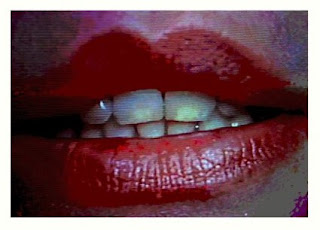
Videodrome Lips Art Print designed by ep-pandality 
 
 
Kiss me with the kisses of your mouth, for your love is deadlier than poison.
 
 
I. 
 
To press one's lips against those of another human being and then to insert your tongue into their mouth in an act of amorous exploration, has always seemed a rather queer thing to do. 
 
Of course, I'm no philematologist, and I don't know if kissing is an instinctual act of passion or an example of learned behaviour reinforced by poets and filmmakers. But I do think that Freud was right to identify it as a primary form of perversion [a].    
 
And I do think that D. H. Lawrence was right to describe the close-up kiss on screen in terms of obscenity (i.e., a loss of scenic distance) [b]. There's something profoundly unpleasant about an intimate and private act made visible and public - when it is literally in your face.
 
And the sound of smooching can also become disgusting and disorientating when it is recorded, amplified, or in some way mechanically processed - as we discover in J. G. Ballard's short story 'Track 12' [c]. The fact is, there are some sights that should always remain unseen and there are some sounds that should always remain unheard ...
 
 
II.     
 
Ballard's story rather reminds me of one of those written by Roald Dahl that originally formed the basis of the British TV series Tales of the Unexpected (ITV 1979-88); slightly sinister, darkly comic, and with an unexpected sting in the tail.
 
'Track 12' concerns a love triangle between a university professor, Sheringham, his wife, Susan, and her lover, Maxted. The latter, a former athlete, has been invited by Sheringham to his home on the pretext of discussing a potential business deal (although Maxted suspects he is about to be confronted over the affair).   

Throughout the evening, Sheringham insists on playing odd sound recordings of otherwise inaudible sounds amplified 100,000 times and challenging Maxted - fitted out with headphones that have made his ears feel bruised and numb - to guess what they are (one of them is the sound of a pin dropping). 
 
Maxted finds these games infantile and irritating; one man's obsession with microsonics is another man's boring waste of time:
 
"'Some of the records are interesting,' he admitted. 'They have a sort of crazy novelty value, like blown-up photographs of moths' faces and razor blades. Despite what you claim, though, I can't belive microsonics will ever become a scientific tool. It's just an elaborate laboratory toy.'" [91]  
 
Maxted - "a tall fleshy man with a coarse handsome face" [92] - also finds Sheringham a grotesque bore: 
 
"He surveyed Sheringham with as much detachment as he could muster, wondering whether this prim unattractive man, with his pedantry and in-bred academic humour, had any redeeming qualities whatever." [92]  
 
Sheringham insists on playing one last track. Maxted, however, is feeling cold and shivers as a low noise begins to crackle from multiple speakers placed around the patio. As he attempts to reach across the table to help himself to more whisky, he uncontrollably falls back into his chair:
 
"His stomach seemed to be full of mercury, ice-cold and enormously heavy. He pushed himself forward again, trying to reach the glass, and knocked it across the table. His brain began to fade, and he leaned his elbows helplessly on the lass edge of the table and felt his head fall onto his wrists." [93]  
 
This is never a good sign: in fact, it's often a sign one has - as in this case - been poisoned: "'Chromium cyanate. Inhibits the coenzyme system controlling the body's fluid balances, floods hydroxyl into the bloodstream. In brief, you drown'" [93], as Sheringham politely informs Maxted with a sympathetic smile. 
 
He then goes on to reveal his knowledge of the affair that's been going on behind his back and explains to Maxted how he's been secretly recording the illicit acts of intimacy with numerous hidden microphones. Meanwhile, track 12 continues to play:
 
"Being fed into the patio was a curiously muffled spongy noise, like elastic waves lapping in a latex sea. The rhythms were huge and ungainly, overlaid by the deep leaden wheezing of gigantic bellows. Barely audible at first, the sounds rose until they filled the patio and shut out the few traffic noises along the highway. 
      'Fantastic, isn't it?' Sheringham said. [...] 'These are 30-second repeats, 400 microsens, amplification one thousand. I admit I've edited the track a little, but it's still remarkable how repulsive a beautiful sound can become.'" [94]
 
Fearing that the drugged and dying Maxted will never guess what it is he's listening to, Sheringham gives him a clue: 
 
"'Last Saturday, just after midnight, you and Susan were lying back in this same chair. [...] The wind is your own breathing, fairly heavy at the time, if I remember; your interlocked pulses produced the thunder effect.'" [94]
 
But it's no good: Maxted is too far gone to answer. Watching as his rival "drifted in a wash of sound" [94], Sheringham pumps up the volume and bellows in his rival's ear: 
 
"'Maxted, can you hear the sea? Do you know where you're drowning?' [...] 
      'In a kiss!' Sheringham screamed. 'A kiss!'" [95]
  
 
Notes
 
[a] In his Introductory Lectures on Psychoanalysis (1916-17), Freud reminds readers that the mouth is the entrance to the digestive tract and not a sex organ per se. Thus, even a kiss between the most respectable married couple who pride themselves on leading a normal love life might be described as a perverse act, since it consists in the bringing together of the oral erotogenic zones instead of the genitals.
 
[b] In his essay 'Pornography and Obscenity', Lawrence claims that "the most obscene painting on a Greek vase [...] is not as pornographical as the close-up kisses on the film". See Late Essays and Articles, ed. James T. Boulton, (Cambridge University Press, 2004), p. 253. 
      See also Lawrence's poem 'When I went to the film', in The Complete Poems, Vol. I, ed. Christopher Pollnitz, (Cambridge University Press, 2013), p. 385, and Lawrence's 1928 painting Close-Up (Kiss), in D. H. Lawrence's Paintings, Introduction by Keith Sagar, (Chaucer Press, 2003), p. 58. Prints of this artwork are available to buy on pixels.com in a variety of formats: click here
 
[c] 'Track 12' first appeared in the April 1958 edition of the British science fiction magazine New Worlds (Vol. 24, No. 70). Readers can find it in several different collections of Ballard's short stories, including Passport to Eternity (1963), The Overloaded Man (1967), and The Venus Hunters (1986). It is also in The Complete Short Stories, Vol. I, (Fourth Estate, 2014), pp. 90-95, and it's this edition that page numbers given in the post refer to. 
      Interestingly, the story was adapted for screen by Harold Pinter and a short film (22 mins), directed by Joseph Losey, was made in 1967, featuring Stanley Baker (as Maxted), Dirk Bogarde (as Sheringham), and (an uncredited) Julie Christie (as Susan), whose puckered lips fill the screen at the film's deadly climax (a scene which, according to Mark Bould, had a profound influence on David Cronenberg's Videodrome (1983)).  
     
 
Musical bonus: 'Kiss Me Deadly', written by Billy Idol and Tony James, from the album Generation X (Chrysalis, 1978): click here. Or, to see Generation X in action, click here