Showing posts with label kenneth williams. Show all posts

22 Apr 2026

Notes on Mark Fisher's Capitalist Realism (2009) 1: Chapters 1-3

Mark Fisher: Capitalist Realism 
(Zer0 Books, 2022) [a]
 
'The tiniest event can tear a hole in the grey curtain of reaction ... 
From a situation in which nothing can happen, 
suddenly anything is possible again.' 
 
 
I. 
 
It's arguable that since his death in 2017, Mark Fisher has gone from being merely a cult figure within certain academic circles to something resembling a posthumous spiritual leader to an entire generation; one who is "quoted feverishly by his disciples" [b]. 
 
That's not his fault, I suppose - I can't imagine Fisher would have wanted faithful followers forever asking themselves What would Mark think? when confronted with the latest political or cultural development. 
 
But we are where we are and the fact is that, today, Fisher has become an enormous cult and it amuses me to think of him doing his best Kenneth Williams impression up in Heaven, telling the angels of his status [c].
 
As one might imagine, there is an ever-increasing number of articles, essays, books, and films made about him and his work; particularly his seminal debut text, Capitalist Realism (2009), and it's this slim volume I would like to discuss here ... [d]  
 
 
II.  
 
The title of the opening chapter provides the book's tagline: "It's easier to imagine the end of the world than the end of capitalism." (1) 
 
It's a borrowed phrase by which Fisher refers to the fact that capitalism is more than an economic arrangement of society or a political ideology; that it has become a singular reality that is so all-encompassing that we mistake it for the natural order or inevitable way of the world. 
 
This, in turn, makes alternative models either unimaginable or seem foolish and utopian. 
 
It's a neat trick: though Wilde might say that capitalism's passing itself off as natural is merely an irritating political pose. 
 
Nevertheless, pose or not, it remains a huge problem for those who, like Fisher, want to bring about revolutionary change and a form of what he later calls acid communism - something which, apparently, will unleash post-capitalist desire, raise levels of consciousness, and reclaim the creative ideas and countercultural energies of the world before neoliberalism.       
 
For the record, I'm broadly sympathetic to this line of thinking. I don't accept the argument that capitalism is in fact natural and aligns with the human condition by fostering competition and the innate desire to trade, invest, own property and aspire to a materially more comfortable existence. 
 
Or, if this is in fact a valid argument, then, for me, it simply reinforces the Nietzschean idea that man is a bourgeois compromise and, as anti-humanist philosophers, we are obliged to value that which lies overman [e].    
 
Having said that, I'm a little more cautious - maybe even a little more liberal - than I was thirty years ago when developing my own politics of desire in the philosophy department at Warwick University [f], and just as I wince at some of the things I wrote then, so too do I cringe at some of the things in Fisher's book.
 
Capitalism may not be the same as the Real, but I seriously doubt there's anything particularly acidic (or in any way unmediated) about communism ...    
 
 
III. 
 
One of the pleasures of reading Fisher is that he doesn't seem to make any hard and fast distinction between fiction and theory, or the world of thought and that of feeling. 
 
I can see how this might irritate those readers who, like Jürgen Habermas, believe that the false assimilation of one enterprise to another robs both of their substance, purpose, and productivity [g], but, for me - as a lover of Nietzsche and Lawrence - I approve of this intertextual promiscuity. 
 
Like Fisher, I think that philosophy, the arts, and politics have a profound and congenial relation to one another and that the best writers are those who produce a text that is radically and openly figurative, drawing upon all manner of considerations; including those ideas and images found within popular culture that were previously regarded as unacceptable or irrelevant to serious critical debate.     
 
Fisher's devising of a highly idiosyncratic mode of accessible (but never simplistic) language in his writings - and its application to a wide variety of contemporary issues - is undoubtedly one of his strong points (and it's something I have tried to replicate in my own manner here on Torpedo the Ark).
 
The key thing is this: in Capitalist Realism Fisher is essentially trying to imagine an alternative reality principle; one that is capable of providing new forms of practice, new attitudes, and new historical possibilities - even if, by his own admission, "for most people under twenty in Europe and North America, the lack of alternatives to capitalism" (8) isn't really an issue. 
 
Further, he wants to provide an authentic sense of solidarity and community; to "fill the conditions of a collective enunciation that is lacking elsewhere", as Deleuze and Guattari would say [h]. For Fisher, it's not capital which is the essence of reality; but the complex and shifting world of relationships between people [i].
 
But - and this is what worries me - hasn't Fisher's book already succumbed to the fate that met Picasso's Guernica in Alfonso Cuarón's Children of Men (2006); the dystopian film that Fisher discusses in chapter 1?
 
That is to say, hasn't Capitalist Realism - "once a howl of anguish and outrage" (4) - simply morphed into another popular bestseller "accorded 'iconic' status" (4); just another cultural artefact available for free delivery with Amazon Prime? [j]
 
  
IV. 
 
Am I mistaken, or does Fisher hanker after something to believe in? 
 
That's a concern if true (and would explain how he ends up promoting acid communism). We will need to be on the lookout for signs of religiosity when (re-)reading through Capitalist Realism
 
Sadly for him, one of the things he can't believe in anymore is pop culture; the death of Kurt Cobain in 1994 "confirmed the defeat and incorporation of rock's utopian and promethean ambitions" (10) and as for hip-hop, well, that was pretty much stillborn and complicit with capitalist realism from the get-go. 
 
Likewise, movies and comic books became equally hopeless; a mixture of neoliberalism and neo-noir (although that's a pretty seductive combination if, like me, you happen to like Tarantino's Pulp Fiction and Frank Miller's Batman). 
 
 
V. 
 
Chapter 2 of Capitalist Realism poses an interesting question: 'What if you held a protest and everyone came?' 
 
Though it's perhaps a question that any teenager who ever decided to throw an open house party when their parents went away for the weekend might be able to answer. I refer readers to the 2012 teen comedy film directed by Nima Nourizadeh, Project X, which tells the story of three friends who attempt to gain popularity by throwing a party which then quickly escalates out of their control.   
 
I would remind readers also of Nietzsche's warning against the attempt to turn a subtle revolutionary idea into a mass movement by dumbing down one's philosophy and painting "great al fresco stupidities" [k] on the walls. 
 
I'm not saying this is what Fisher has done. But he does give the impression at times of being a political and social fantasist, inviting a revolutionary overturning of the global economy in the belief that "fair humanity will then rise up as though of its own accord" [l]. 
 
In such a dangerous (and delusional) dream, says Nietzsche, one hears "an echo of Rousseau's superstition, which believes in a miraculous primeval but as it were buried goodness of human nature and ascribes all the blame for this burying to the institutions of culture" [m].    
 
Unfortunately, history has taught us that whilst mass uprisings and revolutions can unleash "the most savage energies in the shape of the long-buried dreadfulness and excesses of the most distant ages" [n], they can neither perfect man nor society. 
 
That said, Fisher is smart and honest enough to recognise that the anti-capitalist protest movement - with its hysterical demand for the impossible - invariably just reinforces capitalism itself: "Protests have formed a kind of carnivalesque background noise to capitalist realism, and the anti-capitalist protests share rather too much with hyper-corporate events [...]" (14) 
 
Fisher particularly loathes Live 8 [o], which he describes as "a strange kind of protest; a protest that everyone could agree with" (14) and one which "the logic of the protest was revealed in its purest form" [14]; basically, a chance to scream at Daddy (or the Man). 
 
For it is "not capitalism but protest itself which depends upon this figuration of the Father" (14) and he explicitly tells his readers the harsh truth that they themselves are complicit "in planetary networks of oppression" (15) - even when pumping their fists in the air or singing along with Bono and the boys at Wembley. 
 
Fisher writes: 
 
"What needs to be kept in mind is both that capitalism is a hyper-abstract impersonal structure and that it would be nothing without our co-operation. The most Gothic description of Capital is also the most accurate. Capital is an abstract parasite, an insatiable vampire and zombie-maker; but the living flesh it converts into dead labour is ours, ad the zombies it makes are us." (15)
 
What this means, therefore, is that in order to reclaim real political agency, one must first of all accept one's "insertion at the level of desire in the remorseless meat-grinder" (15). 
 
This, for me, is Fisher at his most Landian - and I like it. His exposure of the myth that caring individuals "could end famine directly, without the need for any kind of political solution or systemic reorganisation" (15) - provided they bought the right products - is brutal and brilliant. 
 
 
VI. 
 
Chapter 3 returns us to the question of capitalism and the Real ... 
 
And a confession from Fisher that not only was the phrase about it being easier to imagine the end of the world than the end of capitalism not his - it was earlier used by both Fredric Jameson and Slavoj Žižek - but neither is the term capitalist realism an original coinage: 
 
"It was used as far back as the 1960s by a group of German Pop artists and by Michael Schudson in his 1984 book Advertising, The Uneasy Persuasion, both of whom were making parodic references to socialist realism." (16)  
 
I don't really have a problem with borrowings like this and, besides, Fisher doesn't just adopt the term, he ascribes a more expansive (and more exorbitant) meaning to it. For Fisher, capitalist realism "cannot be confined to art or to the quasi-propagandistic way in which advertising functions" (16). 
 
It is in fact, "more like a pervasive atmosphere, conditioning not only the production of culture but also the regulation of work and education, and acting as a kind of invisible barrier constraining thought and action" (16). 
 
Fisher at this point openly reveals his hand, in a crucial passage worth quoting:
 
"If capitalist realism is so seamless, and if current forms of resistance are so hopeless and impotent, where can an effective challenge come from? A moral critique of capitalism [...] only reinforces capitalist realism. Poverty, famine and war can be presented as an inevitable part of reality, while the hope that these forms of suffering could be eliminated easily painted as naive utopianism. Capitalist realism can only be threatened if it is shown to be in some way inconsistent or untenable; if, that is to say, capitalism's ostensible 'realism' turns out to be nothing of the sort." (16)
 
Quite simply, I don't agree with that. I don't think it makes much difference whether capitalism is consistent or inconsistent, real or false - any more than whether God is an actual entity or virtual being. Marxists have been droning on for years about the many internal contradictions of capitalism and how these would one day trigger a crisis from which it would be impossible to recover - and yet, here we are.
 
Unfortunately for those who pin their hopes on this idea, contradictions have not caused a terminal collapse because the system is highly adaptive and able to stumble on from one crises to the next, sustaining production and restoring profitability, even without ever resolving the underlying issues (such as massive inequality).  
 
The masses are not going to be spurred into revolutionary action when it is revealed to them that capitalism is a fraud, anymore than the faithful simply abandoned God following the announcement of his death. Nietzsche famously concedes that God's posthumous shadow or ghost would be encountered for thousands of years, meaning humanity would continue to uphold the same moral values long after faith in the existence and authority of an actual deity had vanished (that's why the revaluation he called for will not happen overnight) [p]. 
 
Similarly, the overcoming of capitalism isn't as easy as simply revealing its structural inconsistencies and internal conflicts. Perhaps it will even require the kind of accelerationism that Fisher probably subscribed to when under the influence of Nick Land during his days at Warwick and involvement with the Ccru (Cybernetic culture research unit).       
 
In other words, perhaps the revolutionary path is not to withdraw from the global economy into private fantasy or try to simply side-step the coldest of all cold monsters like a crab, but accelerate the forces that the market economy has itself unleashed:
 
"To go still further, that is, in the movement of the market, of decoding and deterritorialization. For perhaps the flows are not yet deterritorialized enough, not decoded enough, from the viewpoint of a theory and practice of a highly schizophrenic character." [q]        
 
From the viewpoint, that is, of the theory and practice developed by Deleuze and Guattari - writing here in Anti-Oedipus (1972) - who argue that, through its process of production, capitalism "produces an awesome schizophrenic accumulation of energy" [r], which it is obliged to repress but which, nevertheless, continues to act as capitalism's external (and absolute) limit.   
 
The task, therefore, is to accelerate the process, so that capitalism can no longer bind these schizo-revolutionary forces and flows which it has itself unleashed. Capitalism, like all great historical systems, will thus "perish more as a result of its successes than its failures" [s] or its contradictions. Admittedly, however, this is a risky (potentially fatal) strategy that will require an exterminating angel who scrambles all the codes.    
 
 
VII. 
 
Finally, we return to the idea of the Real ...
 
Fisher is right to say that "what counts as 'realistic', what seems possible at any point in the social field, is defined by a series of political determinations" (16). And that the real trick, as we noted earlier, was to naturalise ideological values, magically transforming values into facts. 
 
"As any number of radical theorists [...] have maintained, emancipatory politics must always destroy the appearance of a 'natural order', must reveal what is presented as necessary and inevitable to be a mere contingency [...]" (16)  
 
In other words, radical theorists wish to give the game away - to pull back the curtain, like Toto the dog; or, if you prefer a recent cinematic reference, convince others to pop a red pill. The problem, of course, is that most people, given the choice, prefer blissful ignorance and eating virtual steaks. 
 
Who wants the Real - "a traumatic void that can only be glimpsed in fractures" (18) - if it provides none of the comforts of reality - if it risks making one even more depressed (and impoverished) than the illusory world of capitalist realism?  
 
  
Notes
 
[a] This is the most recent edition of Fisher's seminal text published in 2009. It comes with a Foreword by Zoe Fisher, an Introduction by Alex Niven, and an Afterword by Tariq Goddard. All page numbers given in this post refer to this edition.
 
[b] Rosa Abbott, writing in a post titled 'Ghosts of Mark Fisher' (5 Feb 2021), published on her Bad Taste Substack: click here.
 
[c] I'm referring here to Williams's hilarious interview with Terry Wogan in which he declared himself to be an enormous cult (Wogan BBC TV): click here and go to 1:49. 
 
[d] For some reason, I have resisted doing so until now, despite having previously written about two other books completed by him; Ghosts of My Life (2014) and The Weird and the Eerie (2017) - click here and/or here
 
[e] I'm not familiar enough with Fisher's reading of Nietzsche to know for sure how he relates the idea of the Übermensch to his own political thinking (or if he did so). One assumes that he would interpret the concept in communal rather than individualistic terms (i.e., as the realisation of a collectively imagined future that breaks the spell of the capitalist realism and the perpetual present).     
 
[f] Whilst Fisher and I were both doing doctoral research in the philosophy dept. at Warwick in the 1990s - he completed his PhD on cybernetic theory-fiction in 1999 and I submitted my study of Nietzsche-Lawrence-Deleuze the following year - we didn't know one another, nor, I believe, ever cross paths. He was far more involved with the Cybernetic Culture Research Unit (Ccru) than I was, even though Nick Land was overseeing my progress in 1994-95. 
 
[g] See Jürgen Habermas, The Philosophical Discourse of Modernity, trans. Frederick Lawrence (Polity Press, 1994), p. 210.  
 
[h] Gilles Deleuze and Félix Guattari, Kafka: Toward a Minor Literature, trans. Dana Polan (University of Minnesota Press, 1997), p. 18.   
 
[i] As Alex Niven writes in his Introduction: "At its most basic level, whatever political and theoretical nuances it might otherwise have implied [Capitalist Realism ...] was a book which called for a joining of human hands." [xiv] 
 
[j] This isn't, of course, Fisher's fault; he himself noted that capitalist realism works by rapidly absorbing dissent and neutralising it. And maybe I'm being unduly pessimistic; people on the left still insist the book remains relevant and its central argument remains valid (even if it is not the key to unlocking the future that some had once hoped). To date, Capitalist Realism has sold over 250,000 copies and it has been translated into many different languages.    
 
[k] Nietzsche, Human, All Too Human, trans. R. J. Hollingdale (Cambridge University Press, 1993), I. 8. 438, p. 161. Nietzsche goes on to quote Voltaire at this point: Quand la populace se mêle de raisonner, tout est perdu ... 
 
[l] Ibid., I. 8. 463, p. 169.  
 
[m] Ibid
 
[n] Ibid
 
[o] Live 8 was a string of benefit concerts that took place in July 2005, in the G8 states and South Africa, marking the 20th anniversary of Live Aid. The call was to make poverty history. More than a thousand musicians performed at the concerts, which were broadcast on 182 television networks and two thousand radio networks. The BBC estimated the global audience to be around 1.5 billion. 
 
[p] See Nietzsche, The Gay Science, III. 108. 
 
[q] Deleuze and Guattari, Anti-Oedipus, trans. Robert Hurley et al (The Athlone Press, 1994), p. 239.  
 
[r] Ibid., p. 246.
 
[s] Keith Ansell-Pearson, Viroid Life (Routledge, 1997), p. 178. 
 
 
Parts two of this post can be accessed by clicking here
 
Part three of this post can be accessed by clicking here.    
 

6 Jun 2023

I Don't Know as I Get What D. H. Lawrence is Driving at When He Writes of Bursten Bowels ...

Picasso: Gored Horse (1917) 
Graphite pencil on canvas with ochre primer 
(80.2 x 103.3 cm)
 
 
I. 
 
As readers of D. H. Lawrence are very well aware, he loves to write about the mysterious nether region of the human body known as the loins - i.e., that zone of libidinal intensity that lies somewhere between the ribs and the pelvis (or above the legs, but below the waist).
 
In fact, the only thing that excites his imagination more are the bowels ... 
 
 
II. 
 
Unfortunately, a bit like Frank O'Hara, I'm not quite sure I always understand what Lawrence is getting at when he uses this term [1]. On the one hand, it seems to be more than simply an anatomical reference to the gastrointestinal tract; indeed, for Lawrence, the bowels seem to be the seat of human compassion from which the deepest desires also spring. 
 
But, on the other hand, Lawrence likes to base his philosophical understanding of the body in biology where possible. So when he talks about the bowels, he is also referring us to the digestive system and those sausage-like organs known as the intestines or entrails. 
 
And, rather like Kenneth Williams, who described his daily bowel movements obsessively in his diaries, Lawrence seems to be plagued by a fear of things not working properly in this region, as we can see in the novel Kangaroo (1923), for example, when the marsupial-like fascist Ben Cooley is shot several times in his "'bloomin' Kangaroo guts'" [2], as one of his followers says.
 
Richard Somers - the book's Lawrentian avatar - visits Cooley in the hospital and can barely disguise his horror and disgust at the thought of ruptured bowels:
 
"Somers found Kangaroo in bed, very yellow, and thin [...] with haunted, frightened eyes. The room had many flowers, and was perfumed with eau de cologne, but through the perfume came an unpleasant, discernible stench. [...]
      Somers could not detach his mind from the slight, yet pervading sickening smell.
      "'My sewers leak,' said Kangaroo bitterly, as if divining the other's thought." [3]
 
Bruce Steele's explanatory note on this is spot-on:
 
"Jack's angry reaction to his leader's having been shot in the stomach and not killed outright probably reflects the First World War soldier's fear of abdominal wounds. In a pre-biotic age, peritonitis was a common and deadly complication of such wounds. While a ruptured bowel could be stitched, contamination of the abdominal cavity was frequently fatal; it would account for  the 'unpleasant, discernible stench' and Kangaroo's diagnosis 'My sewers leak'. If the sniper had deliberately aimed at his stomach rather than his head - which would probably have killed him instantly - it would have been in the knowledge that the victim would almost certainly die a slow and painful death." [4]
 
Of course, whilst being shot in the stomach can lead to a slow and painful death for a man, being disemboweled by the horns of an angry bull can be an equally horrific (and, arguably, even more obscene) way for an elderly horse to die.
 
And so to Mexico City ...   
 
 
III.
 
There are several disturbing scenes in Lawrence's novel The Plumed Serpent (1926), including the opening one set at the plaza de toros [5] - and I'm not referring to the fact that someone in the crowd thought it funny to throw an orange at the bald spot on Owen's sunburnt head.
 
Rather, I'm referring to the following incident involving a blindfolded horse ...
 
"The picador pulled his feeble horse round slowly, to face the bull, and slowly he leaned forward and shoved his lance-point into the bull's shoulder. The bull, as if the horse were a great wasp that had stung him deep, suddenly lowered his head in a jerk of surprise and lifted his horns straight up into the horse's abdomen. And without more ado, over went horse and rider, like a tottering monument upset.
      The rider scrambled from under the horse and went running away with his lance. The old horse, in complete dazed amusement, struggled to rise, as if overcome with dumb incomprehension. And the bull, with a red place on his shoulder welling a trickle of dark blood, stood looking round in equally hopeless amazement.
      But the wound was hurting. He saw the queer sight of the horse half reared from the ground, trying to get to its feet. And he smelled blood and bowels.
      So, rather vaguely, as if not quite knowing what he ought to do, the bull once more lowered his head and pushed his sharp, florishing horns in the horse's belly, working them up and down inside there with a vague sort of satisfaction." [6] 
      
As the novel's protagonist Kate Leslie rightly recognises, this shocking spectacle reveals nothing so much as human cowardice and indecency. She turns her face away in disgust. And when she looks again, "it was to see the horse feebly and dazedly walking out of the ring, with a great ball of its own entrails hanging out of its abdomen and swinging reddish against its own legs as it automatically moved". [7] 
 
But the sordid show isn't over: another horse is brought into the bullring so that it may be publicly disemboweled for the amusement of the crowd:
 
"Kate knew what was coming. Before she could look away, the bull had charged on the limping horse from behind [...] the horse was up-ended absurdly, one of the bull's horns between his hind legs and deep in his inside. Down went the horse, collapsing in front, but his rear was still heaved up, with the bull's horn working vigorously up and down inside him, while he lay on his neck all twisted. And a huge heap of bowels coming out. And a nauseous stench." [8] 
 
 
IV. 
 
I've never been (and wouldn't go) to a bullfight, and so would find it difficult (and disturbing) to visually imagine this scene were it not for the fact that Picasso - a lifelong bullfighting enthusiast - produced the image at the top of this post, after attending a bullfight in Barcelona during his stay in the city in 1917.
 
As the anonymous author of a piece describing this work on the Picasso Museum's website rightly notes:    
 
"In contrast to what he had mostly done on previous occasions, here the artist leaves aside the colourful and festive representation of the spectacle of bullfighting to focus his attention [...] on the solitary agony of the disemboweled horse, which collapses until it falls on its knees in a fetal position or prayer posture that has been compared to that of a fossilised crustacean or bird. Picasso manages to transcribe the animal's stabbing pain by means of its outstretched neck and raised head, looking upwards with a fixed gaze, as if asking for mercy to put an end to its cruel agony, once and for all." [9]
 
The author concludes: 
 
"The drama and cruelty of the scene reaches its zenith with the horn that sprouts from the ground and stands threateningly, waiting for the horse to finish collapsing to then finish it off." [10] 
 
I suppose, to end on a slightly more positive note, it might be mentioned that bullfighting was banned in Catalonia several years ago and the the last bullfight in the region took place in September 2011. [11]
 
However, there are still eight countries in the world where this ancient festival of gore still takes place - Spain, France, Portugal, Mexico, Columbia, Venezuela, Peru, and Ecuador - and every year around 180,000 bulls (and 200 horses) are slaughtered in the ring.
 
 
V. 
 
In sum, I might not get what D. H. Lawrence is driving at when he writes of bursten bowels, but I do know: 
 
(i) I wouldn't want to be shot in the stomach ...
 
(ii) I don't like cruelty to animals ...
 
 
Notes
 
[1] See Frank O'Hara, 'I don't know as I get what D. H. Lawrence is driving at', Selected Poems, ed. Mark Ford, (Alfred A. Knopf, 2009), p. 167. The poem can be read online at allpoetry.com: click here
 
[2] D. H. Lawrence, Kangaroo, ed. Bruce Steele, (Cambridge Unversity Press, 1994), p. 317.
 
[3] Ibid., pp. 322-323.    

[4] Bruce Steele's explanatory note to 317:12 of D. H. Lawrence's Kangaroo ... p. 406.

[5] In Lawrence's day, the main bullring in Mexico City was the Toreo de la Condesa. This ancient bullring was replaced in 1946 by the monumental Plaza de toros México, an arena that seats over 41,000 people.

[6] D. H. Lawrence, The Plumed Serpent, ed. L. D. Clark, pp. 15-16.

[7] Ibid., p. 16. 

[8] Ibid

[9-10] See the text that accompanies Picasso's Gored Horse (1917) on the Museu Picasso de Barcelona website: click here

[11] The ban was officially annulled for being unconstitutional by Spain's highest court in October 2016. However, despite the overturning of the ban, no further bullfight has taken place in Catalonia. 


26 Dec 2022

Rosebud

Illustration of the clitoris by Fiona Tung / The Varsity
 
 
I. 
 
I've never actually watched Citizen Kane (1941) from start to finish; like W. H. Auden and Kenneth Williams, I'm not a fan of Welles's masterpiece [1]; nor, to be honest, do I particularly like his other work (apart from the TV ads for sherry and Sandeman's port).
 
However, I am aware that the key to understanding the psychology of its protagonist Charles Foster Kane - a fictional character inspired by real-life publishing tycoon William Randolph Hearst - is the single word that he utters on his deathbed: Rosebud
 
Audiences eventually discover that this is simply the trade name of a sledge that Kane loved to play on as a boy. 
 
In other words, we are asked to accept that, in Kane's subconscious mind, Rosebud signified childhood happiness and reminded him of his mother's love, which, for a film that is supposed to be the greatest ever made, is almost laughably trite - as Welles himself acknowledged when interviewed in 1960:
 
"I'm ashamed of Rosebud. I think it’s a rather tawdry device. It’s the thing I like least in Kane. It’s kind of a dollar book Freudian gag. It doesn’t stand up very well. " [2]
 
 
II.
 
Perhaps looking to add a little more interest and intrigue to the origin of the term, Gore Vidal suggested in an essay published in 1989 that Rosebud was actually the pet name that Hearst gave to his mistress's clitoris [3]

I don't know if that's true - and I don't know if Vidal himself really believed it to be true. It seems doubtful; for one thing, how would Welles have had knowledge of this secret term used between lovers? It's difficult to imagine that either Hearst or Marion Davies would have shared such intimate information with him. 
 
In a letter to the New York Review discussing his claim [4], Vidal admits that, whilst he had met both parties, neither Hearst nor Davies ever volunteered this detail. However, he points out that the latter was an alcoholic who liked to surround herself with celebrity friends and fellow drinkers, sharing stories about their lives, and that one of these friends was Herman Mankiewicz; i.e., the man who co-wrote the screenplay for Citizen Kane ...
 
Of course, that still doesn't prove that Rosebud was in fact Hearst's hypocorism for Davies's clitoris. But, as Vidal says, if it was that would certainly explain in part Hearst's furious response to the film - which he attempted to suppress - and his deep hatred of Welles.
 
Ironically, of course, it could be that Welles himself had no idea of any of this. He always gave Mankiewicz full credit for coming up with the idea of Rosebud and it's possible the latter didn't tell Welles the real significance of the term (that he was essentially playing a joke not on Hearst, but on Welles).
 
I suppose we'll probably never know for sure the full meaning of Rosebud - if it is, in fact, anything other than the trade name of a sledge [5]. And in that sense the joke's on all of us who waste time thinking about it ...
  
 
Notes
 
[1] After watching the film on 29 Jan 1942, a 15-year old Kenneth Williams described Citizen Kane in his diary as "boshey rot". See The Kenneth Williams Diaries, ed. Russell Davies, (Harper Collins, 1993), p. 2.
 
[2] Click here for the section from the interview with Welles on the CBC (Canadian Broadcasting Corporation) in which he explains his dislike of the Rosebud device used in Citizen Kane
 
[3] Gore Vidal, 'Remembering Orson Welles', The New York Review (1 June 1989): click here
 
[4] Gore Vidal's letter on what might be termed the Rosebud controversy, was written in reply to a letter sent to the Editors of The New York Review by Jay Topkis (17 Aug 1989): click here

[5] A gay friend tells me that Rosebud actually indicates that Kane had a liking for sodomy and that Welles was a closeted homosexual; for it seems that the term refers not only to the clitoris, but to the anus (and/or the pinkish-red rectal tissue protruding from the anus following a prolapse due to frequent penetration of the latter).
 
 
To watch the official 1941 trailer for Citizen Kane, written and directed by Orson Welles, click here. Unlike other trailers, it doesn't feature any footage from the actual movie, but offers itself as a short spoof documentary on the film's production.   


9 Apr 2022

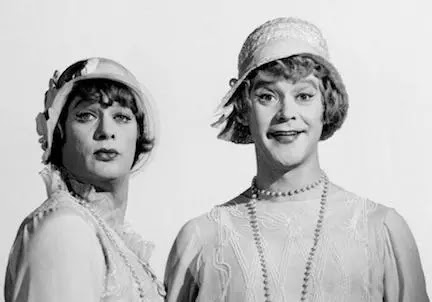
Carry on Cross Dressing

 
Top: Tony Curtis as Josephine and Jack Lemmon as Daphne in Some Like It Hot (1959)
Bottom: Kenneth Williams as Ethel and Charles Hawtrey as Agatha in Carry on Constable (1960)
 
 
I. 
 
For lovers of film and for lovers of drag, Billy Wilder's romantic comedy Some Like It Hot (1959), starring Tony Curtis and Jack Lemmon, is perhaps as good as it gets.
 
And indeed, there's certainly a lot to admire about it, including the performances of Curtis and Lemmon as the two jazz musicians, Joe and Jerry, who go on the run - disguised as women - after witnessing a gangland murder. They could have played the roles of Josephine and Daphne simply for laughs, but instead they invest their acting talent in creating an illusion of womanhood that is convincing as well as comic [1]
 
Perhaps that's why although the Curtis and Lemmon characters of Joe and Jerry are portrayed as red-blooded (heterosexual) males, whose decision to wear female clothing is a sign of their desperation rather than perversity, Some Like It Hot was produced without approval from the censor-morons who enforced the Hays Code and feared the slightest hint of queerness. 
 
Or perhaps they just found Marilyn Monroe's character of Sugar Kane too hot to handle ... [2]
 
 
II.

As good as Curtis and Lemmon are in Some Like It Hot - and as loveable as we may find Josephine and Daphne - they are not, in my view, as good (or as loveable) as Ethel and Agatha, as played by Kenneth Williams and Charles Hawtrey in Carry On Constable (1960) ...

Directed by Gerald Thomas, Carry On Constable is the fourth in the series of Carry On films and contains many of my favourite actors, scenes, and lines of dialogue - including the scene in which Charles Hawtrey as Special Constable Timothy Gorse and Kenneth Williams as PC Stanley Benson, decide to go undercover - dressed as women - in order to catch a gang of shoplifters.

The Carry On films would, over a 20-year, 30-film span, often include scenes of drag; one thinks of Peter Butterworth, for example, as DC Slobotham disguised as female bait in Carry On Screaming (1966), or Kenneth Cope, as Cyril, pretending to be a student nurse in Carry On Matron (1972). 

But whilst heterosexual actors playing straight characters dressed as women may be mildly amusing, it lacks the camp frisson and sheer joyfulness of two homosexual actors openly playing queer characters dressed as women. And thus nothing tops the scene with Hawtrey and Williams dragged up in Carry On Constable, which readers can enjoy by clicking here.
 
 
Notes
 
[1] Curtis and Lemon were helped to play Josephine and Daphne by the legendary female impersonator (and trapeze artist) Barbette, who was hired by the studio to coach them in the art of drag. 
      Much admired by Jean Cocteau, Barbette was described by the French poet and playwright as a combination of angel, flower and bird who transforms effortlessly back and forth between man and woman, revealing the performative aspect of gender. In a seminal 1926 essay, Cocteau instructed his fellow artists to learn from Barbette if they wished to understand the nature of artifice. Cocteau also commissioned a series of photographs by Man Ray of Barbette and cast her in his experimental first film Le Sang d'un Poete (1930).
 
[2] Peter Majda makes the important point that it's not just Curtis and Lemmon who are performing exaggerated forms of femininity in Some Like It Hot - that their co-star Marilyn Monroe is also "essaying another aspect of her comedic persona, which is a cis female-form of drag"; one that is, in fact, "more complicated and layered because she's a woman, playing on the expectations of femininity".
      For Monroe's hyper-feminine (and almost cartoonish) character of Sugar Kane is also carefully constructed with clothes and cosmetics and also relies upon a certain ways of walking and talking, etc. As Judith Butler once said: We are all transvestites.
      See Peter Majda's post entitled 'Performative Femininity and the Absurd: Drag and Comedy in "Some Like It Hot"' (17 April 2019), on his excellent blog A Seat in the Aisle: click here


2 Jan 2017

Why I Love Carry On Cruising

Kenneth Williams as First Officer Marjoribanks


There are many reasons to love Carry On Cruising (dir. Gerald Thomas, 1962), the sixth film in the series and first to be filmed in colour.

Firstly, it retains all the innocence and queer charm of the earlier black and white films and is essentially a finely balanced romantic comedy without too much sentiment or too much vulgarity; it's tender without being soft-centred, saucy without being smutty.   

Secondly, regular cast members - Sid James, Kenneth Williams and Kenneth Connor - all deliver excellent (nicely restrained) performances; and, just as crucially, stand-in cast members Lance Percival and the lovely Dilys Laye also do fine jobs. The former, playing the ship's cook, occupies the part originally meant for Charles Hawtrey, dropped from the cast for demanding he be given top billing and a gold star on his dressing room door. The latter, playing a young woman looking for love whilst cruising the Mediterranean, replaced Joan Sims at short notice after she was unexpectedly taken ill just days before the commencement of filming.

Cruising also co-stars the magnificent Liz Fraser and - as I think we can all agree - any film or TV show with Liz Fraser is instantly improved, even if, sadly, not always worth watching. When she departs the series after Carry On Cabbie (1963), it's a real loss. Seeing her in her black underwear always makes happy (and nostalgic); she has the erotic charisma that Barbara Windsor in the later movies, for all her infectious giggling, completely lacks.                    

Someone else who always makes happy (though for very different reasons) is the diminutive, Australian-born character actress and funny-woman, Esma Cannon, here making her third of four appearances in the Carry On series. British cinema would not be British cinema without her and Miss Madderley is a very welcome passenger on board the Happy Wanderer. Her table tennis scene with Kenneth Williams is particularly pleasing.   

Finally, Cruising also contains a somewhat curious scene in which James and Williams discuss different schools of psychoanalysis. James, as Captain Crowther, declares himself to have always been a Freudian and too old to change; Williams, as First Officer Marjoribanks, quips in response that that's nothing to worry about or apologise for - just so long as one remains Jung at heart

It's not the greatest joke ever written. But it's inclusion in a film of this nature is surprising and a welcome relief from the more predictable double entendres, sight gags, and elements of slapstick.