Showing posts with label pistol. Show all posts

21 Nov 2026

Telemorphosis: the Sex Pistols on Screen

Four decades of the Sex Pistols on screen 


I. 
 
The title of Stephen Glynn's essay, 'The Sex Pistols on Screen' [a], was bound to catch my eye. 
 
Not only as someone still haunted by the English punk band nearly fifty years after the event, but also as someone who has seen the major screen examinations of their story discussed here, namely: The Great Rock 'n' Roll Swindle (dir. Julien Temple, 1980); Sid and Nancy (dir. Alex Cox, 1986); The Filth and the Fury (dir. Julien Temple, 2000); and Pistol (dir. Danny Boyle, 2022).  
 
Glynn argues that these four works all essentially neutralise "any sense of the mid-1970s UK anarchy" (192) and "ultimately participate in and thereby sustain the social structures their subject matter ostensibly seeks to subvert and dismantle" (192). 
 
That's true enough - although I'm not as concerned as Glynn about "racial and gender representations" (192). The Sex Pistols didn't spend their weekends rocking against racism like The Clash [b] and neither did they have any problem playing with stereotypical ideas born of the pornographic imagination.  
 
My interest, as a philosopher, is thus more in how these works filter, flatten, and replace reality. That is to say, how they transform actual events into on-screen spectacles that are cleverly visualised but lacking in historical depth and how they turn actual people into spectral presences devoid of lived experience. 
 
The issue is the extermination of singular being, as Baudrillard might say: the Sex Pistols are not so much represented on screen as they are screened out [c]. 
 
 
II.  
 
Glynn proposes that the above four works - "each privileging a different perspective" - demonstrate the "partiality of any recreation of the past" (192). 
 
Viewed holistically, he argues, "they offer punk's own version of the film Rashomon (Kurosawa, 1950)", whose epistemological framework "reveals the subjectivity and self-interested advocacy of interpretation" (192).  
 
I see what he means. But, as a perspectivist, rather than a relativist, I do not believe that all interpretations are equally valid.
 
Even if we can never achieve a completely neutral form of objectivity, some perspectives are far more reliable and have a greater truth content than others. Nietzsche teaches us to always ask who's speaking and from what standpoint. 
 
Thus, Glynn is wrong to suggest that the Rashomon effect proves that no one is innocent. What it does, rather, is demonstrate that some are more guilt-ridden than others and prepared to distort reality out of ressentiment by inventing comforting lies. 
 
 
III. 
 
Glynn provides an interesting recap of details surrounding the Swindle, including its critical reception at the time and subsequent examinations. Those who understand the film's "distinctly meta-cinematic and postmodern" (194) character are obviously more approving than those who don't. And those who don't foolishly see the film as a reliable documentary, rather than a work mixing fact with theory-fiction.     
 
Along with some excellent observations, however, the chapter unfortunately contains some factual errors: the uncredited actor playing starry Nazi on the run Martin Bormann in the Rio de Janeiro sequences alongside Cook, Jones, and Biggs was Henry Rowland - not James Jeter [d]; and the song 'Lonely Boy' is not a rock 'n' roll standard by Eddie Cochran, but an original track written by Paul Cook and Steve Jones, the latter of whom performs it in the Swindle [e].
 
 
IV. 
 
Unfortunately, as hinted at above, Glynn can't help raising predictable concerns about the film's problematic "racial and gender politics" (195). 
 
Women, he says, are largely marginalised or sexually objectified, while black disco performers are belittled (but then, according to Glynn, so is Rotten belittled in the title song sequence, so maybe the Black Arabs are not being subject to discriminatory treatment after all).
 
Women are also "the object of violence" (195) - Glynn suggesting that we view the scene in which Vicious "shoves a newly bought cream cake into a prostitute's face" as hinting at punk's "abrasive and potentially destructive patriarchal power" (195). 
 
And there was me thinking it was a classic piece of slapstick rooted in vaudeville and silent comedy.
 
 
V.  
 
Glynn next discusses Temple's 2000 feature documentary The Filth and the Fury - which he describes as a corrective to the Swindle two decades down the line. 
 
Why Temple felt the need for this apologetic piece of revisionism which basically replaces McLaren's perspective with Rotten's, I don't know. Misplaced guilt, I suppose. At any rate, we are given punk history filtered through hindsight and studded with old grievances (as well as crocodile tears). 
 
Predictably, unlike the Swindle, this new film was "overall, very positively reviewed" (196) and, to be fair, the work has its strengths and there are things in it to admire and enjoy. But Rotten is already well on the road to becoming the abject, self-justifying bore that we all know and hate today. 
 
Somewhat disappointingly, while Glynn busies himself fretting over the fact that The Filth and the Fury retains the Swindle's "racial and gender erasure" (196) - can he just not accept the fact that the band members were all young white males? - it's left to Thomas Cohen to persuasively note that "'the film's obsequious promotion of John Lydon as Guardian of Truth compromises its credibility'" (197) [f]. 
 
That's a sentence Glynn is able to quote, but which I cannot imagine him writing as, it seems to me, he's very much a John Lydon fanboy - far more so than a supporter of "arch-provocateur/huckster McLaren" (197). 
 
Thus, he accepts Lydon's tears for the death of Sid Vicious as real (though acknowledges in brackets that they could be performative), and says they demonstrate that "the Sex Pistols was not a calculating and cynical construct with cartoon characters as depicted and demeaned in the Swindle, but a group of creatives fighting for agency and expression, individuals with heart, still pained by their experiences" (198). 
 
For those who buy into this sort of thing, this is the sort of thing they buy into ...   
 
 
VI. 
 
So, what about Sid and Nancy (1986)? 
 
I recently discussed this (cult) film in a post on Torpedo the Ark titled 'Love Kills (Or Sometimes Just Lies Limp)' and I'm pretty sure I didn't speak of it displaying "authentic punk credentials" (198) - though readers are welcome to click the link and check this for themselves. 
 
For the director and co-writer Alex Cox, it's essentially a love story; "a tale of amour fou" (199) that distances itself from punk history and the socio-cultural context in which that history unfolds. Glynn says this is perhaps a blessing "since the few attempts at a wider perspective are over-determined" (199).
 
Mind you, pretty much everyone - including Cox - now agrees the absurd fantasy ending of the film is bullshit.   
 
Still, at least Glynn is cheered that black characters are given "a positive role" to play in Sid and Nancy - "admittedly still minor but a major advance on the Swindle" (200). 
 
That said, Glynn takes issue with the fact that in the film we "hear X-Ray Spex's 'O Bondage, Up Yours' (sung by Anglo-Somalian Poly Styrene) but see a Siouxsie Sioux lookalike" (200) [g]. He calls this an "especially unfortunate" (200) example of whitewashing - but, actually, there's a reason for this ...
 
The scene was originally scripted for Siouxsie and the Banshees to be the band on stage - which explains why the actress on screen looks like Siouxsie rather than Poly. 
 
However, the Banshees refused permission to use their music and so the filmmakers decided to add a cover version of the famous X-Ray Spex song; i.e. one recorded specifically for the film, sung by the actress Sallie Anne Field, and backed by Dave McIntosh, John Hoare, and former Sex Pistols bassist Glen Matlock.  
 
In brief: there's no wilfully malicious act of whitewashing going on here - it was just the result of a last-minute issue concerning song rights.
 
 
VII. 
 
Finally, we come to Pistol (2022) - Danny Boyle's six-part TV miniseries in which the Sex Pistols are subject to an embarrassing Disneyfication. 
 
I'm pleased that Steve Jones was happy with the result and that he was given the chance to see his story told (the series is based on his 2016 autobiography, Lonely Boy). I'm also pleased that Jones, Cook, and Matlock were prepared to go ahead with the project without Rotten's collaboration or permission. The fact that he sought to legally obstruct the production speaks volumes.    

Discussing the predominantly negative press reviews, Glynn makes it clear Boyle achieves the difficult task of making a work that is both po-faced and pantomimic at the same time. The series misfires in several directions: "Most obtrusively, style and content fail fully to cohere." (202) 
 
"There are also difficulties with pacing and emphasis", says Glynn, and - most interestingly - "problems with pronouncements, notably the quasi-risible life-into-art literalness with which Rotten regularly utters staccato sentences that will pass directly into the Sex Pistols songbook" (202). 
 
Having said this, Glynn is happy to announce that there are, in fact, "incontrovertible plus points to Pistol [...] the series accords more space, credit, and even (a degree of) agency to female protagonists in the history of the Sex Pistols and of punk in general" (202).
 
I think we all knew this was coming. But still, Glynn is right, of course, it is good to see Vivienne and Jordan given credit as key instigators. Along with Soo Catwoman, they are indeed the three punk graces [h].  
 
Glynn concludes: Pistol may not be bunk, but it reveals "how even punk [...] has now become itself an agent of nostalgia" (204). And it's hard to argue with that. The Sex Pistols have been successfully captured on film - and every second of their life is ruined for life.    
 
      
Notes
 
[a] This essay by Glynn can be found in The Routledge Handbook of the Sex Pistols, ed. Mike Dines, Gabriela Gelain, Paul Graves-Brown and John Schofield (Routledge, 2026), pp. 192-205. All page references to this work are given in the main post. 
      Stephen Glynn, a film writer and lecturer, is also author of The Sex Pistols on Screen: The Films and the Fury (Routledge, 2025), a 138 page book on the subject. 
 
[b] If that's your cup of tea, then you'd be better off watching Rude Boy (dir. Jack Hazan and David Mingay, 1980) than The Great Rock 'n' Roll Swindle, as the former film heavily features The Clash and contains footage shot at a Rock Against Racism gig at London's Victoria Park on Sunday 30 April, 1978. 
 
[c] The phrase screened out is also the English title of Baudrillard's 2002 essay collection, trans. Chris Turner, which was originally published in French as Écran total (2000). 
     In his later work, Baudrillard also coins the term télémorphose to describe the transformation of reality and human social life into hyperreal images that eventually come to define experience. See the short work Telemorphosis, trans. Drew S. Burk (Univocal, 2012). 
 
[d] Rowland had previously played Bormann twice for director Russ Meyer, first in Supervixens (1975) and then in Beneath the Valley of the Ultra-Vixens (1979). 
 
[e] There are two Eddie Cochran songs covered by Sid Vicious in The Great Rock 'n' Roll Swindle - 'C'mon Everybody' (1958) and 'Something Else' (1959). Both were released as singles in 1979 under the Sex Pistols name, both reaching number 3 in the UK charts. 
 
[f] Glynn is quoting Thomas Cohen writing in Playing to the Camera: Musicians and Musical Performance in Documentary Cinema (Wallflower, 2012), p. 110. 
 
[g] Not to be too nitpicky, but the actual title of this X-Ray Spex track is 'Oh Bondage Up Yours!'  
 
[h] See my post on Vivienne, Jordan and Soo Catwoman titled 'On the Three Punk Graces' (25 August 2025). And see the sister post - 'On Three More Punk Graces: Siouxsie Sioux, Poly Styrene, and Helen of Troy' (26 August 2025). 
      I've nothing against Chrissie Hynde, but I have to admit I don't really consider her anything other than a peripheral part of the Sex Pistols story - behind that of Debbie Juvenile, Tracie O'Keefe and Nancy Spungen - so I agree with Glynn that Hynde was given way too much of a role in Pistol (as Jones's love interest), even if this fictional exaggeration provided certain dramatic benefits. 
 
 
This post is one in a series on chapters contained in The Routledge Handbook of the Sex Pistols. Already published are: 


17 Nov 2026: 'It Had to Be Brazil' 
 
Whether I will write posts on all 33 chapters in the above work - or, indeed, even read them all - is unlikely, but I'm sure one or two more posts in this series will follow in due course.  


1 Sept 2026

Visions of Malcolm

Malcolm McLaren as played on screen by David Hayman (1986), 
Mark Gatiss (2010), and Thomas Brodie-Sangster (2022)
 
 
I. 
 
I am not an actor. Not in any professional sense, at least. But I imagine that portraying a well-known public figure whose persona is established in the cultural imagination is particularly difficult because the audience already knows how they look, move, and speak.  
 
Rightly or wrongly, viewers will scrutinise the performance in order to assess its accuracy and if something feels off - perhaps only in the smallest detail - this can make the whole thing seem fake and awkward. 
 
Getting the voice right - but without sounding like one is simply doing a comic impression - is perhaps the hardest thing of all. Nevertheless, there are some actors who enjoy the challenge and have an almost chameleon-like ability to play famous real-life figures; one thinks of Michael Sheen, for example, who has given legendary performances as Tony Blair, Brian Clough, and Kenneth Williams [1].  
 
Whether Sheen has some supernatural ability to get under the skin of others and channel their essence - or is just a consummate professional who does intensive research, works closely with voice coaches, and has the kind of features and physique that lend themselves well to different roles - I don't know. 
 
But he's an immensely gifted actor and it's a shame he hasn't played Malcolm McLaren as I think he'd do a great job. He even has the slightly goofy grin, naturally curly hair, and Aquarian-white complexion needed for the role. 
 
Still, who knows, maybe one day ... And in the meantime, we have three other actors to discuss who have given us their on-screen versions of Malcolm: David Hayman, Mark Gatiss, and Thomas Brodie-Sangster ...
 
 
II.  
 
Of the three, Scottish actor David Hayman faced perhaps the greatest challenge when preparing to play Sex Pistols manager Malcolm McLaren in Alex Cox's Sid and Nancy (1986). For he had to embody someone who was a still living (and still notorious) cultural provocateur. 
 
Because Malcolm was such a distinctively animated character, Hayman could not rely on simply reading a standard script outline for his interpretation. He was obliged to meticulously study many hours of filmed interviews with McLaren in order to try and master his accent and intonation which was an amusingly camp mix of art school affectation and cockney [2]. Obviously, he also attempted to get McLaren's theatrical hand gestures and mannerisms spot on too. 
 
Primarily, however, Hayman focused on capturing McLaren's mercenary energy, portraying him as a scheming, detached observer of events who viewed human tragedy purely from the perspective of marketing and media. In Cox's film, he gleefully delivers a line describing Sid Vicious as a fabulous disaster rather than a mere bass player. 
 
That's not entirely unfair or inaccurate, but it does mean we are not shown anything of McLaren's greatest asset - his charm. 
 
Malcolm possessed a very powerful, highly contradictory kind of charisma that he used to captivate, influence, and, yes, manipulate people. There was a reason that so many individuals bought into what Johnny Rotten would dismiss as McLaren's bullshit and if he prioritised cultural provocation over the well-being and long-term success of the band, well, that's not something that troubles me.  
 
My main gripe with Hayman as McLaren is this: he looked too damn old! Malcolm was a young-looking 31-year-old when Sid Vicious joined the Sex Pistols in February 1977. But Hayman, aged 37, was a much more mature screen presence in 1985 when the film Sid and Nancy was shot, as can be seen in the above photo. (And note to wardrobe: McLaren never wore Lennon-style sunglasses.) 
 
Finally, it's interesting to discover that a planned meeting on set to film a promotional face-to-face between McLaren and his cinematic doppelgänger was abandoned after Malcolm saw some early footage from the film and was appalled by how the production was shaping up.    

 
III. 
 
Next on our list is Mark Gatiss, who played McLaren in the biographical drama Worried About the Boy (dir. Julian Jarrold, 2010) [3], about the rise to fame of the singer Boy George (played by Douglas Booth) who very briefly sang on stage with Bow Wow Wow (as Lieutenant Lush) [4].
 
With slightly unfortunate timing, the 90-minute film aired on BBC Two on 16 May 2010, just five weeks after Malcolm's death. 
 
Gatiss approached the role differently to Hayman and gives us a markedly different vision of McLaren, whom he portrayed as more of an old-school impresario and natural-born showman who was then shifting aesthetically from punk nihilism to a new romanticism.     
 
Hayman's McLaren was cruel and calculating: Gatiss tapped into the lighter side of his character; flamboyant and eccentric, a man with wild hair and waving hands who could charm the birds from the trees; less arch-manipulator and more a shrewd and inspiring mentor to young artists such as George (and before him Adam Ant).     
 
Reflecting on playing real public figures like McLaren, Gatiss later revealed that his philosophy is not to attempt an exact impersonation, but to try and convey a suggestion of the person without letting the truth get in the way of the story being told. 
 
In other words, whereas Hayman gave audiences a darker, perhaps psychologically more realistic version of McLaren, Gatiss delivered the performative, larger-than-life figure who wished to cause trouble and make cash from chaos in the name of fun rather than malice.
 
Critics and viewers rightly praised Gatiss's performance. Writing in the Financial Times (21 May 2010), John Lloyd described it as a "vividly cynical cameo". Again, my only issue would be that Gatiss was just slightly too old for the role and his McLaren seems to be based more on a mid-rather than an early '80s version of the character. 
  
 
IV.
 
The most recent actor to try on McLaren's tartan bondage suit is Thomas Brodie-Sangster, who played him in Danny Boyle's six-part miniseries Pistol (2022) [5]. Arguably, his was the standout performance of the entire show - salvaging an otherwise Disneyfied production - and he cleverly pitched it somewhere between David Hayman's hard-edged version and Mark Gatiss's high camp take on the character.
 
Rather than frame McLaren as a detached puppet master, Brodie-Sangster and series writer Craig Pearce actively tried to avoid making him a one-dimensional villain. Brodie-Sangster aimed to show why it was that young, working-class kids would willingly follow him in the first place, highlighting McLaren's genuine, infectious passion for a cultural and artistic revolution.
 
Because he has so much more screen time to develop the character, Brodie-Sangster is able to both experiment with the role and relax his way into it. He later admitted that he found playing the part not only a lot of fun, but liberating for him as an actor.  
 
Physically, Brodie-Sangster had a distinct advantage over the earlier actors who played the part. For he actually possessed the slight build, youthful face, and naturally boyish energy of the real McLaren. Also, during filming he was the exact same age as Malcolm in 1977 and that certainly helped. As does the fact that he pretty much nails the distinct, slightly high-pitched, breathless cadence of McLaren's vocal delivery [6]. 
 
There's a joy in his performance and no trace of tiredness. Having said that, McLaren's character isn't softened too much or emptied entirely of its more Machiavellian aspects. And whilst it's arguable whose performance is best - Hayman's, Gatiss's, or Brodie-Sangster's - the latter's is certainly my favourite.   

In sum: without possessing the uncanny power of Michael Sheen to transform into the character being played, each of the three captured a vital facet of a McLaren who spent his entire life ensuring that nobody could ever completely pin him down.
 

V. 
 
Finally, to end on an ironic note, it might convincingly be argued that the best performance by someone playing McLaren was given by McLaren himself in Julien Temple's The Great Rock 'n' Roll Swindle (1980). 
 
In fact, so good was his hyper-stylised performance in this film that there are still people to this day who take it for an accurate representation - i.e., who miss the fact that McLaren was acting and that he wasn't aiming to expose the truth about himself but construct a self-satirising myth; that the film was a fictionalised narrative in which McLaren played the version of himself that he wished to be - not a documentary, ffs.    
 
The film's relentless cynicism was so perfectly tailored to McLaren's public persona that audiences completely fell for it - believing the lie that the Sex Pistols project was merely a manufactured, art-school scam used to sell bondage trousers from 430 King's Road. 
 
In later years, McLaren regretted being too good an actor. Being mistaken for his role as The Embezzler proved to be burdensome, when it meant that the public, the press, and cultural historians refused to see him as an avant-garde artist, but only as a fast-talking fraud and flamboyant failure.  
 
 
Malcolm McLaren as Malcolm McLaren (The Embezzler) 
in The Great Rock 'n' Roll Swindle (1980)
 
  
Notes
 
[1] Sheen played Blair in three works written by Peter Morgan: The Deal (dir. Stephen Frears, 2003), The Queen (dir. Stephen Frears, 2006), and The Special Relationship (dir. Richard Loncraine, 2010). He played Clough in The Damned United (dir. Tom Hooper, 2009), and Williams in Kenneth Williams: Fantabulosa! (dir. Andy De Emmony, 2006). Sheen has also played other famous faces including David Frost, Chris Tarrant, and Prince Andrew.
 
[2] One could write an entire post trying to describe McLaren's unique accent and intonation. His voice bridged the gap between his Jewish North London roots and his art school education. Thus, he retained the flat vowels of Estuary English, but stretched them out theatrically. 
      Sometimes, he spoke breathlessly at speed; at other times he spoke quite softly and deliberately as if drawing you into a secret. The pitch would go up and down depending on his level of excitement and this gave the delivery its camp and comic aspects. The most notable thing, however, was how he spoke about popular culture with the elevated vocabulary and conceptual framing of a French intellectual, creating a surprising juxtaposition and making him a highly articulate and amusing storyteller.
 
[3] Click on the link provided in the main text and go to 1:02:22-1:08:10 to watch Gatiss's short but memorable performance as McLaren. 
 
[4] Bow Wow Wow were the band McLaren assembled and managed after the Sex Pistols. George O'Dowd - who would become known to the world as Boy George - was, at that time (1980), a nineteen-year-old "gender-defying club kid noted for his soulful singing voice, sassy demeanour and outrageous appearance". O'Dowd's relationship with McLaren and the band was, however, extremely short-lived and he made only a couple of appearances on stage with them. See Paul Gorman, The Life and Times of Malcolm McLaren (Constable, 2020). The line quoted is on p. 471. 
  
[5] Don't get me started on Pistol ... Readers who want to know what I think of this show can see the post 'The Great Rock 'n' Roll Castration' (30 Mar 2021). 
 
[6] Brodie-Sangster noted in promotional interviews that he found McLaren's voice the hardest element to capture, describing it as a mix of a salesman's hustle and an intellectual's lecture, delivered with an almost childlike glee.


29 Aug 2026

Love Kills (Or Sometimes Just Lies Limp): Sid and Nancy 40 Years On

Sid & Nancy (dir. Alex Cox, 1986) 
An official theatrical film poster
 
 
I. 
 
Sid and Nancy - also known by the working title Love Kills [1] - was released 40 years ago. 
 
It premiered at the Cannes Film Festival on 14 May 1986 and was first shown in London at the Limelight Club on 20 July, before going on general release in UK cinemas the following month.
 
It's a biopic directed by Alex Cox, who co-wrote the script with Abbe Wool, starring Gary Oldman as the Sex Pistol Sid Vicious and American actress Chloe Webb as his punk paramour Nancy Spungen [2]. 
 
 
II. 
 
Oldman is a talented and versatile actor - not one of my favourites, though I don't dislike seeing him on screen - but his initial decision to turn down the role of Vicious (not once, but twice) was one I wish he'd stuck by. 
 
For one thing, he was already 27 when filming took place in 1985, which makes him too old to play a character who died aged 21. Also, by his own admission, he had zero interest in Vicious and punk subculture, wasn't a fan of the Sex Pistols, and found the entire story surrounding Sid and Nancy banal. 
 
Ultimately, Oldman only accepted the role at the urging of his agent and after learning that he was being offered a £35,000 fee to star in the movie [3]. 
 
However, to be fair, he did throw himself into the part with all his characteristic intensity once he agreed terms. Amusingly, he lost so much weight in such a short period in order to play Vicious that he was briefly hospitalised with malnutrition [4]. And at least Oldman came from a relatively working-class background, unlike posho actor Louis Partridge who played Vicious in Danny Boyle's ludicrous six-part mini-series Pistol in 2022 [5].  
 
Oldman - who went on to become an Academy Award-winning Hollywood actor - now rarely mentions Sid and Nancy and casually dismisses his own performance in the film.  
 
 
III. 

If Oldman, at 27, was just a tad past it to play Sid, Chloe Webb, pushing 30 when she took on the role of Nancy - who died aged 20 - was way over the hill (certainly by punk standards). 
 
So again, whilst she does a reasonable job, I think it would have been better - or at least more daring - to have cast 20-year-old Courtney Love in the role - one for which she submitted a video audition and was genuinely passionate about. 
 
Cox was deeply impressed by Love's youthful enthusiasm - and her acting ability - but eventually caved in to pressure from the film's financial backers and investors who insisted on a more experienced actress in the role. 
 
He did, however, create and write the minor supporting character of Gretchen for Love (a fictional New York junkie friend of the punk couple) so she could still be part of the project and this marked her debut feature film appearance (several years before she formed the band Hole and met Kurt Cobain).      
 
 
IV. 
 
Although Sid and Nancy failed to recoup its production budget at the box office, the film was received positively by most critics [6] and has since developed a cult following. Strangely, however, it is rarely shown on British TV and I don't think I've seen it other than at the cinema back in August 1986 - when I was less than impressed, as this diary entry makes clear:
 
Sophie and I woke up late. After lunch, we set off on a nice sunny day to King's Road. Boring! Nothing (and no one) caught my eye. From Chelsea to Kensington Market and Hyper Hyper. Still found nothing to excite. Everything seems to have stagnated. But perhaps that's a good thing - a precursor to a change of some kind. Or maybe not.   
      Got to Leicester Square at five-ish. Had something to eat in Pizzaland and then went to the cinema. It had been my intention not to see Sid & Nancy, but felt a strange obligation to do so - and Sophie had bought the tickets. The two main parts were well-acted, so kudos to Gary Oldman and Chloe Webb. Other cast members were less convincing - particularly David Hayman as Malcolm and Andrew Schofield as Rotten. 
      Ultimately, I came away asking myself what was the point of such a film other than to echo the 'Just Say No' anti-drugs campaign? The only thing worse than the ridiculous ending of the film was Joe Strummer's soundtrack. [7]
 
As I say, I don't think I've since re-watched the film - though I'd very much be interested to do so, one day, just to find out if it's as bad as I remember it. 
  
 
Notes
 
[1] Director Alex Cox used the title Love Kills throughout the writing and development process. Why this title was dropped (or relegated to the status of a subtitle) in favour of the more prosaic Sid and Nancy, I don't know, but one suspects there was probably external pressure to do so coming from the film's producers (particularly after a letter was received from a party claiming to own the title 'Love Kills' and threatening legal action).
      Clearly, it must have been a decision made late on, because by then Joe Strummer (formerly of The Clash) had already written the film's title track and 'Love Kills' was released as a single from the film's soundtrack in July 1986. Fans of Strummer will doubtless disagree, but it's a shit track and, personally, I much prefer the song written by Dee Dee Ramone also called 'Love Kills' and also dealing with the tragic story of Sid Vicious and Nancy Spungen. This track can be found on the Ramones album Animal Boy (Sire Records, 1986). 
 
[2] For my own take on these star-crossed lovers, see the post titled 'I'll Put a Knife Right in You' (30 Dec 2020). For a rather more personal take on the story of Sid Vicious see 'Sweet Sixteen' (8 Feb 2022). And for a longer post in memory of Ms Spungen, see 'The Last of the Groupies' (26 April 2022).   
  
[3] I know there will be readers thinking that £35,000 doesn't sound like a lot of money, but it was considered a significant sum to pay a young and relatively unknown theatre actor at the time. Oldman has since revealed in interviews that he was only earning around £80 a week working with the Royal Court Theatre at the time - and that was in a good week (sometimes his income would fall to half that). Thus, for Oldman, £35,000 was a small fortune - one that allowed the purchase of a modest flat in London. 
      Readers need to also remember that Sid and Nancy was an independent British film - not a big-budget Hollywood movie. Total production costs were only around £2.7 million.   
 
[4] For those who might want to know the secret of such dramatic weight loss, apparently the knack is to live on a diet of nothing but steamed fish and lots of melon. 
 
[5] Don't get me started on Pistol ... See the post 'The Great Rock 'n' Roll Castration' (30 Mar 2021). 

[6] Roger Ebert, for example, gave Sid and Nancy full marks in his review (25 Oct 1986). He concludes that Alex Cox has all the makings of a great director: "He and his actors pull off the neat trick of creating a movie full of noise and fury, and telling a meticulous story right in the middle of it." The review can be found on rogerebert.com  
      Thirty years later, Peter Bradshaw writing in The Guardian (4 Aug 2016) was equally enthusiastic, insisting that Sid and Nancy is a "welcome corrective to bland punk nostalgia" and calling it "Alex Cox's Beckettian masterpiece about those two prisoners of futility" and undiagnosed dysfunction.  
 
[7] This is an edited and slightly revised entry in The Von Hell Diaries (Sat 23 August, 1986). 
 
 
Bonus 1: the original trailer to Sid and Nancy (1986) - enhanced version by HD Retro Trailers.  
 
Bonus 2: the trailer for the 30th anniversary Blu-ray edition of Sid and Nancy (Studiocanal, 2016). 


31 May 2022

Reflections on Another Jubilee (There's Still No Future in England's Dreaming)

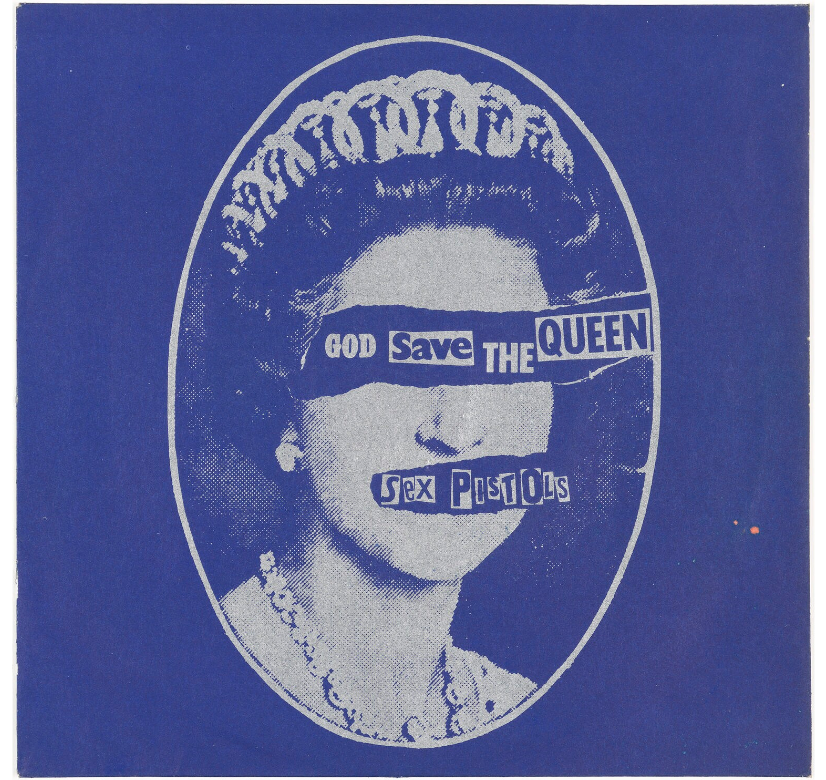
Jamie Reid: sleeve artwork for 'God Save the Queen' 
by the Sex Pistols (Virgin Records, 1977) 
 
 
I.
 
Celebrations to mark the Queen's Platinum Jubilee are set to take place over a special four-day bank holiday weekend from Thursday 2 to Sunday 5 June 2022. 
 
Seeing the Union Jack bunting and hearing all the Gawd bless 'er majesty bullshit reminds me very much of the Silver Jubilee back in the fateful summer of 1977 - the summer of hate as it is sometimes known; i.e., the summer of punk ...
 

II.

Although not old enough to have partied with the Sex Pistols on their notorious jubilee boat trip along the Thames, I was old enough in 1977 to have woken up and realised what side of the bed I was lying on - and it wasn't the side with the red, white and blue sheets.
 
As far as I recall, I was pretty much the only Essex schoolchild who refused to attend (or have anything to do with) the street parties being held on my estate that June. 
 
And my sense of alienation - combined with a long hatred for all the pomp and circumstance surrounding the royal family - meant that I now aligned myself with the Sex Pistols (what this meant in practice was keeping press cuttings about the band, taping 'Pretty Vacant' off the radio [1], and doing my best to perfect a Rotten persona). 
 
The Sex Pistols were the flowers in the dustbin and they were the poison in the human machine, but it was precisely their uncompromising nihilism that made them so attractive; that, and the way they looked [2]. 

 
III. 
 
Finally, while we're on the subject of the Sex Pistols ...
 
Tonight sees the start of Danny Boyle's six-part TV series Pistol - a Disneyfied punk pantomime loosely based on Steve Jones's memoir, in which a kamikaze gang of foul-mouthed yobs is reimagined by a cast of impossibly middle-class actors [3].
 
Were he still with us, I'm sure Malcolm would regard this as a prime example of what he termed karaoke culture [4] - i.e., one lacking in authentic sex, style or subversion.  
 
So, rather than sit through Danny Boyle's load of old bollocks, why not click here to watch a new version of the video for 'God Save the Queen' - one which combines footage shot by Julien Temple at the Marquee in May 1977, with footage of the Thames river boat party (a fun day out which resulted in eleven arrests, including Malcolm's). 
 
 
Notes

[1] I couldn't record 'God Save the Queen', of course, as it was banned from the airwaves. Famously, it was also prevented from getting to number one in the official UK singles chart, although it was the highest selling single during the jubilee week.  

[2] I loved the songs too, but the music was always secondary to the politics, the clothes, and the artwork - which is why I soon came to appreciate that Malcolm was the fabulous architect of chaos and Rotten just another juvenile Bill Grundy. Indeed, he's now something of an admirer of the Queen it appears.
 
[3] For earlier thoughts on Danny Boyle's Pistol click here and here. 

[4] Readers who are interested in this can watch McLaren's TED Talk of October 2009 on authentic creativity versus karaoke culture: click here. 


30 Mar 2021

The Great Rock 'n' Roll Castration

Johnny Rotten and Sid Vicious as portrayed by Anson Boon and Louis Partridge

 
Director Danny Boyle irritated me in 2012 with his ludicrous opening ceremony for the London Olympics, featuring a twenty-minute tribute to the NHS, so when I heard that he was making a six-part TV series about the Sex Pistols (based on Steve Jones's Lonely Boy memoir), I began to prepare for a heavily sentimental take on the story.   
 
But, having now read further details of the project - including who's cast to play Rotten and company - and seen images released from on set, I fear what we are about to be offered is a revision of the past that exchanges sneering nihilism for an uplifting tale of smiling punks in touch with their feelings and struggling to live up to their bad boy image, whilst dealing with issues of abuse, deprivation, and addiction 
 
Even the title of the series - Pistol - speaks of castration; of a band rendered sexless and transformed from cocky young 'erberts with an eye for fashion into sensitive boys crying out for attention and who only wanted to be accepted by society and loved as people.*   
 
Still, as a friend of mine said, you never know; the project might be redeemed by a brilliant script (co-written by Frank Cottrell Boyce and Craig Pearce) and some excellent performances from the young cast. I doubt it. But we'll see when the series airs next year.   
 
 
Notes
 
* John Lydon - who has already spoken out against Boyle's project - mocked this idea of poor misunderstood punks on 'Fodderstompf', the closing track of the first Public Image Ltd. album (Virgin Records, 1978): click here.  
 
For a related post to this one in which I discuss the relationship between acting and authenticity and address the question of whether anyone can be a Sex Pistol, click here.