Showing posts with label bromley contingent. Show all posts

20 Aug 2026

Echoes of the Punk Age - by Jimmy Jazz (In the Manner of F. Scott Fitzgerald)

 Echoes of the Punk Age (SA/2026)
 
It was an age of anarchy; it was an age of art. 
It was an age of gobbing, and it was an age of safety pins.
 
 
Editorial Note
 
The release in October 1976 of 'New Rose' by the Damned was the first signal of the coming youth revolution [1]. Caroline Coon gave the British movement a name: Punk Rock [2]. 
 
In this post, Jimmy Jazz, who remembers the time and observed the subcultural changes of the era first-hand, shares some thoughts in what is essentially a pastiche of a well-known essay written by F. Scott Fitzgerald, first published in Scribner's Magazine in November 1931 [3].   
 
Endnotes have been added to provide context and clarification of terms or references that may be unfamiliar to some readers.      
 
 
*************************************** 
 
I. 
 
It is now almost impossible to write about the Punk Age with genuine enthusiasm without being suspected of senile dementia. 
 
Many punk scholars still succumb to excited nostalgia when they happen upon any of its characteristic terms or images - even though these terms and images have long become familiar forms emptied of any meaning, magic, or menace and ultimately serve the Spectacle. 
 
Having passed over into the world of pure simulation where it exists posthumously as a marketable visual code that is fixed and forever circulating in media and fashion networks, the Punk Age is as undead as any other era in which complex history is replaced by a comforting myth.  
 
And yet, despite everything, the present writer still looks back to the mid-late 1970s with a certain fondness: for in a very real sense it shaped who he is today (for better or for worse).  
 
That brief six-year period, which began when SEX first opened its doors on King's Road in the autumn of 1974, ended when - as if reluctant to grow old or witness its own recuperation - punk signalled its own spectacular demise with The Great Rock 'n' Roll Swindle and the closure of Seditionaries in the autumn of 1980.            
 
 
II.
 
When a pair of burly policemen took Alan Jones into custody for wearing a Cowboys T-shirt and charged him with displaying an obscene print in a public space - and when SEX was subsequently raided by the porn squad, arresting Malcolm and Vivienne on indecency charges - it was the sort of measure bound to alienate the more intelligent and sexually liberated young people. 
 
We didn't know much about the history of free speech in the UK, but we did know that such fascist tyranny and harassment had to be opposed - even if, after the failure of the hippies, we were scornful of the effectiveness of passive resistance and non-violent protest. 
 
For the so-called Summer of Love left those old enough to remember cynical and disappointed rather than optimistic and it was characteristic of the Punk Age that it had no interest in Peace and Love, maaan. Theirs was the politics of boredom and the aim was to exit the twentieth century via a revolt into style; a sartorial attempt to flee the totalising logic of capital through a belief in the ruins.        
 
 
III.
 
It was an age of anarchy, it was an age of art, it was an age of gobbing, and it was an age of safety pins [4]. A cold and distant Queen sat upon the throne of the United Kingdom; her regime making morons of us all. 
 
Nevertheless, we were filled with destructive potential and, thanks to McLaren and Westwood, style belonged to us. Where once we had looked to Carnaby Street, now we assembled at 430 King's Road as the power to determine the look of music and the sound of fashion passed from one generation to another.  
 
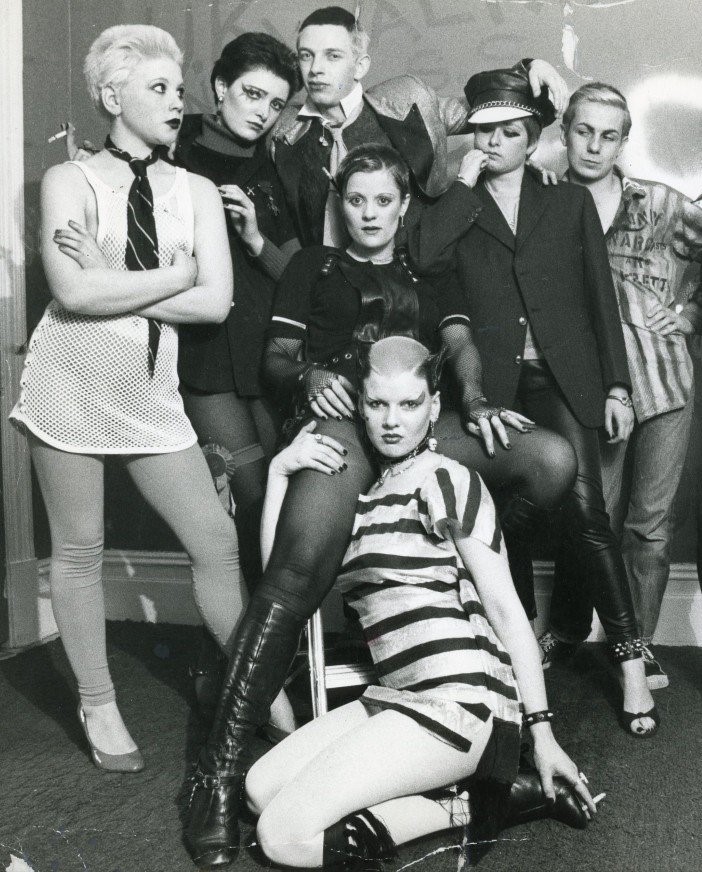
The Bromley Contingent were by-far the best-dressed group of people in the world: who could tell them what was stylish and what was fun? They created their own look and their own pastimes. 
 
The punk revolution - even before it was called such - "created a sensation out of all proportion to its novelty" [5]. As far back as 1975, the Bowie-inspired youth of London's suburbs had discovered that to dress up so as to mess up was a form of empowerment and that, ironically, bondage straps can set free. In other words, by weaponising fetish gear, they transformed restrictive rubberwear into a sign of negative freedom.  
 
At first, punk was confined to a small underground scene, mostly consisting of the Sex Pistols and their friends and followers. Among other young people the old standards and old tastes prevailed. Long-haired hippies in their flared jeans were still regularly encountered on the high street. Only during the Summer of Hate did the Punk Age fully blossom, consigning Elvis, the Beatles and the Rolling Stones to the dustbin of history.  
 
Scarcely had the normally staid citizens of the UK calmed down after the Bill Grundy Incident and the media storm that followed, before the wildest of all generations - the generation which had been too busy playing with their dolls to know about the Summer of Love - brusquely shouldered anyone over twenty-five out of the way and pogoed into the limelight. 
 
This was the generation who dramatised themselves as anarchists, the generation that wanted to fuck the rich up the arse and eventually self-destructed less through a lack of ability and intelligence than through a lack of caring about long-term success. 
 
 
IV. 
 
Arguably, the Sex Pistols topping the charts with 'God Save the Queen' in June 1977 and playing on a boat on the Thames outside the Houses of Parliament was the highpoint of the Punk Age. 
 
For though the era continued even after the band split up in January 1978 [6], it became less and less an affair of rebellious youth and was now renamed (and repackaged) as the New Wave by the elders of the music business looking to regain control over punk's disruptive chaos and make money by promoting big-selling acts acceptable to the US market. 
 
New Wave was like an orgy staged by the impotent at the Cambridge Rapist Hotel tired of missing out on the action and ready to feast on young flesh. As MAMIE record boss Ed Bird informed Steve Jones: 
 
"The Sex Pistols are finished, over! We don't take risks in this business anymore - we don't need to. Anarchy has dropped out of the Top 20 - punk is dead! Rock 'n' Roll can mean anything we want it to mean - peace, love, bringing people together. It can get rid of politics - it can be art, big money, the normal promotion of records. And it's fun!" [7]
 
By 1980, New Wave itself was old hat - say hello to the post-punk world of New Romanticism! Even McLaren and Westwood decided that pirates excited more than rockers and that having gold dust in one's hair was preferable to gel.   
 
The hardcore punks who, in their black leather jackets with 'Punk's Not Dead' defiantly written on the back, refused to quietly fade away or accept that the world had moved on - who rightly pointed out that all the same forces of reaction and stupidity remained in place - soon became as boring as the old hippies that they used to sneer at (and perhaps even more pathetic). 
 
The fact is, once the hacks of Fleet Street made punk headline news the game was nearly over and when the glossy magazines started to celebrate it punk had long ceased to even be news. The songs and the fashions of the Punk Age had changed everything whilst at the same time changing nothing.    
 
 
V.
 
The cooler, more creative, more experimental members of the Punk Age - those who had been to art school and liked wearing makeup - divided into a wide variety of new post-punk subcultures. The more aspirational started wearing expensive suits and were assimilated into the corporate machine where they carved out well-paid professional careers in the media (some of these cunts are still on our TV screens today). 
 
Others, however, just settled back into the normal world; got a job, got married, bought a house, had kids, took up hobbies, and one day looked in the mirror and found they were fat and bald and would no longer dare say bip-bam-boogie and a booga rooga to a policeman [8]. Many of these people now go to punk nostalgia fests and retro events in the vain attempt to relive their younger days, or satisfy their longing for a past they never actually experienced first hand [9]. 
 
 
VI.
 
But what about poor Sid? 
 
That is often the refrain I hear from concerned liberals today. Poor Sid, allowed (and encouraged) to disappear into the dark maw of drug-addled violence. Charged with murdering Nancy (12 October 1978), Vicious found himself in jail on Rikers Island and then, released on bail and awaiting trial, fatally overdosing on heroin supplied by his own mother: too fast to live, but not, it turned out, too young to die (2 February 1979).  
 
Malcolm once said if the Punk Age had continued it would have become much more brutal and destructive and many don't approve of his (rather fanciful) terrorist posturing [10]. But I don't care for their retrospective moralising. 
 
It was fantastic to be young, pretty and vacant in such a nihilistic time: when the apple cart was up-ended just for the pleasure of seeing which way the apples would roll; to not give a shit about anything said by parents and teachers and to think criminals and other notorious figures were more inspiring than second-rate pop stars and boring politicians.  
 
To those who look back in horror on the follies of youth and the excesses of the Punk Age - I give two fingers: "It was the best of times, it was the worst of times" ... and it seemed only a matter of time before the Grundy generation would step aside "and let the world be run by those who saw things as they were" [11]. 
 
Of course the Punk Age seems "rosy and romantic to us who were young then, because we will never feel quite so intensely about our surroundings any more" [12].     
 
 
Notes
 
[1] 'New Rose' was released on 22 October 1976 on Stiff Records, and is acknowledged to be the first UK punk single. The debut single from the Sex Pistols - 'Anarchy in the U.K.' - was released by EMI the following month (26 November). 
      Whilst it's impossible not to love Brian James's punk-pop ditty, the latter track, written by Cook, Jones, Matlock and Rotten, is in a different league: a genuine call to action rather than simply a song belonging to an exciting (but in many ways conventional) music genre. Click here for the astonishing live performance of 'Anarchy' on So It Goes (broadcast 4 Sept 1976).  
 
[2] Caroline Coon is widely credited with helping popularize the term 'punk rock' via her pioneering music journalism (although she didn't coin it). After attending early performances by the Sex Pistols in 1976, Coon recognised a revolutionary shift in youth culture was taking place. Coon is also credited with coming up with the name 'Bromley Contingent' for the stylish early followers of the Sex Pistols (which included Siouxsie Sioux and Billy Idol). 
 
[3] A reference to Fitzgerald's essay 'Echoes of the Jazz Age', which analysed the socio-cultural conditions that gave rise to a fascinating form of hedonistic youth culture in the 1920s. Tap on the link provided to read the essay online as a Project Gutenberg Canada ebook (2014).   
 
[4] This is a reworking of the famous opening line of Fitzgerald's essay: "It was an age of miracles, it was an age of art, it was an age of excess, it was an age of satire."   
 
[5] A direct quote from Fitzgerald's 'Echoes of the Jazz Age' (1931). 
 
[6] The Sex Pistols played their final show on 14 January 1978 at the Winterland Ballroom, San Francisco. 
 
[7] Dialogue from The Great Rock 'n' Roll Swindle (dir. Julien Temple, 1980). The scene set at the (fictional) Cambridge Rapist Hotel is highly provocative to say the least, exposing how the music business exploits young flesh. The MAMIE record boss is played by actor Johnny Shannon.  
 
[8] This echoes the line in Fitzgerald's essay that reads "one day in 1926 we looked down and found we had flabby arms and a fat pot and couldn't say boop-boop-a-doop to a Sicilian". Obviously, the line suggests that he and his contemporaries had suddenly grown old and culturally irrelevant. 
      'Boop-boop-a-doop' was the playful baby-talk catchphrase of Helen Kane, the 1920s singer who inspired cartoon character Betty Boop. It symbolises the carefree, frivolous, and bubbly pop-culture slang used by the flappers of the Jazz Age. As for the phrase 'to a Sicilian', this refers to a tough, hard-working and down to earth breed of people - i.e., just the kind of people who were scorned by the Bright Young Things. 
      The phrase has been updated in the post by incorporating a line from the Bow Wow Wow song 'C30 C60 C90 - Go!' (EMI 1980) and replacing the Sicilian with an authority figure; the policeman who is shrugged off and ignored in the song by the teenage punk pirate.    
 
[9] In 2012, the writer John Koenig coined a neologism for this pseudo-nostalgia for a cultural era or historical period one didn't actually live through: anemoia. While it's not a clinically recognised psychological state, it refers to a genuine feeling experienced by a growing number of individuals - thus the growing interest in older music, vintage clothing, classic films, etc.
      Readers who are interested might like to see The Dictionary of Obscure Sorrows, by John Koenig (Simon & Schuster, 2021), or visit his official website of this name: click here.   
 
[10] In a piece by Michael Watts in Melody Maker (June 1979), McLaren said this when asked how things would have developed if the Sex Pistols had stayed together: "They'd have created serious mayhem. They'd have been an awful lot more brutal and evil. In the end it wouldn't have been puking at airports - it would've been much more to do with burning down buildings." 
      Commenting on this, Simon Reynolds says it is fanciful: "Punks were far more likely to be the victims of violence than its perpetrators. They were merely pretending to be monsters and psychopaths as part of their campaign of symbolic warfare." 
      Reynolds continues: "But the parallels with terrorism are there: escalating shock tactics, goading the authorities into repressive measures. The typical punk move was to commit some kind of outrage, through clothes, language or imagery, and then scorn the revulsion they had sought and achieved." 
      See his review of Paul Gorman's The Life and Times of Malcolm McLaren (Constable, 2020), titled Serious Mayhem in - London Review of Books, Vol. 44, No. 5 (10 March 2022).
 
[11] The first phrase lifts from the famous opening of Charles Dickens's A Tale of Two Cities (1859). The closing sentiment reworks a line from Fitzgerald's 'Echoes of the Jazz Age' (1931). 
 
[12] This is the final, poignant sentence of Fitzgerald's essay, presented almost exactly as written. It serves as the ultimate admission that the magic of any youth subculture is fatally tied to the transient intensity of youth itself.


26 Aug 2025

On Three More Punk Graces: Siouxsie Sioux, Poly Styrene, and Helen of Troy

The Three Punk Graces II: Poly, Siouxsie & Helen of Troy
(SA/2025) 
 
 
I. 
 
The Greeks famously have had their Charites, but punk mythology has given us our very own version of the Three Graces: Jordan, Soo Catwoman, and Vivienne Westwood [1]
 
In fact, I would argue that those who came of age not in ancient Athens, but London in the mid-late 1970s, were doubly blessed. 
 
For I can easily name at least three other astonishing women who may not have personified Classical notions of charm, beauty, and elegance, but certainly embodied forms of radical alterity [2]: Siouxsie Sioux, Poly Styrene, and Helen of Troy ...   
 
 
II.
 
Not only was Siouxsie lead singer, lyricist and frontwoman of her own very successful band - Siouxsie and the Banshees - but she was a key member of that ultra-hip and ultra-loyal group of fans who followed the Sex Pistols in the very early days and became known as the Bromley Contingent [3].
 
In fact, having never really been much of a Banshees fan - I liked some of the early songs, but only ever bought one single and one album by them - it's Siouxsie's devotion to the Sex Pistols that really makes me feel a good deal of affection for her. 
 
Because of her later career as a performer who experimented with various styles of music - and her association with what is known as goth [4] - many commentators forget just how close she was to Rotten and company and how brilliantly she embodied the pervy punk aesthetic being promoted by McLaren and Westwood; quickly becoming notorious on the London club scene for her SEX inspired outfits (often wearing a cupless black bra, for example, with matching swastika armband).     
 
In September 1976, Siouxsie performed a short (mostly improvised) set on stage at the 100 Club Punk Special (an event organised by Malcolm McLaren); Marco Pirroni was on guitar, Steve Severin on bass, and Sid Vicious on drums.   
 
And then, in December '76, she and three other members of the Bromley Contingent accompanied the Sex Pistols to Thames TV where they were being interviewed by Bill Grundy for the Today programme .... and, well, everyone knows what happened (Go on - you've got another five seconds, say something outrageous ... etc.) [5]
 
Now, whilst Grundy was absolutely the cause of his own downfall, it has to be said that if Siouxsie hadn't pretended that she'd always wanted to meet him, then, well, who knows how things might have turned out. 
 
But she said what she said, and thus unwittingly instigated what became known as the Bill Grundy Incident which, in turn, triggered a full media meltdown and moral panic; the Daily Mirror famously putting a picture of her on the cover of one edition (Friday, December 3, 1976) along with the headline: Siouxsie's a punk shocker.    
 
Funnily enough, after all this tabloid fuss, Siouxsie began to distance herself from the scene and stopped following the Sex Pistols after the gig at Notre Dame Hall (London) at the end of December '76, preferring to focus her energy on her own career as a singer and songwriter, releasing her first single with the Banshees in August 1978 [6]
 
 
III. 
 
Punk was never really about the music and, to the extent that it was about the music, it was best suited to the singles format rather than the album. 
 
However, that's not to say there weren't great punk albums and one of these is Germ Free Adolescents (EMI, 1978) by X-Ray Spex; a group fronted by the uniquely talented singer-songwriter Poly Styrene.  
 
Poly was unarguably one of the most distinctive sounding and looking individuals to have come out of the punk movement [7] and is widely recognised (along with members of the Slits) as a seminal influence on the underground feminist movement known as riot grrrl in the 1990s.   
 
Funnily enough, whilst never a member of the Bromley Contingent, Poly was born in the town, but grew up in Brixton; the biracial child of a Scottish mother and a Somali father.    
 
At fifteen, she ran away from home and hit what remained of the hippie trail, hitch-hiking across the country from one music festival to another and trying to scrape a living as an alternative fashion designer and pop-reggae singer. 
 
But then, on her nineteenth birthday (3 July, 1976), she saw the Sex Pistols playing at the Pier Pavilion in Hastings and had her punk epiphany; forming her own punk band, X-Ray Spex, soon afterwards and taking the punk-sounding name Poly Styrene (one that reflected her obsession with the synthetic world of plastics and consumer culture that had boomed in the post-War era).   
 
The band released their debut single - 'Oh Bondage Up Yours!' - in September 1977 and although it was not a hit at the time (in part due to the fact that the BBC banned it), it is now (rightly) regarded as significant a punk anthem as 'Anarchy in the U. K.' by the Sex Pistols or 'White Riot' by the Clash. 
 
After this, no one ever again intoned the idea of little girls being seen and not heard (in the music business at least, if not wider society): click here to play [8]
 
Miss Styrene left the band in mid-1979 and whilst, to be honest, I was not interested in her later life and career, I was saddenned to hear that she died in April 2011 (aged 53) from metastatic breast cancer.  
 
 
IV.
 
Finally, we come to Helen Wellington Lloyd (née Mininberg), or, as she is better known by lovers of The Great Rock 'n' Roll Swindle (1980), Helen of Troy; one of the most committed members of the Sex Pistols' entourage and very much part of the inner circle around the band, being a longtime friend (and, briefly, a lover) of Malcolm McLaren [9]
 
If anyone embodied what I termed earlier in this post radical alterity, then Helen was it; if only due to her achondroplasia - a rare inherited form of dwarfism - which obliged her to confront the ridicule and discrimination that came her way from those of regular stature [10]
 
Punk not only provided her with a more accepting community of creative like-minded individuals, but an identity that allowed her as a little person to openly declare her defiance of and contempt for normies (or those she called plebs) with their conventional notions of beauty, for example.  
     
Helen, a talented art student, was not just a pretty face, however; she it was who first came up with the idea of the Sex Pistols using the ransom note style typography for promotional materials (an idea enthusiastically taken up by Jamie Reid); and she it was who famously featured alongside McLaren in the Swindle, including the famous 'You Need Hands' dance sequence set in Highgate Cemetery - click here - surely one of the most touching scenes in British cinematic history.  
  
Again, as with Siouxsie and Poly Styrene, I'm not too interested in what happened to Helen post-punk; she sold her extensive collection of Sex Pistols memorabilia at Sotheby's (London) in 2001 - which included Rotten's 'Anarchy' shirt (as designed by McLaren and Westwood in 1976) - and then, it's believed, she returned home to South Africa. 
 
Obviously, one wishes her well (if she's still alive) - and obviously, dead or alive, she continues to play an active role in my own imagination.   
 

Notes
 
[1] See the post published on 25 August 2025 in which I discuss this trio of figures who were so central to the British punk revolution: click here.  
 
[2] By radical alterity I refer to Baudrillard's understanding of otherness as it appears throughout his work; i.e., something that is in danger of extinction today, but which might still possibly pose a challenge to the arrogance and narcissism of a closed culture when it is invested with force by a movement such as punk. 
      For me, the three figures discussed here are perfect examples of those Peter York once described as the Peculiars; individuals who are proud not to fit in or subscribe to a model of universal understanding, but to be alien and abnormal, as well as sexy, stylish and subversive. 
 
[3] The name was coined by the music journalist Caroline Coon in September 1976 and, despite the fact that several members of the Bromley Contingent weren't actually from this Greater London suburb (located ten miles southeast of the capital), the name was catchy and convenient enough to stick. 
      Core members included: Siouxsie, Steve Severin, Billy Idol, Simon Barker, Debbie Juvenile, Tracie O'Keefe, Simone Thomas, and Bertie Marshall (Soo Catwoman was often associated with them, but was never considered part of the group by other members or, indeed, by herself).    
      Siouxsie and Steve Severin first saw the Sex Pistols play in London in February 1976 and, after chatting to members of the band afterwards, they immediately became devotees.  
 
[4] Siouxsie often expressed her displeasure with this association and felt the term goth - like punk before it - was ultimately reductive and one used by journalists to oversimplify and categorise work they didn't understand.    
 
[5] For those readers who aren't familiar with the details of the Bill Grundy incident, let me briefly summarise: After Queen cancelled their appearance on the live television show Today show at the last minute, the Sex Pistols were offered the spot in order to promote their debut single, 'Anarchy in the U.K.', and explain what punk rock was all about. 
      Things started badly and quickly got worse when it was clear that Grundy was hostile and dismissive of the band and that the latter - particularly guitarist Steve Jones - were not prepared to take his bullshit, nor listen to his creepy sexual innuendo when speaking to Siouxsie. Suggesting to her that they might 'meet afterwards' triggered Jones into calling him a 'dirty sod' and a 'dirty old man'. 
      Stupidly, Grundy then challenged Jones to 'say something outrageous' - which he did; calling Grundy a 'dirty bastard' and a 'dirty fucker'. Grundy responded, 'What a clever boy! to which Jones hilariously replied, 'What a fucking rotter!'
      Predictably, the phone lines to the Thames switchboard lit up and the national press had a field day. Grundy was suspended by Thames and his career effectively ended. The Sex Pistols were fired shortly afterwards by their record label EMI and were now branded as public enemies. The interview - click here - has become one of the most requested TV clips of all time. 
 
[6] Siouxsie and the Banshees, 'Hong Kong Garden' (Polydor Records, 1978): click here. This debut single reached number 7 in the UK chart.  
 
[7] In many ways, Poly is as a uniquely-looking and uniquely-sounding character as Johnny Rotten and both must rank as amongst the most unconventional - but charismatic - performers in rock history. In order to appreciate this fact, here she is singing perhaps my favourite X-Ray Spex song, 'Identity', which was released as the band's third single (on EMI) in July 1978: click here
 
[8] It should be noted that the song is not simply a feminist rejection of male sexual oppression as some imagine; rather, as one critic points out, it's also 'an indictment of consumer culture, denouncing the blind impulses of the mainstream shopper', as the lines: Chain store, chain smoke, I consume you all / Chain gang, chain mail, I don't think at all! make clear. 
      See Lauraine Leblanc, Pretty in Punk: Girls' Gender Resistance in a Boys' Subculture (Rutgers University Press, 1999), pp. 45-46.    

[9] Helen met McLaren on enrolment day at Goldsmiths College, in 1969. Later, through her connection with Malcolm she became a regular on the early London punk scene, where she felt happy and secure surrounded by freaks like her who liked to dress up and mess up: 
      'For the first time I didn't try and merge into the background. I wanted people to look at me with my chains, safety-pins, foxtail and black eyes. For once being a dwarf didn't matter.' - Helen, quoted by Stephen Colegrave and Chris Sullivan in Punk: The Definitive Record of a Revolution (Thunder's Mouth Press, 2001), and cited on the page dedicated to her on the Punk77 website: click here
 
[10] I'm conscious of the fact that one must be wary of going too far in this; that too often well-intentioned depictions of dwarfs in books or films, for example, suggest that they are not simply people of reduced stature, but individuals who have special (almost magical) powers and status due to their condition. Unfortunately, that's not the case and idealising little people is just as bad ultimately as devaluing, denigrating, or disparaging them due to their size.   
      Those interested in working to create a more inclusive society for those with dwarfism might like to visit the websites of Little People UK (co-founded by the actor Warwick Davis) - click here - and the Restricted Growth Association (RGA) - click here.         


24 May 2025

Of Punks and Prostitutes (Everyone Has Their Price)

Linda Ashby with Soo Catwoman and members of the Bromley Contingent 
(L-R: Debbie Juvenile, Siouxsie Sioux, Steve Severin, Sharon Hayman, and Simon Barker)
Photo by Ray Stevenson (1976)
 
 
I. 
 
According to the official trailer, The Great Rock 'n' Roll Swindle is the staggering story of a punk group that not only "held the record business to ransom", "stuck a safety pin through Her Majesty's nose" and "turned the national press into an occupied zone", but also "smuggled a Great Train robber into the top ten and destroyed the myths of their own success" [1]
 
All of these things are true: but were the Sex Pistols really a "kamikaze gang of cat burglers and child prostitutes" [2], or is that just a metaphorical mixture of Mclarenesque fantasy and hype? 
 
Leaving aside ideas to do with self-destructive behaviour and criminal theft, let's examine the more disturbing claim that the Sex Pistols - using that term in its wider application to refer not simply to the members of the band, but to all the many colourful, creative, and often fucked-up characters associated with them - might be viewed as child prostitutes ...
 
 
II.  
 
Some readers may recall that back in July 2019, I published a post in which I discussed an idea central to the Swindle project that the music industry ruthlessly exploits the young artists it controls as well as the young fans who buy its products [3].   
 
It doesn't simply make a point about the exploitative nature of the music business from a financial perspective, however. It also explicitly suggests with its language of pimping and prostitution that the music industry has a sleazy underbelly [4]
 
Not that Malcolm was adverse to exploiting young flesh himself in order to create a stir and he seemed to genuinely delight in the world of pornography, fetish, and prostitution, as his early T-shirt designs for Sex make clear. 
 
And many of the kids who hung around (or worked in) his store on the Kings Road and later became friends and followers of the band fronted by Johnny Rotten, also seemed drawn to the world of vice; particularly those who fell under the spell of Linda Ashby, a key figure in the early punk scene and a professional dominatrix, skilled in the art of S&M.    
 
 
III.
 
Ashby, with her short blonde hair, distinctive eye makeup, and often dressed in a favourite outfit from The London Leatherman [5], was a member of what we might term the illicit underground; that demi-monde of gay bars, strip clubs, sex shops, drug dens, and houses of ill repute frequented by a wide variety of people, from artists and entertainers, to politicians and bowler-hatted city gents.  
 
She was also one of those rare customers at 430 King's Road who actually had money to spend and, before long, her large central London apartment - just off Green Park - became an important location for the punk elite to meet up and crash out. This included members of the Bromley Contingent, who were famously photographed by Ray Stevenson in 1976 cavorting on the floor having just spray painted her walls with graffiti [6].
 
Of course, being associated with a known prostitute did not make the teens who gathered round her prostitutes themselves, although, everybody's favourite punk blonde, Debbie Wilson (aka Debbie Juvenile), when not following the Sex Pistols or working as a sales assistant at Seditionaries alongside her best friend Tracie O'Keefe [7], wasn't averse - according to Bertie Marshall (aka Berlin) - from turning tricks in Mayfair to clipping mug punters in Soho. 
 
Indeed, Marshall also worked as a rent boy and he described himself and his friends, like Debbie, who were on the game, as a bizarre and exotic pack of whore hounds [8]
 
And so, the phrase from The Great Rock 'n' Roll Swindle trailer with which I opened this post wasn't entirely fictitious, nor referring simply to the manner in which record companies exploit young talent. There was an all too literal sense in which prostitution was an acceptable (and celebrated) aspect of the punk lifestyle - as it was in the contemporary art world at that time [9].          
 

Notes
 
[1-2] Lines from the official trailer to The Great Rock 'n' Roll Swindle (dir. Julien Temple, 1980), narrated by the famous British newsreader and commentator on BBC Radio John Snagge. To watch on Youtube, click here.
      Note that this commentary - entitled 'Pistols Propaganda' - can also be found as the B-side of the Sex Pistols' single '(I'm Not Your) Stepping Stone' (Virgin Records, 1980), released from the soundtrack of The Great Rock 'n' Roll Swindle (Virgin Records, 1979).

[3] See the post entitled 'Young Flesh Required: Notes on Punk and Paedophilia' (18 July 2019): click here

[4] In fact, as Deleuze and Guattari demonstrate in Anti-Oedipus (1972), flows of capital and flows of desire belong to one and the same libidinal economy. Thus sexuality, as they say, is everywhere; as much in the boardroom as in the bedroom; "the way a bureaucrat fondles his records, a judge administers justice, a businessman causes money to circulate ..." it's all about desiring-production
      See Gilles Deleuze and Félix Guattari, Anti-Oedipus, trans. Robert Hurley, Mark Seem, and Helen R. Lane (The Athlone Press, 1984), p. 293.

[5] The London Leatherman (est. 1972), which caters to connoisseurs of a certain taste, significantly influenced the fetish fashions and accessories sold at Sex by McLaren and Westwood and, later, the wider punk scene. Thus, the name Ken Magson arguably deserves to be more widely known than it is: a brief biography can be found on The London Leatherman website: click here
      A description of the LP7 Wrestlers Suit favoured by Ashby - and a photo of her wearing such - can also be found on thelondonleatherman.com: click here.
 
[6] Ashby would have regularly encountered members of the Bromley Contingent not just at 430 Kings Road, but also at Louise's, a lesbian club in Soho that they and members of the Sex Pistols liked to frequent and where her girlfriend at the time would often DJ. 
      The photo session I refer to with members of the Bromley Contingent, taken at Ashby's flat by Ray Stevenson in October 1976, featured in the first (and only) issue of the Sex Pistols fanzine Anarchy in the U. K. One of the pictures (cropped) can be seen at the top of this post. 

[7] See the post entitled 'Reflections on a Photo of Two Young Punks' (4 December 2018): click here, in which I pay my respects to (and express my fondness for) Debbie and Tracie. 

[8] See Marshall's memoir, Berlin Bromley (SAF Publishing Ltd., 2006). 
      Marshall - aka Berlin - was just 15 in 1976 when he and fellow suburban misfits Susan Ballion (Sioxsie Sioux), Steven Bailey (Steve Severin), and Simon Barker (Six) began to hang around 430 King's Road and follow the Sex Pistols. They formed the core of the Bromley Contingent and, along with a small handful of others, can be regarded as those whom one cultural commentator at the time described as the "'extreme ideological wing of the Peculiars'". 
      See Paul Gorman, The Life and Times of Malcolm McLaren (Constable, 2020), p. 329, who quotes Peter York writing in an article entitled 'Them', in Harpers & Queen (October, 1976).     

[9] I'm referring here to the Prostitution exhibition (1976) by the performance art collective founded by Genesis P-Orridge - COUM Transmissions - at the Institute of Contemporary Arts in London, which included (amongst other delights) pornographic images, used sanitary products, bloody bandages, rusty knives, and dirty syringes. The opening night show featured a stripper and prostitutes and punks were invited to mingle with the gallery audience; this included members of the Bromley Contingent, some of whom - including Debbie - got their pictures in the papers. 
      Perhaps not surprisingly, the show - which ran for just over a week - caused press outrage and debate in parliament; one Tory MP described all those involved as the wreckers of civilisation. Despite criticism from almost every quarter, the ICA director, Ted Little, defended the show which is still regarded to this day - almost 50 years later - as one of the most controversial in both the ICA's history and that of British contemporary art, challenging moral and aesthetic values in a manner similar to McLaren's Sex Pistols and obliging him to thereafter up his game as a provocateur. 
 
 
Musical bonus: 'We Are All Prostitutes' by The Pop Group (Rough Trade, 1979): click here.  
    

21 Mar 2024

On the Nature of the Ridiculous (and the Ridiculous Nature of the Sex Pistols)


Sex Pistols
Photo by Richard Young (1976)
 
"We have passed beyond the absurd: our position is absolutely ridiculous." [1]
 
 
I. 
 
Gavin Butt is a professor at Northumbria University and someone who knows more than most - certainly more than me - about the connections between visual art, popular music, queer culture, and performance [2].

So when he privileges the term ridiculous in his work I'm confident he has very good reasons for doing so. 
 
However, that doesn't mean I can't briefly reflect upon this concept myself in contradistinction to what some regard as the more profound (and serious-sounding) philosophy of absurdism and then say something about the Sex Pistols. 
 
 
II. 
 
The crucial aspect of the ridiculous is that it solicits, incites, or provokes laughter; often of a mocking or cruel nature, but not always. If you're someone like Georges Bataille, then you'll probably find everything ridiculous - one recalls the following short poem:
 
Laugh and laugh 
at the sun 
at the nettles 
at the stones 
at the ducks 
 
at the rain 
at the pee-pee of the pope 
at mummy 
at a coffin full of shit [3]  
 
For Bataille, this laughter is liberating; by viewing the entire universe as ridiculous - including death and the excremental nature of the decomposing corpse - he feels able to escape from what Zarathustra terms the Spirit of Gravity.
 
This may seem synonymous with the sublime philosophical idea of absurdism, but, actually, it's not the same thing at all. Finding existence laughable is very different from finding it meaningless; one is expected - as a creature of reason - to be angst-ridden by the latter idea, not gaily indifferent to the fact or able to smile when standing before the nihilistic void [4].

Being ridiculous makes one in the eyes of those who insist upon moral seriousness at all times an inferior being; shallow and lacking dignity. But I would counter this by saying it makes us Greek in the sense understood by Nietzsche: i.e., superficial - out of profundity! [5].
 
 
III.
 
One might also view punk - in its more playfully anarchic manifestation as given us by Malcolm McLaren - as an attempt not merely to challenge authority, but to escape from enforced seriousness. 
 
The Sex Pistols - and those closely associated with them, such as members of the Bromley Contingent - were ridiculous because they advocated for a Lawrentian revolution:

If you make a revolution, make it for fun,
don't make it in ghastly seriousness,
don't do it in deadly earnest,
do it for fun.

Don't do it because you hate people
do it just to spit in their eye. [6]

Po-faced punks concerned about social justice might recoil from this, but, for me, the idea of tipping over the apple cart simply to see which way the apples will roll, is crucial. McLaren encouraged the youngsters under his spell to be childish and irresponsible - to be everything this society hates - to make themselves ugly and grotesque: in a word, ridiculous [7]
 
 
Notes
 
[1] I'm slightly misquoting the American actor, director, and writer Ronald Tavel, who coined the phrase Theatre of the Ridiculous in 1965 initially to describe his own work. Tavel himself ends this sentence with the word 'preposterous'. 
 
[2] I had the pleasure of listening to Butt speak at the Torn Edges symposium held at the London College of Communication on 20 March 2024 - an event exploring the points of contact and crossover between punk, art, design, and history. 
      Although his paper was rather more Pork than punk, that was fine by me and his discussion of Warhol's 1971 play in relation to the Theatre of the Ridiculous - a genre of queer experimental theatre - was fascinating.  
 
[3] The original poem by Bataille, entitled 'Rire' ['Laughter'], can be found in volume 4 of his Oeuvres complètes, (Gallimard, 1971), p. 13. The English translation is from the Preface to Nick Land's The Thirst for Annihilation: Georges Bataille and Virulent Nihilism, (Routledge, 1992), p. xvii.
 
[4] In a sense, I'm following Hobbes here who distinguished between the absurd and the ridiculous, arguing that the former is to do with invalid reasoning, whilst the latter is simply about laughter. For non-philosophers, however, the absurd and the ridiculous are pretty much now regarded as synonymous. 
      As for the sublime - with which the ridiculous is often juxtaposed - it's interesting to note just how quickly one can pass from the former to the latter; one small misstep is all it takes.
 
[5] Nietzsche, The Gay Science, Preface to the second edition (4).
 
[6] D. H. Lawrence, 'A Sane Revolution', The Poems, Vol. I, ed. Christopher Pollnitz (Cambridge University Press, 2013), p. 449. 
 
[7] Not only ugliness, but deformity is considered by some to be essential to the ridiculous; one recalls that Johnny Rotten in part based his hunched over stage persona on that of Richard III and would perform in an exaggerated physically awkward manner.    


4 Dec 2018

Reflections on a Photo of Two Young Punks

Debbie Juvenile and Tracie  O'Keefe
(Seditionaries 1977) 


There are two reasons why I like this photograph ...

Firstly, there are the clothes: McLaren and Westwood's idiosyncratic designs looked fucking amazing back then and they look even more astonishing now. One forgets just how romantic and swashbuckling punk fashion was - and just how queer (using that word in its fullest sense, to mean strange and outlandish as well as sexually deviant in some manner). It was never really a style that came from the streets; it came, rather, from the extraordinary imaginations of Malcolm and Vivienne and made very little sense outside of the world of 430, Kings Road. Clothes for heroes - and clothes for weirdos.         

Secondly, there are the two girls: Debbie Juvenile and Tracie O'Keefe.* They seem unable to contain their pride and joy at looking so fabulous as they pose for the camera lens and actively transform themselves into an image. The fact that each is smiling - such a rare thing for a punk to do - provides the picture with a warmth and a charm that makes me love it and love them.   

If they look so young, it's because they were so young. And their youth - the freshness of faces, the whiteness of hands - also illuminates the image and arouses great affection in me (almost a kind of tenderness). But what gives it a special poignancy is the distressing knowledge that both girls are no longer living.

I look at this photo and see two lovely - if unconventional - young women, dressed in their punk finery; they would appear to have their whole lives ahead of them. But in the back of my mind is the thought: they are going to die ... This, of course, is the challenge and the scandal of every photo. Indeed, it might even be said death is the very essence of photography; that every snap is to some degree or other mortifying: A second of your life ruined for life.

However, as Roland Barthes points out, the photograph also powerfully attests to presence and to the reality of lives that have been. It doesn't merely remind us of the past, or preserve what was abolished by the passing of time. It forms an actual bridge between ourselves and the dead. Thus, you look at Debbie and Tracie and - although they are no longer physically with us - they manage nevertheless to affect those of us who are still here in the flesh; not as ghosts, but as tiny suns that continue to shine long after they have burned out.

To paraphrase Susan Sontag, the presence of the absent being touches me like the delayed rays of a fading star.


Notes

Roland Barthes, Camera Lucida, trans. Richard Howard, (Hill and Wang, 1981).

*Both girls were early fans of the Sex Pistols and part of the so-called Bromley Contingent; both worked as sales assistants at Seditionaries; and both were arrested during the Sex Pistols' Jubilee gig on a Thames riverboat. Tracie, however, was the only one to be given a prison sentence (for assaulting a policeman), although she was later acquitted on appeal. Shockingy, she died the following year, from cancer, aged 18.

As for Debbie, she embodied the look and spirit of punk: it was Debbie who sold programmes on the Anarchy in the UK tour and it was Debbie who can be seen singing backing vocals on stage with the Sex Pistols auditioning for a new frontman in The Great Rock 'n' Roll Swindle. Post-punk, she apparently drifted into the world of vice. Then she simply disappeared and is presumed dead.