Showing posts with label danny boyle. Show all posts

29 Aug 2026

Love Kills (Or Sometimes Just Lies Limp): Sid and Nancy 40 Years On

Sid & Nancy (dir. Alex Cox, 1986) 
An official theatrical film poster
 
 
I. 
 
Sid and Nancy - also known by the working title Love Kills [1] - was released 40 years ago. 
 
It premiered at the Cannes Film Festival on 14 May 1986 and was first shown in London at the Limelight Club on 20 July, before going on general release in UK cinemas the following month.
 
It's a biopic directed by Alex Cox, who co-wrote the script with Abbe Wool, starring Gary Oldman as the Sex Pistol Sid Vicious and American actress Chloe Webb as his punk paramour Nancy Spungen [2]. 
 
 
II. 
 
Oldman is a talented and versatile actor - not one of my favourites, though I don't dislike seeing him on screen - but his initial decision to turn down the role of Vicious (not once, but twice) was one I wish he'd stuck by. 
 
For one thing, he was already 27 when filming took place in 1985, which makes him too old to play a character who died aged 21. Also, by his own admission, he had zero interest in Vicious and punk subculture, wasn't a fan of the Sex Pistols, and found the entire story surrounding Sid and Nancy banal
 
Ultimately, Oldman only accepted the role at the urging of his agent and after learning that he was being offered a £35,000 fee to star in the movie [3]. 
 
However, to be fair, he did throw himself into the part with all his characteristic intensity once he agreed terms. Amusingly, he lost so much weight in such a short period in order to play Vicious that he was briefly hospitalised with malnutrition [4]. And at least Oldman came from a relatively working-class background, unlike posho actor Louis Partridge who played Vicious in Danny Boyle's ludicrous six-part mini-series Pistol in 2022 [5].  
 
Oldman - who went on to become an Academy Award-winning Hollywood actor - now rarely mentions Sid and Nancy and casually dismisses his own performance in the film.  
 
 
III. 

If Oldman, at 27, was just a tad past it to play Sid, Chloe Webb, pushing 30 when she took on the role of Nancy - who died aged 20 - was way over the hill (certainly by punk standards). 
 
So again, whilst she does a reasonable job, I think it would have been better - or at least more daring - to have cast 20-year-old Courtney Love in the role - one for which she submitted a video audition and was genuinely passionate about. 
 
Cox was deeply impressed by Love's youthful enthusiasm - and her acting ability - but eventually caved in to pressure from the film's financial backers and investors who insisted on a more experienced actress in the role. 
 
He did, however, create and write the minor supporting character of Gretchen for Love (a fictional New York junkie friend of the punk couple) so she could still be part of the project and this marked her debut feature film appearance (several years before she formed the band Hole and met Kurt Cobain).      
 
 
IV. 
 
Although Sid and Nancy failed to recoup its production budget at the box office, the film was received positively by most critics [6] and has since developed a cult following. Strangely, however, it is rarely shown on British TV and I don't think I've seen it other than at the cinema back in August 1986 - when I was less than impressed, as this diary entry makes clear:
 
Sophie and I woke up late. After lunch, we set off on a nice sunny day to King's Road. Boring! Nothing (and no one) caught my eye. From Chelsea to Kensington Market and Hyper Hyper. Still found nothing to excite. Everything seems to have stagnated. But perhaps that's a good thing - a precursor to a change of some kind. Or maybe not.   
      Got to Leicester Square at five-ish. Had something to eat in Pizzaland and then went to the cinema. It had been my intention not to see Sid & Nancy, but felt a strange obligation to do so - and Sophie had bought the tickets. The two main parts were well-acted, so kudos to Gary Oldman and Chloe Webb. Other cast members were less convincing - particularly David Hayman as Malcolm and Andrew Schofield as Rotten
      Ultimately, I came away asking myself what was the point of such a film other than to echo the 'Just Say No' anti-drugs campaign? The only thing worse than the ridiculous ending of the film was Joe Strummer's soundtrack. [7]
 
As I say, I don't think I've since re-watched the film - though I'd very much be interested to do so, one day, just to find out if it's as bad as I remember it. 
  
 
Notes
 
[1] Director Alex Cox used the title Love Kills throughout the writing and development process. Why this title was dropped (or relegated to the status of a subtitle) in favour of the more prosaic Sid and Nancy, I don't know, but one suspects there was probably external pressure to do so coming from the film's producers (particularly after a letter was received from a party claiming to own the title 'Love Kills' and threatening legal action).
      Clearly, it must have been a decision made late on, because by then Joe Strummer (formerly of The Clash) had already written the film's title track and 'Love Kills' was released as a single from the film's soundtrack in July 1986. Fans of Strummer will doubtless disagree, but it's a shit track and, personally, I much prefer the song written by Dee Dee Ramone also called 'Love Kills' and also dealing with the tragic story of Sid Vicious and Nancy Spungen. This track can be found on the Ramones album Animal Boy (Sire Records, 1986). 
 
[2] For my own take on these star-crossed lovers, see the post titled 'I'll Put a Knife Right in You' (30 Dec 2020). For a rather more personal take on the story of Sid Vicious see 'Sweet Sixteen' (8 Feb 2022). And for a longer post in memory of Ms Spungen, see 'The Last of the Groupies' (26 April 2022).   
  
[3] I know there will be readers thinking that £35,000 doesn't sound like a lot of money, but it was considered a significant sum to pay a young and relatively unknown theatre actor at the time. Oldman has since revealed in interviews that he was only earning around £80 a week working with the Royal Court Theatre at the time - and that was in a good week (sometimes his income would fall to half that). Thus, for Oldman, £35,000 was a small fortune - one that allowed the purchase of a modest flat in London. 
      Readers need to also remember that Sid and Nancy was an independent British film - not a big-budget Hollywood movie. Total production costs were only around £2.7 million.   
 
[4] For those who might want to know the secret of such dramatic weight loss, apparently the knack is to live on a diet of nothing but steamed fish and lots of melon. 
 
[5] Don't get me started on Pistol ... See the post 'The Great Rock 'n' Roll Castration' (30 Mar 2021). 

[6] Roger Ebert, for example, gave Sid and Nancy full marks in his review (25 Oct 1986). He concludes that Alex Cox has all the makings of a great director: "He and his actors pull off the neat trick of creating a movie full of noise and fury, and telling a meticulous story right in the middle of it." The review can be found on rogerebert.com  
      Thirty years later, Peter Bradshaw writing in The Guardian (4 Aug 2016) was equally enthusiastic, insisting that Sid and Nancy is a "welcome corrective to bland punk nostalgia" and calling it "Alex Cox's Beckettian masterpiece about those two prisoners of futility" and undiagnosed dysfunction.  
 
[7] This is an edited and slightly revised entry in The Von Hell Diaries (Sat 23 August, 1986). 
 
 
Bonus 1: the original trailer to Sid and Nancy (1986) - enhanced version by HD Retro Trailers.  
 
Bonus 2: the trailer for the 30th anniversary Blu-ray edition of Sid and Nancy (Studiocanal, 2016). 


9 Nov 2025

On the Politics of the Smile

 
And Still You Wear That Happy Face ...
 (SA/2025) [1]
 
 
I. 
 
Whilst totalitarian regimes do not enforce happiness and demand that citizens always smile per se, they do, nevertheless, require outward displays of satisfaction and conformity and often clamp down on any signs of discontent or unhappiness. 
 
Thus it is that one doesn't see many frowns on the faces of those depicted in state controlled propaganda and public emotion at mass events is carefully stage managed. 
 
And this is as true of Disneyland as it is of Nazi Germany; of corporate-media spectacles, such as the Olympics opening ceremony, as it is of a worker's parade in Pyongyang. 
 
Mickey Mouse, Joseph Goebbels, Danny Boyle, and the Supreme Leader of North Korea, Kim Jong Un, all know how to put on a good a show and make the people smile. 
 
In other words, they all understand the importance of exploiting what Freud calls the pleasure principle [2] and transforming what should be a natural expression of joy [3] into a regulatory facial mechanism that signals the correct response to power.
 
 
II. 
 
Having said that, the smile can still, I think, be a counterfascist gesture; for as Baudrillard reminds us, there is the possibility of a sudden reversal even in a single ironic smile, "just as a single flash of denial in a slave effaces all the power and pleasure of the master" [4].
 
This is not to imply we can laugh all our troubles away, but to suggest that the more hegemonic the system, the greater is its vulnerability to even the smallest of set-backs or acts of defiance. Any challenge, even at a micropolitical level, represents a failure and threatens to quickly go viral; a total system requires complete control and demands absolute complicity. 
 
Thus, smiling - perhaps more with the eyes than the mouth - is still an important ability to possess. If one smiles with a mix of cheerful insouciance and philosophical indifference to the circumstances in which one finds oneself [5], then, who knows, perhaps others might smile back ...             
  
 
Notes
 
[1] The title of this image is taken from the lyrics written by Jello Biafra and John Greenway for 'California Über Alles"' (1979), the debut single by American punk band Dead Kennedys. The background artwork is a detail taken from the sleeve for the single, designed by Winston Smith. 
      The main image (allegedly) shows a woman wearing a smile mask intended to fight depression, taken in Budapest, 1937. The theory behind the mask, designed to force the wearer's mouth into a smile using mechanical devices like wires or medical tape, was that if people looked happier then they would feel happier. Unfortunately, if such masks were ever actually used, they proved to be ineffective and did nothing to reduce the high number of suicides in the city at that time. 
 
[2] For Freud, the Lustprinzip is the instinctive seeking of pleasure (and the avoidance of pain) in order to satisfy biological and psychological needs. In his 1921 work, Beyond the Pleasure Principle, however, he considered the possibility of something more primal and operating independently of a pleasure principle conceived in relation to the life instinct; something that he termed the death drive (Todestrieb).   
 
[3] Whilst it's true that in different cultures and societies smiling can convey emotions other other than joy and amusement - such as confusion and embarrassment, for example - there are no non-smiling peoples and evolutionary biologists have traced smiling back millions of years to our earliest ape ancestors.
      Interestingly, smiling may also be something that men do more than women and a common female complaint is being told to smile by male strangers, as this is seen as aggressive and controlling rather than born of concern for their happiness.     
 
[4] Jean Baudrillard, Simulacra and Simulation, trans. Sheila Farier Glaser (University of Michigan, 1994), p. 163.  
 
[5] It's important to note that I'm not asking for sincerity to be expressed in one's smile; nor do I want people to smile enthusiastically. I want them to smile in a manner similar to the Cheshire Cat, so that they become elusive and enigmatic (or imperceptible, as Deleuze and Guattari would say).  
 
 
Musical bonus: Nat King Cole 'Smile', recorded and released as a single in 1954, it can be found on the album Ballads of the Day (Capitol Records, 1956): click here
      Or for Jimmy Durante's version of 'Smile', originally found on his 1965 album Hello Young Lovers (Warner Bros.) and which famously features in the movie Joker (dir. Todd Phillips, 2019), click here.  
 

23 Apr 2024

On the Triumph of Karaoke Culture and Punk Pantomime

Poster design for Pretty Vacant - The Story of Punk & New Wave 
(Not exactly Jamie Reid, is it?)
 
 
I. 
 
Shortly before he died in April 2010, Malcolm McLaren bemoaned the fact that artistic creativity (which is a chaotic phenomenon that often ends in failure) was increasingly becoming impossible within what he described as a karaoke world - i.e., an ersatz society, that only provides us with an opportunity to safely revel in the past achievements of others; a life lived by proxy [1]
 
And, whilst I'm a little uneasy with his use of words like authenticity, McLaren was making an important (though hardly original) point: Britain's got talent; but it's lost its soul. 
 
And so it is, fifteen years on, the Dominion Theatre in London's West End and numerous other venues around the UK and Ireland are planning to stage Ged Graham's Pretty Vacant - The Story of Punk & New Wave ...   

 
II.
 
Ged Graham is a 62-year-old Irish writer, musician, actor, podcaster and producer; what my mother would call a jack of all trades, but, let's be generous, and say he's a multi-talented and versatile individual with a great many passions and ideas. The sort of person who, when you speak with them, always has another project in the pipeline
 
The sort of person also who claims to have lived through punk as a teenager and now, à la Danny Boyle, wants to turn this event into a musical stage show; a combination of pantomime, karaoke, and nostalgia for those who want to sit down and enjoy an evening's entertainment. As Graham says in an interview: 
 
"At sixty-two you don't want to be in a nightclub, watching a band on stage. You want to be sat down with a glass of wine or an £8 bottle of beer in a theatre. The old knees just don’t want to do the standing up gigs anymore ..." [2] 
 
That may be true: but not all of us have come to the conclusion that punk is now simply a family-friendly narrative that provides an opportunity to reminisce and have a good singalong; some of us don't wish to be taken on a rollercoaster ride by an incredibly talented cast of musicians, singers and dancers; some of us seriously doubt that the punk attitude can be recreated on stage (even if it can be mimicked, just as punk fashions can be knocked up by costume designers).   
 
Graham may insist in a promotional statement that Pretty Vacant is "not just a show - it's a rebellion against the ordinary!" [3] - but that, as Steve Jones would say, is a load of old bollocks.  

I don't know if Malcolm will be spinning in his grave at this latest development, or looking on with Sid and laughing. But I do know that members of the following bands who - along with many, many more - presumably gave permission for their music to be used should hang their heads in shame:
 
Sex Pistols
The Clash
Blondie
The Damned
Ramones
Buzzcocks
Sham 69
The Undertones
Tom Robinson Band
Ian Dury and the Blockheads
The Police
The Jam
Generation X
Siouxsie and the Banshees
The Pretenders
Joy Division
The Stranglers
The Rezillos [4]
 
 
Notes
 
[1] Readers who are interested can click here to watch McLaren deliver his final public talk at the Handheld Learning Conference (2009). Originally entitled 'Never Mind the Bollocks, Here's the Txt Pistols', the talk is now better known by the title it appears under on ted.com - 'Authentic creativity vs. karaoke culture'. 

[2] Interview with Ged Graham by Kevin Cooper on UK Music Reviews (5 March 2024): click here

[3] Click here to read this statement in full on the Pretty Vacant website. You can also buy tickets, visit a picture gallery, sign up to a mailing list, or watch a trailer for the show on the website. The latter can also be found on YouTube: click here.  
 
[4] Obviously, I am disappointed with some of these bands far more than others.    


25 Mar 2024

On Torn Edges and the Need to Archive (God Save the Punk Scholars Network)

London College of Communication (UAL) 
(20 March 2024)
 
I. 
 
Held at the London College of Communication - one of six colleges that make up the University of the Arts London - the Torn Edges symposium explored the relationship between punk, art, and design history [1].
 
An international body of researchers, in what is said to be a "relatively new and emerging field within the broader theme of punk scholarship", gave short papers and took audience questions and it soon became clear that punk studies "have moved beyond relatively limited histories of the early scene in New York or London to reflect a much deeper critical analysis of punk music, fashion, politics, philosophy and aesthetics around the globe over a period of more than fifty years" [2].
 
 
II. 
 
The question which arises, however, is this: Is that a good thing? 
 
Because some might argue that the spirit of punk is exorcised in three ways: (i) it is commodified by capital; (ii) it is Disneyfied by the media; (iii) it is intellectualised by academics. 
 
In other words, punk is made profitable, made safe, and absorbed into a seamless cultural history. Any rough or torn edges are thereby given a smooth finish (or de-deckled, if such a word exists).  
 
One of the speakers at Torn Edges - Marie Arleth Skov - addresses this concern about punk ending up in the universities, galleries, and museums in an online conversation with James Campbell of Intellect Books [3].
 
Asked about the importance of ensuring that punk is properly archived, Skov says it is crucial; that we're at the stage now where materials currently held by private individuals need to be preserved and made accessible to a wider public within an institutional framework, before those individuals snuff it and the materials are lost.
 
In other words, old punk rockers (like me) need to overcome their fear of institutionalism and mutualisation and accept that the museums, galleries, and universities actually represent the best (and maybe the only) chance that something of the original punk spirit can survive, in a way that doesn't happen when punk is co-opted by big business or turned into a Disney+ miniseries by Danny Boyle [4].
 
Thus, resistance to this Borg-like process of being archived may or may not be futile, but it's almost certainly mistaken. Ultimately, punk needs those like Marie Arleth Skov and Russ Bestley working in academia and/or the art world who care passionately about subcultures and countercultural phenomena. 
 
God Save the PSN!


Notes
 
[1] Full details of the event and speakers can be found on the Eventbrite website: click here.
 
[2] I'm quoting from the Torn Edges programme, which, I'm guessing, was written by Dr Russ Bestley who organised the event and is (amongst many other things) a founding member of the Punk Scholars Network.      

[3] Marie Arleth Skov is a Danish-born art historian and curator based in Berlin. She is the author of Punk Art History: Artworks from the European No Future Generation (Intellect Books, 2023) and the chair of the Punk Scholars Network in Germany. She is currently researching for an exhibition at ARoS art museum in Denmark on the topic of the body in punk culture.
      James Campbell is a lecturer in education at Deakin University, Australia. He is also Head of Marketing and Sales at Intellect Books
      The 35 minute interview between Campbell and Skov conducted last autumn is available to watch on YouTube: click here. Arleth's thoughts on the need to archive punk begin at 24:58.

[4] For my thoughts on Danny Boyle's Pistol (2022) see the posts entitled 'The Great Rock 'n' Roll Castration' (30 March 2021): and 'Can Anyone Be a Sex Pistol?' (31 March 2021).


31 May 2022

Reflections on Another Jubilee (There's Still No Future in England's Dreaming)

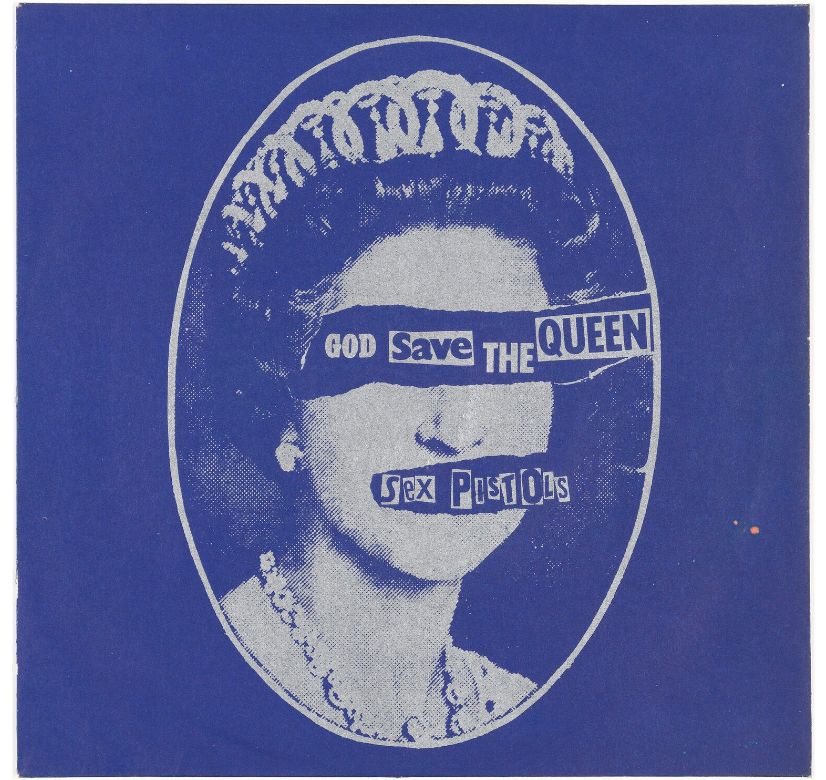
Jamie Reid: sleeve artwork for 'God Save the Queen' 
by the Sex Pistols (Virgin Records, 1977) 
 
 
I.
 
Celebrations to mark the Queen's Platinum Jubilee are set to take place over a special four-day bank holiday weekend from Thursday 2 to Sunday 5 June 2022. 
 
Seeing the Union Jack bunting and hearing all the Gawd bless 'er majesty bullshit reminds me very much of the Silver Jubilee back in the fateful summer of 1977 - the summer of hate as it is sometimes known; i.e., the summer of punk ...
 

II.

Although not old enough to have partied with the Sex Pistols on their notorious jubilee boat trip along the Thames, I was old enough in 1977 to have woken up and realised what side of the bed I was lying on - and it wasn't the side with the red, white and blue sheets.
 
As far as I recall, I was pretty much the only Essex schoolchild who refused to attend (or have anything to do with) the street parties being held on my estate that June. 
 
And my sense of alienation - combined with a long hatred for all the pomp and circumstance surrounding the royal family - meant that I now aligned myself with the Sex Pistols (what this meant in practice was keeping press cuttings about the band, taping 'Pretty Vacant' off the radio [1], and doing my best to perfect a Rotten persona). 
 
The Sex Pistols were the flowers in the dustbin and they were the poison in the human machine, but it was precisely their uncompromising nihilism that made them so attractive; that, and the way they looked [2]

 
III. 
 
Finally, while we're on the subject of the Sex Pistols ...
 
Tonight sees the start of Danny Boyle's six-part TV series Pistol - a Disneyfied punk pantomime loosely based on Steve Jones's memoir, in which a kamikaze gang of foul-mouthed yobs is reimagined by a cast of impossibly middle-class actors [3].
 
Were he still with us, I'm sure Malcolm would regard this as a prime example of what he termed karaoke culture [4] - i.e., one lacking in authentic sex, style or subversion.  
 
So, rather than sit through Danny Boyle's load of old bollocks, why not click here to watch a new version of the video for 'God Save the Queen' - one which combines footage shot by Julien Temple at the Marquee in May 1977, with footage of the Thames river boat party (a fun day out which resulted in eleven arrests, including Malcolm's). 
 
 
Notes

[1] I couldn't record 'God Save the Queen', of course, as it was banned from the airwaves. Famously, it was also prevented from getting to number one in the official UK singles chart, although it was the highest selling single during the jubilee week.  

[2] I loved the songs too, but the music was always secondary to the politics, the clothes, and the artwork - which is why I soon came to appreciate that Malcolm was the fabulous architect of chaos and Rotten just another juvenile Bill Grundy. Indeed, he's now something of an admirer of the Queen it appears.
 
[3] For earlier thoughts on Danny Boyle's Pistol click here and here

[4] Readers who are interested in this can watch McLaren's TED Talk of October 2009 on authentic creativity versus karaoke culture: click here


31 Mar 2021

Can Anyone be a Sex Pistol?

 Anson Boon / Johnny Rotten
 
 
I. 
 
For whatever reason, I'm still thinking about Danny Boyle's new six-part series based on the story of the Sex Pistols. And the question that keeps returning is this: Can Anson Boon convincingly play the part of Johnny Rotten? 
 
Or is it the case that, in order to truly inhabit a role, an actor needs the same lived experience [1] as the person they are portraying? Ultimately, what is the relationship between acting and authenticity?


II. 
 
Firstly, let me say this: I know why some people think it important that, for example, black actors play black characters on stage and film and that such roles aren't given to white actors wearing theatrical makeup. I understand the issues surrounding blackface and how it has lent itself to racial stereotyping and, indeed, racist caricature and can see why such a practice is now considered offensive (even when there is no wilful malice or disrespect intended by the actor playing the part). 
 
Similarly, I sympathise with disabled actors who time and again see roles for which they would seem to be ideally suited go to able-bodied performers. It seems discriminatory - and probably is discriminatory. For although the performing arts take place in an aesthetic space that is uniquely different to what most people think of as the real world, that space is not entirely separate from the latter and still unfolds within a wider cultural history and a network of power and politics, privilege and prejudice. 
 
As Howard Sherman writes:
 
"If we lived in a society, a country, where everyone was indeed equal in opportunity, then the arguments for paying heed to the realities of race, ethnicity, gender and disability might be concerns that could be set aside. But that's far from the case, and if the arts are to be anything more than a palliative, they must think not just of artifice, but also about the authenticity and context of what they offer to audiences." [2] 
 
Unfortunately, whenever someone points this out they are immediately told that the very essence of acting is people pretending to be what they're not; about performance, persona, and pretence; that it's not about the lived reality of an actor, who is paid to wear a mask not bear their soul or expose their true selves. 
 
However, as Sherman goes on to argue, the it's called acting defence is one that often serves to uphold a state of affars in which too many people have been marginalised and unfairly treated for too long; where the lived experience of those who don't determine the rules of the game - including the rules and conventions of the supposedly liberal world of the arts - has been denigrated or dismissed.      
 
 
III. 
 
Having said that - and this brings us back to Danny Boyle's project and the question I asked at the beginning of this post - one of the key lessons of The Great Rock 'n' Roll Swindle was that anyone can be a Sex Pistol, regardless of their background.
 
Why? Because it's all about attitude, rather than authenticity; style and swagger, rather than an identity rooted in one's so-called lived experience. As much as Boyle's castration of the Sex Pistols irritates me - click here - the idea that actors can only play people who are the same as them is clearly absurd. 
 
It can be vexing - I wouldn't say offensive - when posh people attempt to portray working class life, or straight actors play gay characters. But, as Julie Burchill says, "if an actor doesn’t look like he’s making fun of someone, we should trust him to give a part his all - and more credit to him if the part is outside of his experience" [3]
 
So, good luck to Anson Boon in his attempt to play Rotten! 
 
And good luck also to Louis Partridge as Sid Vicious and Maisie Williams as Jordan. These bright young thespians may never quite understand what was so phenomenal about the Sex Pistols, but that needn't detract from their performance and, as Burchill also points out, there's a danger in getting too uptight about all this: for such anxiety about casting "is merely the equity branch of the cultural-appropriation asshattery" [4]
 
 
Notes
 
[1] This moral-ideological notion - increasingly used to negate objective reality - is one I have italicised throughout this post in order to indicate my own scepticism regarding its legitimacy. For those who are interested, it is discussed at length by Brendan O'Neill in a recent essay entitled 'The tyranny of "lived experience"', Spiked, (19 March, 2021): click here.    
 
[2] Howard Sherman, 'The Frightened Arrogance Behind "It’s Called Acting"', (2 August, 2016): click here. Sherman - an arts administrator, advocate and author - was Interim Director of the Alliance for Inclusion in the Arts (New York), from 2013 - 2017. Although I'm sympathetic to his concerns, I worry that his arguments can be extended in a way that ultimately renders acting - and, indeed, even the imaginative creation of characters by writers - almost impossible. In other words, that a call for political correctness ends in a form of woke puritanism.         
 
[3] and [4] Julie Burchill, 'It’s called acting for a reason', Spiked, (21 August, 2018): click here.
 

30 Mar 2021

The Great Rock 'n' Roll Castration

Johnny Rotten and Sid Vicious as portrayed by Anson Boon and Louis Partridge

 
Director Danny Boyle irritated me in 2012 with his ludicrous opening ceremony for the London Olympics, featuring a twenty-minute tribute to the NHS, so when I heard that he was making a six-part TV series about the Sex Pistols (based on Steve Jones's Lonely Boy memoir), I began to prepare for a heavily sentimental take on the story.   
 
But, having now read further details of the project - including who's cast to play Rotten and company - and seen images released from on set, I fear what we are about to be offered is a revision of the past that exchanges sneering nihilism for an uplifting tale of smiling punks in touch with their feelings and struggling to live up to their bad boy image, whilst dealing with issues of abuse, deprivation, and addiction 
 
Even the title of the series - Pistol - speaks of castration; of a band rendered sexless and transformed from cocky young 'erberts with an eye for fashion into sensitive boys crying out for attention and who only wanted to be accepted by society and loved as people.*   
 
Still, as a friend of mine said, you never know; the project might be redeemed by a brilliant script (co-written by Frank Cottrell Boyce and Craig Pearce) and some excellent performances from the young cast. I doubt it. But we'll see when the series airs next year.   
 
 
Notes
 
* John Lydon - who has already spoken out against Boyle's project - mocked this idea of poor misunderstood punks on 'Fodderstompf', the closing track of the first Public Image Ltd. album (Virgin Records, 1978): click here.  
 
For a related post to this one in which I discuss the relationship between acting and authenticity and address the question of whether anyone can be a Sex Pistol, click here


25 Mar 2020

On Protecting the NHS


One of the justifications for the Great Confinement - or lockdown as those who prefer prison slang refer to it - is that we need to protect the NHS, i.e., prevent an increasingly creaking, crisis-ridden institution from collapsing as the number of coronavirus cases requiring critical care rapidly escalates.    

It's an interesting slogan: one cynically designed to play on people's love for a state run health care system staffed by (heroic overworked) doctors and (angelic underpaid) nurses and accorded sacred cow status amongst the Great British Public. You can criticise anything and everything, it seems, but not the mythical monolithic NHS, no matter how poor, actually, the level of service provison and how desperately in need of reform it is.

I don't know when or why the NHS became quite such a powerful symbol of national pride and identity, but as Danny Boyle's preposterous London 2012 opening ceremony demonstrated, that is precisely what it has become. [1] We may not have a mighty empire any longer, or a world beating football team, but we do have Great Ormond Street and Pudsey Bear.

As one commentator notes, the NHS "provides the state with its moral purpose, and citizens with an idea not of the Good Life, but of the Healthy Life". But it also, of course, allows the state to relate itself to us not as citizens so much as patients or patients-to-be, ascribed a number on one huge waiting list. From cradle to grave, the Nanny State is there to care for us (which is why, ironically, we must now stay at home and protect it).

Ultimately, however, as Tim Black argues:

"The NHS doesn’t need saving; it needs demystifying. And perhaps then, stripped of its ideological role as the long therapeutic arm of the state, it might be possible to have an honest and open debate about what exactly we want from a national health provider. A point-of-need service, or a secular religion?" [2]


Notes

[1] Boyle's 20-minute long tribute to the NHS - with dancing medics and a giant baby - brought a tear to the eye of many a viewer, but I'm not the only one to have found it absurd, delusional, and slightly sick-making in its sentimentality. Whilst the vast majority of people employed within the NHS are well-intentioned and hard-working, that shouldn't blind us to the grim reality of many UK hospitals or make the system (in all its bureaucratic ineptitude and wastefulness) immune to criticism.      

[2] Tim Black, 'NHS: the state religion', Spiked (10 Jan 2017): click here to read online.

For a related post to this one - on clapping our NHS heroes - please click here.