27 Aug 2021

Reflections on Lady Chatterley's Daughter (Part I: Chapters 1-11)

Front cover of Lady Chatterley's Daughter 
by Patricia Robins (Consul Books, 1961) [a]
 
 
I.
 
D. H. Lawrence's final and most notorious novel, Lady Chatterley's Lover (1928), has been a gift that keeps on giving to parodists and pornographers, as well as more earnest filmmakers and writers of popular romantic fiction, such as Patricia Robins, author of over 80 novels between 1934 and 2016, including, in 1961, a sequel (of sorts) to Lawrence's banned book.
 
Readers familiar with Lawrence's novel will know that it ends (a little droopingly) with the lovers separated; Connie goes with her sister, Hilda, to their parental home in Scotland and Mellors gets a job on a farm in the Amber Valley district of Derbyshire. 
 
It's agreed that they'll remain apart for six months, so that he can get his divorce (regardless of whether Connie obtains hers from Clifford or not), then reunite in the late spring and buy a small place of their own. By then, their baby will have been born - assuming Connie doesn't miscarry, or decide to have an abortion and forget all about a man who regards their child as a side issue
 
The point is, that not only does Robins presuppose that Connie and Mellors do, in fact, reunite, but that the baby is born - and is female. Lawrence gives us the hope of such a happy-ever-after ending, but does not provide such and I think it important to note this before we begin. 
 
 
II. Chapters 1-3      
 
Set twenty years after Lawrence's novel, in wartime London, Lady Chatterley's Daughter is the tale of a nurse, Clare Mellors, and the guilty secret which held her on the edge of a surging passion
 
Clare is engaged to a young officer called Robin. Whilst he's fighting with Monty and the boys in Tripoli, Clare is living with her aunt Hilda (and cousin Pip) in a flat near Sloane Square. She's a friendly and attractive young woman: "Her figure was perfect and her colouring - the red hair, milk-white skin and very large blue eyes - made her very striking." [7] 
 
But she is withdrawn, even, we might say, a little cold; "there was always an invisible barrier between herself and the opposite sex" [8]. Luckily, her fiancé "seemed to understand and appreciate the quality of reserve in her" [8]. Indeed, he respected her modesty so much that he hadn't attempted to initiate pre-marital sexual relations - which she considered improper - with any real determination.
 
Clare, then, is the very opposite of her mother, Connie, who had indulged in love affairs both before and after her marriage to Clifford without any sense of shame or wrongdoing, as discussed in a recent post: click here
 
Indeed, Clare is somewhat estranged from both her parents: 
 
"There weren't often rows [...] but undercurrents of dissension and misunderstanding which were turning Clare against her parents and making her less inclined to go home [...] Aunt Hilda seemed to understand her much better than her mother did." [8]
 
That, I think, is a nice touch by Robins, who appreciates that a couple such as Connie and Mellors, who only ever think of their own fulfilment, would probably have had little time for poor Clare. And I rather like the fact that their daughter is determined to lead a morally conventional lifestyle, upholding traditional ideas to do with sex and marriage and wearing warm and sensible pyjamas to bed.   
 
One day, Robin arrives on leave. It turns out her fiancé is rather like Clifford; fair-haired, good-looking, well-mannered, full of charm and always smartly dressed: "One never associated him with untidy clothes - or untidy principles." [16]           
 
Unfortunately for Clare, war can change a man: as can too much champagne. And after dancing the night away at the Savoy, they return to the flat in Chelsea, where he attempts to seduce her, much to her chagrin: 
 
"She thought she would die of disappointment. She had counted on his integrity and understanding of her feelings. [...] Now, suddenly, Robin was not only completely disregarding the conventions he approved of but was showing a side of his nature she had never seen before." [25]
 
She asks him to stop and return to his bedroom. But he doesn't: "He was no longer the chivalrous and noble Robin but a stranger who disgusted her." [26] In a frenzy, she finally manages to fight off her fiancé-turned-would-be-rapist. Whilst Clare is understandably upset, Robin is indignant and tells her that if she is so repulsed by sex then she should inform him now: "'I don't want a frigid wife who gives her body as a duty [...]'" [26]  
 
Clare calls him an animal - and hands back her engagement ring. Robin leaves, "nursing his frustrated passions" [28] - which I take to be a euphemism for epididymal hypertension - and ends up in a basement night club in Knightsbridge, where he bumps into an old pal from Nottingham to whom he blurts out his troubles and expresses disbelief that the daughter of the scandalous Lady Chatterley could be so sexually unresponsive.   
 
 
III. Chapter 4-7
 
Clare decides to go home for a week; to the beautiful old Sussex farmhouse, just outside Brighton, where her parents had settled and raised her. 
 
Her mother, who is now a plump figure in her forties, had made the house "warm, homely, and comfortable" [33] with thick carpets and curtains; she had even installed central heating (one can't imagine Mellors approving of this, but I suspect he spent most of his time outdoors with his prize herd of cattle).        
 
Clare tells her mother what happened between her and Robin ...
 
On the one hand, Connie is pleased that the latter is out of the picture, as she and Mellors had never considered him a real man: "Oh, so charming, and English, and well-bred, but too conventional for words" [37]. But, on the other hand, she thinks Clare is being terribly unreasonable and ought to "'forgive the poor boy'" [40]
 
And with that, Connie returns to stuffing a chicken; proud of her own moral unconventionality. Unfortunately, Clare's father isn't any more understanding: 
 
"Queer that a child of his shouldn't feel the body's urge. Pity if some chap couldn't wake her up. [...] A woman without love and loving must be miserable [...] half-fulfilled, ever-seeking to solve the unknown mysteries of life." [44]
 
It's depressing to discover that - twenty years on - Mellors is still subscribing to the same cod philosophy. But, alas, all too believable. Rather less believable is the fact that two days after breaking things off with Robin, Clare is canoodling with a tall, slim-hipped, dark-haired American airman from Virginia called Hamilton Craig: "Perhaps Ham would help to lay Robin's ghost completely." [52] 
 
And so she let's him cop a feel of her "rounded little breasts" [53], beneath her pale green woolly jumper. I mean, a gal's got to move on, but this seems a bit hasty and out of character. That said, the minute he tries to raise the stakes, she's playing the virgin card once again and that's the end of their brief romance. 
 
Next up, is Bill Roberts; a handsome naval officer. They have fun together, but in a purely platonic manner. For Bill is engaged to another and so "did not attempt to become either serious or intimate" [69], much to Clare's relief; "it was good to know that she could actually enjoy this sort of thing and feel light-hearted and wthout the old burden of fears and repressions" [70]
 
This last line makes one wonder if, actually, there is something wrong with Clare; had she had some terrible childhood trauma involving sexual abuse? Or was it the shame she felt at having been born out of wedlock? 
 
If I'd written the novel, I would've opted for the former explanation and revealed Oliver Mellors as an incestuous paedophile à la Eric Gill [b]. But it seems that Robins prefers the latter, telling us how, aged fourteen, Clare was horrified when she discovered her illegitimacy and "the facts about her mother's sensational love-affair with her father" [71]
 
Rightly or wrongly, Clare felt herself the product of sin - and this is why she has been reluctant to love. And this is why she decided to devote herself to nursing in an attempt to atone for her parents adultery. Again, rightly or wrongly, the shame had stayed with her ever since: 
 
"Even now in the middle of the war, when she was an adult and a nurse, and such things as illegitimacy seemed less terrible, her abhorrence of the whole situation remained." [76]


IV. Chapters 8-11

On another visit to her parents, Clare finally gets to meet her half-sister (i.e., the daughter born to Mellors and his first wife, Bertha), about whom she has almost no knowledge or memory:
 
"She had a rather curious figure, short, dumpy, with a shabby duffle-coat stretched around a large stomach. She was hatless, with short, lanky hair falling in crimped waves on either side of a long, narrow face. Definitely an unhealthy and unattractive looking person, Clare thought, judging her to be in her early thirties." [82]
 
Having said that, the woman had a queer wild attraction and brilliant blue eyes. And, it became clear, she wasn't fat, but heavily pregnant. She has come to see Mr. Mellors; so Clare invites her in to await his return. 
 
As the stranger sits drinking a drop of brandy, Clare takes the opportunity to pass further silent judgement upon her; noticing the ladders in her cheap silk stockings, for example, and the awful earrings that make her look like a poorly educated gipsy. Apparently, such snobbery laced with racism was acceptable at the time, but it doesn't help contemporary readers to much like Miss Mellors.
 
It turns out she - Oliver's eldest daughter (now going by the name Gloria) - had become involved with an American serviceman, who had been "generous with the dollars, nylons, chocolates and cigarettes" [85]. Generous too with his affections, leaving her knocked up, before getting himself posted elsewhere.           
Eventually, the woman reveals her identity: "Clare stood perfectly still. It was as though she had been struck by lightning. She went deadly pale." [86] Strangely enough, when Mellors gets home and is confronted by his first child, he too turns pale (maybe it's a family thing). 
 
As for Connie, she reacts rather like Clare at the sight of the wretched figure sat on her sofa, i.e., with cruel judgement and class hatred: "This girl with her dissipated face and dirty nails repelled Connie. [...] She even felt unclean because of the contact with 'Gloria' [...]" [92]
 
Nevertheless, she abides by her husband's decision to help (and house) the girl in a nearby cottage. And soon enough, she's warming to Gloria and trying to convince Clare not to be so hard on her - an accusation that causes the latter to erupt: "'Why is it that if somebody wants to live decently and stick to their ideals, they are called 'hard'?" [98]

Connie sighs, and decides that her daughter is not only intolerant, but inhuman; whereas Gloria, for all her faults, weaknesses, and vices - in fact, because of these things - is at least human. This doesn't stop Connie walking her daughter to the bus stop, however, when the latter leaves to go back to London. 
 
But Clare, having been called inhuman and an intolerant snob by her mother, is in no mood to reconcile and tells of the great discomfort she felt as a child when her parents paraded naked around the house "preaching the 'Beauties of Nature' [and] giving each other let's-go-to-bed looks'" [101]
 
In a powerful and moving indictment of her proto-hippie parents, Clare continues: 
 
"'You never have asked yourself what I thought or felt. For instance - if you'd had the smallest understanding, the least you and Father could have done was to reserve exhibiting your great passion for each other until you were in your own bedroom. [...] I suppose you couldn't help it. I've read in books some women are made that way but I think you might have tried a little harder to control yourself in front of me. As for Father, well, the only excuse for him is that he's never known how decent people behave.'" [101-02]
 
"'If I am a snob, you made me that way. You sent me to the 'best' schools which meant I made friends amongst the 'best' people. How do you think I felt comparing Father with the father of that girl Cynthia who used to be my best friend at school? [...] He was erudite and appreciative of art and music; he could talk about opera, science, history - so many things. How could I ask Cynthia back to our house with you and Father mooning over each other and no other topic of conversation but the birds and the bees.'" [102]        
 
Obviously, this reduces Connie to tears. When she gets home she tells her husband what happened. Mellors tells her to stop fretting and have some tea; his answer - along with fucking - to everything. Strangely, despite feeling heart-sick with a sense of maternal failure, a nice cuppa does the trick: 
 
"Dear Oliver, thought Connie. He was always so kind. This man who had been able to lead her to the ultimate rapture of loving could soothe her just as miraculously." [104]  

Thus soothed, Connie learns nothing.

Back at the hospital, it turns out Clare has a friend, Elizabeth Peverel, who "came from a very wealthy family with a big estate up in Derbyshire" [110], only five miles away from Wragby. Liz has even met Sir Clifford, once or twice, whom she describes as a friend of her father's and "'an attractive man in a queer sort of way'" [111].     

This serves to further kindle Clare's interest in Sir Clifford, about whom she has been thinking a great deal recently. Chapter ten ends, however, on a rather nasty note: Clare is pestered by phone and letter, before being finally accosted in person, by a former patient who is erotically obsessed with her. 
 
Luckily, before things turn very nasty, she is saved by a passing member of an ambulance crew - a woman with "strong brown attractive hands and  [...] rather handsome in a boyish way" [117], called Jo, who invites Clare back to her place for a drink ...
 
Clare finds Jo to be extremely pleasing company. Despite her masculine appearance "she had a distinctly feminine understanding of what another woman needed" [121] and it was a huge relief for Claire "not to have to be on her guard as was inevitable with a man" [121]. Jo was without doubt a "most unusual, charming woman" [121].
 
The two women enjoy fish for dinner - served with "one of Jo's wonderful sauces" [125] and a bottle of white wine. Afterwards, Jo made some excellent coffee. Then the sirens sound, announcing another German air raid. Jo insists Clare simply must stay the night at her flat, as the bombs fall all around them. 
 
To her credit, Jo refuses to let the Luftwaffe spoil her evening; she puts on another record and makes some more strong coffee. The two women talk and laugh until long past midnight:
 
"Clare allowed herself to be completely organized by Jo. She had to admit that Jo seemed to know exactly what she most needed. A hot bath - even a big hot towel, warmed by Jo in front of the fire and tossed to her when she was ready for it. Perfumed essence to make the water especially tempting and fragrant [...] She had put fresh linen on the bed in her little room and in spite of Clare's protests finally tucked her up there. [...]
      Clare was a little bewildered by all this attention but grateful. She had never known anybody look after her as well as Jo did." [130]

As she drifts off to sleep, Jo stands looking down at her, admiring her beauty ...
 
The next morning, Jo leaves for work whilst the objet de son désir makes herself some coffee. Unfortunately, it's at this point that Monica - Jo's ex-girlfriend - turns up and there's a scene. She tells Clare: "'I think you're a bitch, to stay here with Jo, knowing just what she means to me and how things are between her and myself.'" [133]
 
Still the sexually naive Clare doesn't click what's going on. It's only after Monica screams: "'I loved Jo. And I know she loves me. I won't let you take my place here!'" [134] before collapsing on the sofa in tears that - finally! - the penny drops. 
 
And once the penny has dropped, Clare responds with the same level of hateful prejudice and homophobia that her father displays in a famous rant in Lady Chatterley's Lover (see chapter XIV or click here for my discussion of this in a post from June 2013):
 
"At last she realized what this was all about. She knew what Jo was. One of those. Her attention, the wonderful way she had cherished Clare ... all that thoughtful care, sprang not from the normal desire for friendship but from perversion. [...]
       Now that Clare remembered the look in Jo's eyes and the way those long nervous fingers had grasped hers, she shivered [...] She, who had had sex flung at her in its natural form all her life, had never come up against this sort of thing before. It did not hold out a vestige of attraction for her. [...] The very thought of facing Jo again horrified Clare. Better Cas Binelli [ - the former patient from whose clutches Jo had rescued her -] than that." [134-35]
 
That, for me, is the final straw: having overlooked her ascetic idealism, her judgemental snobbery and casual racism, I cannot simply turn a blind eye to her lesbophobia. 
 
Clare Chatterley may be a good nurse. And she may be very beautiful. But she's a nasty-minded woman; one whom would rather be raped in a back alley by a straight man, than treated with loving kindness by a queer woman. The only positive thing that can be said is that, unlike her father, at least she doesn't think lesbians should be killed.
 
That is the end of Part One of Robins's novel. My hope is that in Part Two Clare will learn to see things differently ...      
 

Notes
 
[a] All page references given in the post refer this edition of the text. 
 
[b] Eric Gill (1882-1940) was an English sculptor, designer, and printmaker, associated with the Arts and Crafts movement. He is perhaps best known today however, as an incestuous paedophile, who not only had illicit sexual relations with his sisters and daughters, but also with his dog: click here for further details.
      Interestingly, in chapter XVII of Lady Chatterley's Lover, Clifford interviews his gamekeeper about the local scandal surrounding him and at one point the ever-impertinent Mellors says: "'Surely you might ma'e a scandal out o' me an' my bitch Flossie. You've missed summat there.'" Which is a strange thing to say and suggests that Mellors must himself at some point have entertained such a zoosexual fantasy. 
      See D. H. Lawrence, Lady Chatterley's Lover, ed. Michael Squires, (Cambridge University Press, 1993), pp. 268-69. 
 
To read part two of this post on Lady Chatterley's Daughter, click here.


24 Aug 2021

All Change: Notes on Chapter 5 of Metamorphoses by Emanuele Coccia

 
Throughout this post, and at this very moment, 
I am thinking in you ...
 
 
I. 
 
Although Emanuele Coccia thinks every living being is already biodiverse, he favours extending this inner diversity outwards and amplifying the metamorphic force that animates us. He also supports creating spaces of metamorphic conspiracy, so that forms can combine and become-other, etc. 
 
And I'm with him in this, although I'd sooner slit my wrists than speak of imparting "a more intense and richer life" [a] to Gaia. The more animals and plants there are, the better as far as I'm concerned.

In fact, I wouldn't even object to large predators prowling the streets and gobbling up a few fat children; for what is this ultimately but an exchange of solar energy; "every act of feeding is nothing other than a secret and invisible exchange of extra-terrestrial light" [149].
 
Tyger tyger, burning bright / In the cities of the night ... [b]
 
 
II.
 
Coccia's argument in this fifth and final chapter is, simply, we need one another. That is to say, all beings - be they plant, animal, or human - fundamentally rely on (and live off the lives of) other beings in an interspecies community. Interdependence is the name of the game and this interdependence is, for Coccia, primarily "of a cognitive and speculative order" [157]
 
Intellect - or mind - is not a property of the individual; it's a relation between species. Thus, the intelligence of the wolf, for example, has developed due to (and within) the relationship large predators have with those animals they prey upon. And in some cases, the intellect of one species is actually embodied in another:
 
"With the flower, the plant [...] entrusts another species belonging to another kingdom with the task of making a decision on the genetic and biological destiny of its own species. It entrusts them with the task of directing the metamorphosis of its species. In a certain sense, the flower transfers the plant's species-mind into the body of the bee." [158]
 
Coccia continues: 
 
"It is not simply a collaboration, it is the constitution of a cognitive and speculative interspecific organ. This means not only that all evolutionary development is co-evolution [...] but also that [...] co-evolution is what we normally call agriculture or husbandry. Each species decides, in its own way, the evolutionary fate of others. What we call evolution is nothing more than a kind of generalized interspecies agriculture, a cosmic crossbreeding - which is not necessarily designed for the benefit of one or the other. The world as a whole thus becomes a kind of purely relational reality [...]" [158]         
 
As a reader of Lawrence, one would be tempted to call this a democracy of touch ... [c]
 
 
III.

For Coccia, the form taken by each species is neither a destiny nor something that has necessarily arisen through chance or the mechanism of natural selection obliging them to adapt to their environment. 
 
For Coccia, there is a will of some kind at work:
 
"The shapes of living bodies - their colours, decorative patterns, etc. - are not only expressions of the individual's adaptation to the world around them. They are also and above all the expression of a taste, of a sort of artistic will that drives the individual of a species to prefer one form over the other." [162]
 
Darwin described this in terms of sexual selection, but I suspect Coccia has also been influenced in his thinking here by Nietzsche, who wrote of art as an organic function of the the will to power and as the "great means of making life possible, the great seduction to life, the greatest stimulant of life" [d]
 
And this is true in both man and animal, between whom there is no cardinal distinction
 
Indeed, art, says Nietzsche, is ultimately a form of animal vigour; "an excess and overflow of blooming physicality into the world of images and desires" [e]. We see this for ourselves each spring, when animals produce "new weapons, pigments, colours, and forms; above all, new movements, new rhythms, new love calls and seductions" [f]
 
Ultimately, for Coccia, species are "nothing more than expressions of  a 'biotic art', a sort of aesthetic performance conducted on an anatomical level" [163], and ecology should reinvent itself in terms of art rather than good housekeeping, accepting that nothing is natural and there are no areas of wilderness to conserve; that all is cultivated and artificial. 
 
Anthropologists and ethnologists long ago stopped talking about primitive peoples and noble savages. Now, ecologists and environmentalists should stop pretending there are primitive species and savage beasts, who are somehow more authentic - more natural - than us. As Coccia writes: 
 
"Everything that constitutes us derives from the non-human and has the same nature, but the reverse is also true: everything that defines humanity, beginning with error, art, artifice, and moral arbitration, also defines the totality of living species." [167]    
 
 
IV.
 
In the final section of Chapter 5, Coccia continues to make some striking claims, including for example, that evolution should be considered as "the production of [...] contemporary nature" [168]. Fortunately, he explains what he means by this:
 
"From the beginning of the twentieth century, when art established itself as avant-garde, it ceased to fulfil an aesthetic function. It freed itself from the task of producing beauty, or decorating what already exists and bringing it into harmony. In claiming to be contemporary [...] art became a collective practice of the divination of the future [...] an attempt [by society] to reproduce itself differently from what it is [...] Art embodies a society's desire for and project of metamorphosis." [168-69]     
 
Thus evolution - as Coccia understands it - is the mode of life "that corresponds to what contemporary art is for culture" [169]. He continues:

"Nature is not only the immemorial prehistory of culture, but its unrealized future; its surrealistic anticipation. Contemporary nature is the scene where life enters into the avant-garde of its future. It is life as natural avant-garde. It is the surrealistic reproduction of forms of life." [169]

Thus, cities shouldn't just become eco-friendly and sustainable, but contemporary nature galleries in which the future is reimagined and engineered: 
 
"Bringing together artists, scientists, designers, architects, and farmers, it will be a matter of building multispecies associations somewhere between city, garden, plantation, and stable, where each living being produces works for others and for themselves." [170] [g]
 
To be honest, I don't know how seriously to take this virtuous exercise of the imagination - or whether I find it appealing or appalling. 
 
It's certainly a more sophisticated proposal than my suggestion made earlier to simply release the wolves, but it's also - like all utopian fantasies of the ideal society - inherently fascistic. It's as if Coccia wishes to build a multispecies labour camp overseen by (presumably human) artists and scientists who will, as it were, attempt to take control of evolution. 
 
It seems an odd note on which to finish - one that essentially defeats the whole point and purpose (and central argument) of the book: that metamorphosis is the essential, unstoppable, and inhuman law of life; one that is unfolding all of the time and everwhere, including in our cities, without any need for human direction (as if it were even possible for man to stand outside, as it were, and control events).
 
I know that Coccia knows this: knows that the future cannot be determined, because it's "the pure force of metamorphosis" [180]; knows that life is not something that belongs to any of us, "either as individuals, as a nation, or as a species" [180] - so I don't know quite why he ends his work where and how he does. 
 
Maybe he's been hanging around with artists for too long ...   
 
 
Notes
 
[a] Emanuele Coccia, Metamorphoses, trans. Robin MacKay, (Polity Press, 2021), p. 147. Future page references to this book will be given directly in the main text. 
 
[b] This is not quite Coccia's hope for cities of the future; for his far-grander and more utopian vision see pp. 169-70 of Metamorphoses (which I discuss in section IV of this post).
 
[c] I very much regret the fact that Coccia chooses to conclude his work on interspecies relationship in terms of a cosmic mind produced by "an infinite series of arbitrary and rational encounters and decisions taken by different species at different times, according to the strangest of intentions" [161]. 
      For me, what's crucial about this relationship is that the encounters are libidinal rather than rational, involving a politics of desire: "The touch of the feet on the earth, the touch of the fingers on a tree, on a creature, the touch of hands and breasts, the touch of the whole body to body, and the interpenetration of passionate love: it is life itself, and in the touch, we are all alive."
      See D. H. Lawrence, The First and Second Lady Chatterley Novels, ed. Dieter Mehl and Christa Jansohn, (Cambridge University Press, 1999), p. 323. This line is from the second version of the novel.
      I have written several posts on Lawrence's notion of a democracy of touch here on Torpedo the Ark and readers who are interested can go to labels and click on the term. 
 
[d] Nietzsche, The Will to Power, ed. Walter Kaufmann, trans. Walter Kaufmann and R. J. Hollingdale, (Vintage Books, 1968), note 853 (II), p. 452. 
      I would encourage readers to familiarise themselves with all of Nietzsche's notes on the will to power as art; see Book III, Part IV, notes 794-853, pp. 419-453. And for a fascinating philosophical discussion of Nietzsche's thinking on animality, art, and will to power (in relation to Darwin), see Keith Ansell-Pearson's essay, 'Nietzsche contra Darwin', in Viroid Life, (Routledge 1997), pp. 85-122.      

[e] Nietzsche, The Will to Power, note 802, p. 422. 

[f] Ibid., note 808, p. 426. 

[g] Apparently, this vision of a museum for contemporary nature is inspired by Stefano Boeri's Vertical Forest project (2007-14), in Milan. Visit Boeri's website for more information on this and on his latest work involving trees: click here
 
 
To read my notes on the Introduction and first chapter of Emanuele Coccia's Metamorphoses, click here
 
To read notes on chapter two ... click here
 
To read notes on chapter three ... click here
 
To read notes on chapter four ... click here.


22 Aug 2021

Tie Me to a Tree: Notes on Chapter 4 of Metamorphoses by Emanuele Coccia

Lee Marvin as Ben Rumson in Paint Your Wagon (1969)
 
 
I. 
 
The ancient Greeks thought of planets as objects characterised by their irregular movement. Indeed, the modern English word planet derives from the term ἀστήρ πλανήτης (astēr planētēs), which, translated, means wandering star
 
Emanuele Coccia reminds us of this fascinating fact in the fourth chapter of his book Metamorphoses (2021) [a], arguing that the earth, first and formost, is a kind of migrant (although it's not true to say that it's wandering aimlessly through space, obliged as it has been to maintain a relatively stable orbit about the sun for the last 4.5 billion years) [b].
 
For Coccia, wandering is a key word in his philosophical lexicon. Like Heraclitus, he insists that everything is constantly moving and everything is constantly changing: all is flux. Not because all is fire, but because of the planetary nature of existence:
 
"Look at everything around you, regardless of its texture, shape, age, or consistency. The birds, the wind, the rivers, but also the buildings, the smells, the colours: everything moves, everything changes. Everything changes places, even if we do not perceive it. Everything changes form even if this transformation remains invisible to our eyes. The world as a planetary reality is a wandering body and, inversely, wandering is the primary attribute of all bodies in this universe, terrestrial and celestial alike." [116]
 
It's important to note, however, that just as nomadism in the Deleuzean sense refers to a trip in intensity, rather than just moving from one place to another, so too does wandering, for Coccia, mean more than spatial movement: "It is a far more intimate, corporeal movement that is at work at all levels of the life of every earthly being." [116] 
 
Eating, loving, and dying are all forms of metamorphosis and all expressions of this movement. Wandering is simply the cosmic name for metamorphosis; metamorphosis in its "most original, elementary, mineral form" [117]
 
I have to say, I do like this line of thought. It might be nonsense to some to construct a cosmology in terms of a metaphysics of wandering, but I find it seductive and like the idea that we are all drifters, hobos, nomads, or migrants; all born, like Ben Rumson, beneath a wand'rin' star [c]
 
Amusingly, even those who would stay put and cherish the notion of a home built upon fixed foundations - who find the thought of terra firma psychologically reassuring - are obliged to be constantly on the move, just as everything that surrounds them is transforming. In sum: there is no firm ground; even the continents are drifting, making a mockery of geographers and cartographers alike. 
 
We're all at sea, drifting about on an endless voyage ... 
 
 
II. 
 
In a neo-Platonic section which develops a theory based on the ancient Greek notion of ochema [ὄχημα] - a term meaning vehicle, that is often used in esoteric circles concerned with the transportation of souls - Coccia suggests that because "everything is the planet for something else", it means that "everything is a vehicle for something else" [121]
 
Continuing with this line of thought, he explains:      

"To be in the world is to bear something other than oneself and to be borne, transported, by others. So that the metaphysics of wandering is also a metaphysics of vehicularity." [121]
 
From this, Coccia then makes the astonishing claim that being-in-the-world can best be thought of not as the formal existential expression for the being of Dasein, but in terms of Noah's Ark: "Life has made each living being an ark for an infinite number of living and non-living beings." [126]  
 
This, essentially, is how Coccia also understands evolution; one species is borne into the world by another species, for which it will in turn serve as an ark: "Thus, we humans were introduced to Gaia by way of the ark of the great apes: the primates were our ark, and we are now theirs." [126]

And this, essentially, is how Coccia also conceives the universe:

"These arks traverse the history of the planet and the cosmos, not just their geographies: they traverse the totality of apparent boundaries - those that seem to separate the living from the non-living, those that we suspect to exist between matter and spirit or between individuals, species, places, and times." [126-27]

 
III. 
 
I have to admit, even as someone whose primary instinct is to torpedo the ark, Coccia makes me nostalgic for a time when I was equally keen to dissolve boundaries and distinctions. And, like Emanuele, I still remain suspicious of the notion of an ideal home; a neat, clean, orderly space of one's own. 
 
In an important paragraph - which reminds me of something Ray Brassier says in Nihil Unbound [d] - Coccia writes:
 
"This obsession with home is much more profound than it seems. Not only does it structure our political experience [... and] our experience of things [...] It also, above all defines, the way in which we continue to think about the relationship between living beings, and between living beings and the space that surrounds them. Indeed, it is on this idea that all ecology is based [...] For not all reflections on the living, it seems, have managed to free themselves from a childish nostalgia for the idea of nature as an immense, natural, welcoming, benevolent home [...] Ecology as a whole testifies to a will to [...] reproduce everywhere the form of the house - the opposite of the vehicle. The very term 'ecology' already confesses this predilection for the domestic." [130]
 
Ultimately, home, green home is as objectionable as the fantasy of home, sweet home: it's a form of limitation that turns the chaotic splendour of that which lies outside the gate [e] into just another economy; i.e., "a system within which everything and everyone must have a meaning and a function" [132]
 
Ecology betrays the natural world; even the most ferocious of beasts and alien of creatures are tamed and made familiar; even the most exotic plants growing in the most remote areas are, as it were, placed in a pot:
 
"In its attempt to question the relationship between living beings, ecology ended up projecting out of the cities - into the spaces of the so-called 'wild' - a very bourgeois, very nineteenth-century order of life. [...] In trying to safeguard the non-human, ecology has ended up as one of the world's greatest agencies for the anthropomorphizing and humanization of the non-human. Thanks to ecology, the world is like an immense allotment garden where all life forms [are expected to] politely respect the boundaries." [132-33]  
 
Take that, Ernst Haeckel! Well, I say that, but it's a little unfair to blame the great German zoologist, naturalist, eugenicist, philosopher, physician, professor, marine biologist, and artist.  
 
For although Haeckel coined the term ecology (in a work of 1866), it was, as Coccia points out, just a variation on the older term natural economics and it was not modern ecology that "first imposed upon living beings the metaphor of a strictly indoors relationship to life forms and the territory they occupy" [134]
 
Another discipline, of which ecology is a descendant (or unconscious reincarnation if you prefer), is responsible for this: the economy of nature, which can be traced back to Linnaeus. The economy of nature is basically a form of Christian theology, investigating the relationship between God and His Creation: "Or rather, the relationship that all living beings entertain with one another and with the material world on the basis of a sovereign decision made by the Creator." [134-35]      
 
According to this proto-ecological doctrine, "every being has its own place in the great household of the world, a place granted to it  by the head of the family, God" [134].
 
One of the great ironies of this is that although many of today's environmental activists pride themselves on being anti-capitalist, their thinking of nature in terms of oikos is not only rooted in Christian moral culture, but shares a "common epistemological framework and language" [137] with capitalism - take that Greta Thunberg!   
 
What's more - and perhaps worse - it perpetuates ideas of native and alien species (with the latter often thought to threaten the former):
 
"Whenever ecology persists in talking about 'invasive' species [...] it obliges us to impose upon the plant world the mores and conventions of a geographically and historically minute part of human culture (namely, nineteenth-century British legal culture)." [143]

What Coccia is attempting to do, then, via his philosophy of metamorphosis, is liberate living beings from their captivity within old ideas and norms which attempt "in various ways, to force onto non-humans social forms typical of [...] states with closed borders" [143]
 
In other words, Coccia wants all things to wander like stars ... 
 
 
Notes
 
[a] Emanuele Coccia, Metamorphosis, trans, Robin Mackay, (Polity Press, 2021). All page references to this work will be given directly in the main text. 

[b] It should be noted, however, that the possibility exists for this to be thrown into chaos and that the earth, like all other planets in the solar system, is actually drifting away from the sun (due to the decreasing mass and thus weakened gravitational pull of the latter), at an annual rate of 1.5 cm.
 
[c] Wand'rin' Star is a song written by Alan J. Lerner and Frederick Loewe, for the stage musical Paint Your Wagon (1951). Click here to see it beautifully performed by Lee Marvin, as Ben Rumson, in the 1969 film adaptation, dir. Joshua Logan. 
 
[d] In the preface to Nihil Unbound: Enlightenment and Extinction, (Palgrave Macmillan, 2007), Brassier writes: 
      "Nature is not our or anyone's 'home', nor a particularly beneficent progenitor. Philosophers would do well to desist from issuing any further injunctions about the need to re-establish the meaningfulness of existence, the purposefulness of life, or mend the shattered concord between man and nature." [xi]   

[e] I'm aware of the fact that Coccia would find this phrase outside the gate problematic. In chapter 5 of his book - which I will discuss in more detail in a separate post - he argues that the opposition between what is within and without of city walls is a political myth that is both illusory and dangerous. See pp. 148-49. 
      Coccia has largely been influenced in his thinking on this question by William Cronon's important essay 'The Trouble with Wilderness; or, Getting Back to the Wrong Nature', in William Cronon (ed.), Uncommon Ground: Rethinking the Human Place in Nature, (W. W. Norton, 1995), pp. 69-90. 
      In my defence, I'm not simply referring to the natural world when I use the concept of the Outside, as the first section of this post published in June 2020 on Torpedo the Ark hopefully makes clear. Readers who wish to know more about my thinking on this might also like to see a post I wrote for James Walker's blog, The Digital Pilgrimage: click here.
 

To read my notes on the Introduction and first chapter of Emanuele Coccia's Metamorphoses, click here
 
To read notes on chapter two ... click here.

To read notes on chapter three ... click here
 
To read notes on chapter five ... click here.


20 Aug 2021

Reincarnation is Making a Comeback: Notes on Chapter 3 of Metamorphoses by Emanuele Coccia

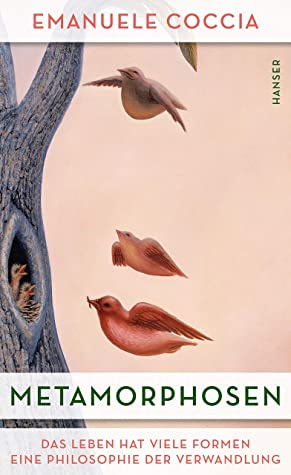
Cover of the German edition of 
Emanuele Coccia's Métamorphoses (2020) 
 
 
I. 
 
One of the things I like about Coccia's book is that he makes mundane things - like eating - sound strange. Most people having a sandwich for lunch tend not to think of this as "more like an alchemical mystery than a physiological necessity" [a], no matter what the ingredients. 
 
But Emanuele Coccia does, and I admire him for that. It's precisely such a level of craziness which makes him a writer and philosopher. He wants to remind readers of the fact that when they eat a chicken salad they "literally incorporate the bodies of other living things" [87]. And quite right, too!
 
I think he's wrong, however, to believe that the reason many people choose to overlook or forget this fact is due to a powerful sense of guilt:
 
"We feel so guilty about this common, banal, everyday, yet miraculous and incomprehensible act that we tend to reduce it to a simple exchange of energy that can be described in terms of pure thermodynamics" [88] 
 
Or, in the case of vegetarians and vegans: 
 
"We feel so guilty about the fact that our lives involve the death of other living beings that we prefer to establish an arbitrary limit, an artificial boundary between living beings that suffer (animals) and those that do not (plants)." [88]       
 
Actually, most people are simply indifferent; they just don't care that they are obliged as heterotrophic beings to life off the lives of other organisms. 
 
Coccia's presumption of guilt is the sign of a moralist who cannot conceive of the fact that most people have no such feeling and don't view food from an ethical perspective (that's why, for example, informing them about the terrible cruelty involved in factory farming has very little effect on their behaviour). 
 
Although, having said that - and if I read Coccia correctly - then he really doesn't want anyone to feel guilty about stuffing plants and animals in their face. For eating is not all about death and it's "a misrepresentation to see the act of eating only as a form of sacrifice and violence" [88]. Eating is the enigmatic transmission of (indeterminate) life - a kind of vitalistic game of pass the parcel and food is "the contemplation of life in its most terrifying universality" [89].

The chicken eats the worm; we eat the chicken; the worm eats us - it is, as Elton and Tim would say, the circle of life. Coccia puts it this way:

"Life goes from body to body, from species to species, never entirely satisfied with the form in which it is found. And that is all eating is: proof that there is only one life, common to all living beings [...] Proof that no barrier of nature, species, or personality can enclose it eternally in one single form, one single species, one single body." [90]
       
And death? Death is only a metamorphic threshold, so not something we should fear. Nothing really dies, says Coccia, everything is just transformed, recycled, and reincarnated. Like eating, dying is a "universal multispecies encounter" [91] which forms a kind of posthumous community beyond all difference and all borders. (Which is fine, but I don't want to be there when it happens ...)
 
In sum: as a thanatologist, I'm neither unfamiliar with nor averse to Coccia's line of thinking on the deathly reality of life and the necessity to eat. Indeed, in a post written back in December 2016, entitled Reflections from a Sickbed, I expressed a preference for a traditional Tibetan sky burial when I die. 
 
In other words, I'm quite happy to be fed to the vultures and don't feel it is in any way shameful or degrading for a human corpse to become food. In fact, I don't even think being eaten alive by a pride of lions or a pack of wolves, is the worst way to die - though as I'm not a vore fetishist, I don't erotically desire this to happen. 
 
Learning to accept ourselves as prey or a potential meal is, as Val Plumwood, realised, crucial to the development of a truly radical ecosophy that rejects the hyperseparation of humans from the natural world [b].     
 
 
II.
 
One of the things I don't like about Coccia's book is that he makes material processes - like death - sound vitalistic. Carbon atoms, for example, may endlessly pass from one body to another, but carbon atoms are not alive, so it's simply not true to say that "the life that animates our body [...] will migrate elsewhere" [99] when we die, like a little bird flying off [c].  

In a sense, I still tend to side with those thinkers who, like Wittgenstein, insist that death is not an event in life and nor is it lived through [d]. Coccia would reject this as a mistaken positing of death as an absolute event and accuse me of dogmatically making a fetish of temporary forms, but there you go. I would rather be accused of doing this - would rather even be guilty of this - than of writing which (at times) veers toward tautological mysticism.  
 
Ultimately, for Coccia even death is just an everyday aspect of the unstoppable dance that is life; whereas for me, following Nietzsche, life is just a rare and unusual way of being dead. 
 
And so, whilst I have myself written a post on atomic reincarnation [click here] which concluded that the living house and reincarnate the carbon atoms of the departed - and that it is in this way the souls of the dead might be said to re-enter and pervade the souls of the living - I do not see this as a form of spiritual continuity or psychic transmigration
 
It is only due to the conservation of mass, that we can legitimately declare ourselves to be all the names in history and Coccia's insistence that the dead think in us, is an ideal misunderstanding of this point. And whilst every self may be multiple, it is not a spiritual reincarnation of the life force and I really don't think it helps matters to borrow the technical terms of theology to discuss this important topic either [e].
 
 
Notes
 
[a] Emanuele Coccia, Metamorphoses, trans. Robin Mackay, (Polity Press, 2021), p. 87. All future page references to this work will be given directly in the main text. 
 
[b] Val Plumwood (1939-2008) was an Australian philosopher and ecofeminist, known for her work deconstructing anthropocentrism. Her posthumously published book The Eye of the Crocodile, ed. Lorraine Shannon, (ANU E-Press, 2012), details her violent and life-changing encounter with a saltwater crocodile in Kakadu National Park, in February 1985. 
      Plumwod first described this incident in the essay 'Human vulnerability and the experience of being prey', in Quadrant, 29 (3), (March, 1995), pp. 29-34. Click here to read online in The Aisling Magazine.       
      Although Coccia mentions Plumwood and the crocodile (pp. 96-98), he informs readers that he primarily developed his idea of reincarnation by way of reflections on the work of the French artist Philippe Parreno. Although he doesn't mention any specific works by the latter, I'm guessing he would have been a big fan of the 2013 exhibition Anywhere, Anywhere Out Of The World. Using sound, image, lights, and the spectral presence of objects, Parreno transformed the monumental space of the Palais de Tokyo in Paris; turning the building itself into a constantly evolving organism.
 
[c] Writing under the influence of Aldo Leopold - whom he describes as "one of the greatest thinkers of the last century" [102] - Coccia seems to believe that atoms are, in a sense, alive and that seeing things from their perspective is philosophically instructive: 
      "Adopting the point of view of the atom [...] is what makes it possible to understand and to demonstrate the absolute continuity, both material and spiritual (subjective), of all life on this planet. [...] Discontinuity is not ontological (death), but purely modal and formal: X and Y - Leopold's atoms - change their mode of being, not their substance." [103]
      See Aldo Leopold, A Sad County Almanac and Sketches Here and There, (Oxford University Press, 1949). 
 
[d] See Ludwig Wittgenstein, Tractatus Logico-Philosophicus (1922), 6.4311.  
        
[e] I know how Coccia would reply to this: he would say I'm one of those who, whilst finding it easy "to imagine the material continuity of the universe", remain "troubled by the idea that this continuity might also apply on a spiritual and speculative level" [104]. 
      That's right: and the reason I find this difficult to accept is because I don't believe in the transmigration of the self and don't believe that "every act of thinking is an exchange of spiritual identity" [107]. Coccia suggests that whenever we utter the phrase cogito, ergo sum we are momentarily allowing "the spirit of Descartes to be reincarnated" [104] in our person. This may be figuratively true, but it's not literally true in the way that the recycling of atoms, or the passing on of genes, is true.
 
 
To read my notes on the Introduction and first chapter of Emanuele Coccia's Metamorphoses, click here
 
To read notes on chapter two ... click here
 
To read notes on chapter four ... click here
 
To read notes on chapter five ... click here


18 Aug 2021

Cocoon Above! Cocoon Below! Notes on Chapter 2 of Metamorphoses by Emanuele Coccia

Emanuele Coccia: Associate Professor at the  
École des hautes études en sciences sociales
 
 
What kind of man likes the idea of shutting himself up in a cocoon? Well, Emanuele Coccia, certainly seems excited by the thought: 
 
"I've often dreamt of it. [...] Cutting off all relations with the world and giving myself over entirely to the transformative workings of matter. Feeling my soul carving itself out and knitting itself together anew, in a new form." [a]   
 
This sounds a rather solipsistic fantasy to me and, personally, I could think of nothing worse than being cocooned in spun silk. 
 
But Coccia is right, however, to argue that metamorphosis is something greater than a conversion or revolutionary change; the two terms in which men (contra caterpillars) usually think transformation:
 
"In conversion it is only the subject that changes: their opinions, their attitudes, their way of being are transformed, but the world remains, and must remain, the same. Only a world left untouched by conversion can testify to the transformation. Conversion is often the outcome of an inner journey, full of trials and revelations, long periods of abstinence and asceticism. Such change presupposes absolute and total self-mastery.
      Nothing could be further from metamorphosis than a conversion." [47]
 
As for the second model of change, revolution:
 
"In this case it is the world that changes; the subject who causes this change and stands surety for the passage from one world to another, cannot themselves be transformed because they are the only witness to the transformation underway." [48]
 
Thus, in a sense, revolution is "as far removed from metamorphosis as conversion" [49]
 
So what then is metamorphosis - and what makes it so unique? Well, according to Coccia:
 
"In metamorphosis, the power that passes through us and transforms us is not a conscious and personal act of will. It comes from elsewere, it is older than the body it shapes, and it operates outside any decision. Above all, there is [...] no negation of a past or a former identity. On the contrary, a metamorphic being is a being that has renounced all ambition to recognize themselves in one face alone." [48]     
 
Unfortunately, whilst that's fine for insects - and Coccia writes a whole section in praise of insects [see pp. 50-54] - we're not metamorphic beings and the only people who renounce all ambition to recognise themselves in one face alone are actors, impressionists, and schizophrenics [b]
 
Just to be clear: I'm as interested in insects as the next man (unless they happen to be an entomologist). I've even written several posts on our six-legged friends: click here, for example, or here
 
But I find it hard to share Coccia's obsession with insect metamorphosis in its various stages and what he terms postnatal eggs (his term for the chrysalis or cocoon built by the larva), even though I do find intriguing his suggestion that to change form "means having the strength to turn one's body into an egg capable of creating and bearing a new identity" [63].  
 
I do worry, however, that this is Coccia's method for reviving the (slightly addled) idea of the mundane egg; a major symbol in creation myths around the world, which even some modern cosmologists have figuratively adopted [c]. The egg, writes Coccia, "is the emblem of the metamorphic state" [63], a line which could have come straight from a theosophical handbook. 
 
More interesting, to me at least, is Coccia's argument that the cocoon-as-postnatal egg must be understood as a question of technics and not simply as something natural or spontaneous; nor as a form of what Ernst Kapp termed Organsprojektion [d]:
 
"According to Kapp any technical object, any instrument, is merely the projection of an organic structure outside the body, in a perfectly isomorphic relationship. The extension of the organ, its projection out of the anatomical body, makes it possible to correct its defects [...] but above all to humanize the world. Thanks to the organ-projection, thanks to technics, the world becomes an extension of the human body." [72] 
 
As Coccia rightly points out, from this perspective, technics is something Allzumenschliches - as if other organisms couldn't possibly be technologically savvy. He's right also to say that in the idea of technics embodied by the cocoon, "the manipulation of the world becomes something that allows us to cast off our own nature, to change it from within rather than project it outward" [73].   
 
Coccia arrives at the interesting conclusion that every technical object is (potentially at least) a cocoon that enables metamorphosis:
 
"A computer, a telephone, a hammer, or a bottle are not just extensions of the human body. On the contrary, they are ways of manipulating the world that render possible a change of personal identity, ethologically if not anatomically. Even a book is a cocoon that makes it possible to reformulate one's own mind." [73]
 
The cocoon, then, for Coccia, is "the paradigm not only of technics, but of being-in-the-world in general" [80]; a kind of transcendental form not only of selfhood, but self-consciousnes, thus proving that "metamorphosis is above all the relationship we have with ourselves" [81] [my emphasis]. 
 
I somehow knew Coccia would say that, as he drifts back into a dream state, seeing cocoons everywhere and enjoying the sensation of being encased in "white, soft silk" [84] like a grub. Still, who am I to criticise if, like Samuel Beckett, his preoccupation with the eternally larval allows him to reimagine the human condition [e].  
 
 
Notes
 
[a] Emanuele Coccia, Metamorphoses, trans. Robin Mackay, (Polity Press, 2021), p. 45. All future page references to this work will be given directly in the main body of text. 
      When Coccia, expanding upon his fantasy of becoming-unrecognisable, describes seeing wings sprout from his body one is reminded of something that Seth Brundle famously said: "I'm an insect who dreamt he was a man and loved it. But now the dream is over and the insect is awake." See David Cronenberg's 1986 film The Fly, starring Jeff Goldblum as Seth Brundle.  

[b] I suppose Coccia might argue that insects didn't originally possess the ability to metamorphose either - that this was something that evolved over time. And so perhaps people too, in some distant future, might be able to "condense within the formal plurality of a single individual existence the impulse towards the multiplication of forms", thereby making planetary biodiversity into "a question of personal virtuosity" [50]. 
      It should be pointed out, however, that in the absence of an exoskeleton, it seems highly unlikely that this will ever come to pass outside of fiction, such as Kafka's Die Verwandlung (1915) and George Langelaan's 'The Fly' (1957), although maybe certain religious-minded people who believe in reincarnation or metempsychosis might claim that metamorphosis is already a human reality.          

[c] Following Edwin Hubble's experimental observations of the universe's constant expansion in 1929, Georges Lemaître proposed that what he had earlier described as a primeval atom might better be thought of as a cosmic egg, from which the universe had hatched. Understandably, not all physicists welcomed the idea (not least because it created the need for a cosmic chicken). 

[d] See Ernst Kapp, Grundlinien einer Philosophie der Technik, (1877), one of the first books on the nature of modern technology by a philosopher. It has recently been translated into English, by Lauren K. Wolfe, as Elements of a Philosophy of Technology, (Minnesota University Press, 2018).   

[e] For a prize-winning essay on Beckett's thinking on the eternally larval (as well as what he called the worm-state), see Rachel Murray, 'Vermicular Origins: The Creative Evolution of Samuel Beckett's Worm', in the Journal of Literature and Science, Vol. 9, No. 2 (2016), pp. 19-35. 
      See also Murray's fascinating book on the role of insects in modern literature; The Modernist Exoskeleton, (Edinburgh University Press, 2020). A revised version of the above essay appears as chapter 4, following on from a chapter on Hilda Doolittle's experimental writings on the cocoon, in which the author contends (in a similar manner to Emanuele Coccia) that the latter not only has a protective function, but allows the self to respond to its surroundings in new ways. 
 
 
To read my notes on the Introduction and first chapter of Emanuele Coccia's Metamorphoses, click here
 
To read notes on chapter three ... click here
 
To read notes on chapter four ... click here.  To read notes on chapter five ... click here


17 Aug 2021

Kill Me Now: Notes on the Introduction and First Chapter of Metamorphoses by Emanuele Coccia

(Polity 2021)
 
 
I. 
 
Emanuele Coccia has called his new book Metamorphoses. But he may as well have called it Pantheism, because what this book primarily affirms is the "unity of all living things [...] and the unity of the living being with the matter of the world" [a]
 
According to Coccia, pantheism is a hidden tradition with a repressed history within philosophy; a claim which, like many others in this book, is one I doubt the veracity of. For it might be argued, that philosophers simply prefer to use the less religious-sounding term monism to describe unity and the peculiar satisfaction that it gives some people to announce that All is One.

Anyway, let's get down to business ... 

As well as an Introduction and Conclusion, there are five chapters in this book: Births, Cocoons, Reincarnations, Migrations, and Associations. Here, in part one of the post, I'll discuss the first of these chapters and the Introduction.
 
 
II. 
 
Coccia opens his Introduction with a three-word phrase even more provocative than I love you: In the beginning ... 
 
Obviously, he knows this is the opening phrase of the Bible; a translation of the Classical Hebrew expression Bereshith [בְּרֵאשִׁית‎]. And whilst one hopes he's using it with a certain irony, I do worry that he's preparing the way for a religious narrative to follow. 
 
Anyhoo, in the beginning, says Coccia, "we were all the same living creature, sharing the same body and the same experience" [3]. I suppose that's true enough - banal, but true enough [b]. But we might wish to challenge Coccia's following sentence: "And things haven't changed so much since then." [3] 
 
For this is said as if the new forms and modes of existence which have proliferated in the 3.5 billion years since LUCA (Last Universal Common Ancestor), hardly matter; as if all that really counts is the life force which animates them. For life, clearly, is the essential for Coccia, who, I suspect, would like to write the word with a capital L if he dared.    
 
Coccia challenges his readers to accept the "deepest meaning of the Darwinian theory of evolution" [5] - the one that biologists (allegedly) don't like to think about, as it means regarding species as life games, i.e., "unstable and necessarily ephemeral configurations" [5], rather than substantial entities.     
 
Coccia also wants readers to come to terms with the fact that, as Nietzsche put it, being alive is only a rare and unusal way of being dead:
 
"There is no opposition between the living and the non-living. Not only is every living creature continuous with the non-living, it is its extension, metamorphosis, and most extreme expression." [5]
 
Again, that's true enough, but it's nothing very new; thanatologists, including myself, have been pointing this out for years now: click here, for example, to read a post based on an essay from 2006 in which I attempted to dissolve the distinction between life and death. 
 
And, what's more, some of us have also dared to draw the consequences from this fatal truth; we realise that if all life is essentially the same, then a human life has no more inherent value than that of a cockroach [c], and if there is no difference between living things and the world of dead matter, then there's no point crying over species facing extinction, for example.    
 
This - to use Coccia's own phrase - is the deepest meaning of nihilism and why Ray Brassier is right to argue that philosophy's destiny (and duty) is to acknowledge the fact that "thinking has interests that do not coincide with those of the living" [d].
 
  
III.
 
Does Coccia share this view? Maybe. Take a look at this sentence, for example:
 
"Our adult life form is no more perfect, no more 'us', no more human, no more complete than that of the bicellular embryo that comes directly after the fertilization of the egg ..." [8]  
 
Is Coccia making the metaphysical claim that the soul enters at conception? Is he demanding full rights for the unborn? Or is he suggesting, rather, that it would be fine with him were we to abort human beings at any stage of their development - even long after birth - since each and every form "has the same weight, the same importance, the same value: metamorphosis is the principle of equivalence between all natures" [9]
 
If all life is just a game of forms played out on the same plane - and that plane is material actuality (i.e. death) - then it makes perfect sense to say that an embryo is the same as a foetus, a foetus is the same as a baby, and a baby is the same as an adult. It just becomes a question of whether you think their value is inestimable or zero. 
 
 
IV.
 
Coccia makes a big deal of the fact that, like the rest of us, he was born to parents, who were themselves born of their parents, who were born ... well, you get the idea: "Birth is not simply the emergence of the new, it is also the erratic wandering of the future through a limitless past." [14] 
 
He thinks we are too forgetful of this, although the fact that there's a multibillion dollar birthday industry might suggest otherwise; as might the fact that Happy Birthday to You is the most sung song in the world [e].   
 
Coccia, the proud parent of a young daughter, Colette, to whom he dedicates this book, is clearly still in the flush of first-time fatherhood. Thus it is that everything about pregnancy, birth, and babies seems miraculous and makes him gush to his readers about how special his child is:
 
"She arrived barely five years ago and she has changed everything around her, and around me: she has lit up worlds through which she has travelled with a joy and a grace I had never before encountered. She knows all the secrets of metamorphosis - and she has revealed a few of them to me." [x]

If that's the case, then one rather wishes that Colette had written the book ... Perhaps if she had, we would've avoided being told in a section entitled 'Birth and Nature' that there is "nothing more universal" [19] than birth; something that makes me as impatient as it made Roland Barthes over sixty years ago. 
 
In 'The Great Family of Man', Barthes demythologises the idea that events such as birth and death can be understood outside of history:

"Birth, death? Yes, these are facts of nature, universal facts. But if one removes History from them, there is nothing more to be said about them; any comment about them becomes purely tautological. [...] For these natural facts to gain access to a true language, they must be inserted into a category of knowledge which means postulating that one can transform them, and precisely subject their naturalness to [...] criticism. [...] True, children are always born but in the whole mass of the human problem, what does the 'essence' of this process matter to us, compared to its modes which [...] are perfectly historical? Whether or not the child is born with ease or difficulty, whether or not his birth causes suffering to his mother, whether or not he is threatened by a high mortality rate, whether or not such and such a type of future is open to him [...]" [f] 
 
This is the sort of thing that Coccia's book might have usefully reminded us, instead of fobbing us off with lyricism surrounding the fact of birth: "To be born [...] is to experience being a part of the infinite matter of the world [...] It is always Gaia who says 'I' in us." [21] [g]
 
To which I can only say kill me now, or let's move on ... 
 
Every now and then, we come to something that might be interpreted as a philosophical statement. For example; "multiplicity is not simply arithmetical, and it does not negate the profound unity [...] of all living beings" [27]
 
But isn't that just saying what Deleuze and Guattari reduced to a simple equation: Pluralism = Monism [h] ...?
 
This is the magic formula which Deleuze learns from his readings of Spinoza and Nietzsche and one might have hoped that Coccia would have at least referred to this. But he doesn't. I don't know why. Perhaps it's because he's worried about becoming trapped in "the enclosed courtyard of traditional books, subjects, and arguments, all sanctioned as 'properly philosophical' by an arbitrary and culturally quite limited canon" [i].    
 
Whatever the reason, Coccia seems unwilling to reference Deleuze; even when, later on in the chapter, he meditates on difference and repetition: "We are all a repetition of a past life. [...] Yet in being so expressed, the past is [...] rearranged, arbitrarily reconstituted, transfigured." [34] 
 
I would've thought this was the perfect opportunity to at least mention Deleuze's powerful critique of representation; one that develops concepts of difference and repetition that are metaphysically prior to any concept of identity [j].
 
Instead, Coccia chooses to discuss the symbolic theory of Sándor Ferenczi - "one of Freud's most brilliant and heterodox students" [34] - who offers such astonishing insights as this: "there is a 'symbolic identity of the womb with the sea and the earth on the one hand, and of the male member with the child and the fish on the other'" [36] [k]
 
I've said it before - and I very much suspect I'll be forced to say it again whilst reading this book - kill me now!
 
 
Notes
 
[a] Emanuele Coccia, Metamorphoses, trans. Robin Mackay, (Polity Press, 2021), p. viii. All future page references to this work will be given directly in the post. 
 
[b] Coccia's opening reminds me of D. H. Lawrence's Introduction to Fantasia of the Unconscious (1922), in which he writes: "In the beginning was a living creature, its plasm quivering and its life-pulse throbbing." See Fantasia of the Unconscious, ed. Bruce Steele, (Cambridge University Press, 2004), p. 69.   

[c] This is not say that you can't value a human life above that of a cockroach, only that this is a matter of personal preference (or prejudice) and has no real foundation as the same life flows through both. The case of Gregor Samsor is obviously instructive here: click here for my take on Kafka's story.
      Later, in a section entitled 'Metamorphosis as Destiny', Coccia again says something that potentially has fatal consequences; namely, that every metamorphic being "is composed and inhabited by [an] otherness, which can never be erased" [38]. If that's the case - if we carry within us everyone and everything, including all other peoples and all other species, then why does it matter if we exterminate them? 
      In some ways, Coccia reminds me of Walt Whitman who has, as D. H. Lawrence would say, broken the mainspring of his own singular being and now asserts: I am everything and everything is me! as he attempts to become in his own person "the whole world, the whole universe, the whole eternity of time". He cannot accept that outside the egg of his Allness, there is genuine otherness, which he is not and cannot become. See the final version (1923) of Lawrence's essay 'Whitman', in Studies in Classic American Literature, ed. Ezra Greenspan Lindeth Vasey and John Worthen, (Cambridge University Press, 2003), pp. 148-161. The line quoted above is on p. 151.              
 
[d] Ray Brassier, Nihil Unbound: Enlightenment and Extinction, (Palgrave MacMillan, 2007), p. xi.

[e] Later in the chapter, Coccia writes: "Our society is still based on the cult of the dead [...] Birth, on the other hand, remains a mystery and a taboo. [...] We barely talk about it or celebrate it [...]" [25]. This, however, is patently not true; a friend of mine has just had a baby and she never shuts up about the fact, both in person and on social media. And whilst Christian culture attaches great importance to the death of Christ, do we not also celebrate Christmas and Easter - his birth and resurrection?
      To be fair, Coccia, concedes that Christ's nativity is a familiar theme in European art, but argues that what is depicted "is no ordinary birth, but a unique, one-off, unnatural event" [30]. In other words, Christian theology places the birth of Christ outside of any naturalistic framework in order to emphasise its miraculous character.
      Like Nietzsche, who also holds Christianity responsible for throwing filth on the actual origins of life, Coccia argues that we need to liberate ourselves from "this two-thousand-year-old legacy" [32] and reverse its central teachings. However, whereas for Nietzsche this involves reviving the Dionysian mysteries, in order to ensure that every aspect of procreation, pregnancy, and birth awakens the most exalted and solemn feelings, for Coccia, we would do better to imagine that, if God participates in birth, then "he must be incarnated in any natural being whatsoever: an ox, an oak tree, an ant, a bacterium, a virus" [32]. Thinking along this pantheistic line obliges us to see every birth as "a transmission of the divine substance, but above all as a kind of metamorphosis of the gods" [32].
      See the section entitled 'Carnival of the Gods' in chapter one of Metamorphoses, pp. 30-33. And for Nietzsche's Dionysian take on this question, see section 4 of 'What I Owe to the Ancients', in Twilight of the Idols.
 
[f] Roland Barthes, 'The Great Family of Man', in Mythologies, selected and trans. Annette Lavers, (The Noonday Press, 1991), pp. 101-102. 

[g] For those who don't know, Gaia is the primordial Greek goddess and personification of the Earth; she whom all living beings call mother. As well as Ovid's Metamorphoses, Coccia openly admits that his book has been written under the influence of the Gaia hypothesis put forward by James Lovelock and Lynn Margulis [182]. It's their work which he wishes to deepen and radicalise, with sentences like this: "Being born means that we are part of this world: we formally and materially coincide with Gaia, with her body, her flesh, her life force." [37]. Obviously, as a reader of Nietzsche, I'm extremely cautious of those who deify nature or believe the earth to be a living being; see The Gay Science, III. 109.      
 
[h] This formula can be found in Deleuze and Guattari, A Thousand Plateaus, trans. Brian Massumi, (University of Minnesota Press, 1987), p. 20. Deleuze was also influenced in his thinking on this subject by the medieval philosopher Duns Scotus, from whom he borrowed (and adapted) the doctrine of ontological univocity.     

[i] Emanuele Coccia, The Life of Plants, (Polity Press, 2019), p. 167. 
      It's from sentences like this that Coccia attempts to draw what Foucault termed speaker's benefit. That is to say, sentences like this make him appear to be a bit of a rebel, or an outsider, challenging the established order, etc. Which is a bit rich, coming from a man who lectures at the École des hautes études en sciences sociales (EHESS), one of the most selective and prestigious educational establishments in all France. 

[j] I'm referring, of course, to Deleueze's Différence et Répétition, (Presses Universitaires de France, 1968), trans. into English by Paul Patton, (Columbia University Press, 1994).
 
[k] Coccia is quoting from Sándor Ferenczi, Thalassa: A Theory of Genitality, tras. Henry Alden Bunker, (Norton, 1968), p. 45. 


To read my notes on chapter two of Emanuele Coccia's Metamorphoses, click here
 
To read notes on chapter three ... click here
 
To read notes on chapter four ... click here
 
To read notes on chapter five ... click here