Laurence Olivier as Richard III in the 1955 film of that title
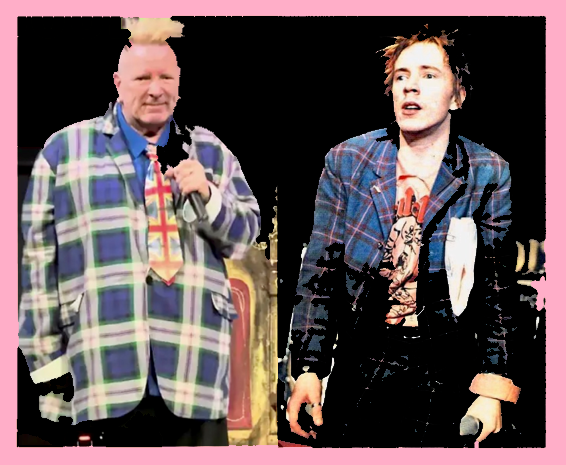
John Lydon as Johnny Rotten on stage with the Sex Pistols (1976)
Max Wall as Professor Wallofski (c. 1975)
"Hello to you out there in normal land
You may not comprehend my tale or understand" [a]
I.
As someone who has written on Johnny Rotten as an abject antihero - i.e., one existing outside of social expectations and moral standards in a manner that unsettles conventional notions of identity and what constitutes a normal body - I was naturally curious to read Karen Fournier's contribution to The Routledge Handbook of the Sex Pistols (2026).
Titled 'John Lydon's Unruly Body', the chapter examines the idea of punk posture with reference to Rotten's televised live performance of 'Anarchy in the U.K.' [b].
Fournier opens by saying that disability studies has "much to offer studies of punk, where singularity has been prized over conformity, normativity has been rejected either as malevolent or banal, and regulations against outward expressions of difference have been challenged" (357) - and I agree with that, though wonder if the reverse might also be true (something to be discussed another day perhaps).
II.
Key, of course, to disability studies, is challenging the notion of a bodily norm, which is viewed as "a social construct whose primacy stems from decisions made by those whose bodies are deemed 'normative'" (357) - i.e., healthy, attractive, able and upright. Those with bodies that don't conform with this ideal or adapt themselves to the world shaped by it are, says Fournier, "marginalized (and in some cases physically locked out) as the corporeal 'other'" (357).
I pretty much agree with this, although I do now struggle with some of the language used. Terms such as 'marginalisation' and 'otherness' may remain standard in the humanities and social sciences, but I worry that they have lost much of their original sparkle - not simply because of their overuse in academia, but also their misuse by corporations and the media who adopted this vocabulary in order to virtue signal.
I'm not quite sure what can be done about this: I'm not calling for a return to plain English (I hate plain English as much as I despise common sense). But I do think that critical theory needs - at some point - to put its thinking cap on and come up with some new concepts and discursive frameworks.
Anyway, let's return to Fournier's essay ...
III.
"Punk transgressed against bodily and neurotypical ideals by inviting its participants to celebrate unique expressions of bodily difference" (357), says Fournier.
And one immediately thinks of the important role played by Helen Wellington-Lloyd in the Sex Pistols' story; as Malcolm McLaren's confidante, as a close friend and follower of the band, and as the woman who originated the iconic ransom-note typography later developed by Jamie Reid.
Yet there's no reference to Helen of Troy in Fournier's chapter ... In fact, there isn't a single mention of her in the entire 538-page book! You'll find Jordan, Vivienne, and Siouxsie Sioux in the index, but not Helen. I find that not only surprising, but deeply disappointing.
What's the point of writing about the marginalisation of those with extra-ordinary bodies whose "abilities are ignored" (357) if you are then going to overlook a woman who frequently spoke of her experiences as a visible outsider due to her dwarfism? [c]
Rotten makes an interesting case study - he lives with permanent physical impairments, such as curvature of the spine and deteriorating eyesight, due to contracting meningitis as a child - but I'm not sure he makes a more interesting case study than Helen and it's worth noting that he does not publicly identify as disabled (even if disability activists and scholars such as Fournier like to think of him as such).
IV.
According to the punk scholar Mary Fogarty, cited by Fournier, the "dominant corporeal paradigm" (357) marked by good (non-hunched) posture, was inverted by Rotten and in her 2021 study [d] she "provides a model for interpreting John Lydon's performance aesthetic as the lead singer of the Sex Pistols" (357).
Building on Fogarty's work, Fournier wishes to put forward an idea of postural incorrectness. She also wishes to examine how critics of punk were disconcerted (and even felt themselves intimidated) by the "hunched back anti-Christ with green teeth" that was thought to be Johnny Rotten - even though, as we now know, he was really "just another juvenile Bill Grundy serving time on Virgin Records" [e].
The moral panic - which was largely a media frenzy following the Grundy incident - was entirely manufactured. The Sex Pistols boosted circulation on Fleet Street; they didn't threaten anything - not even the UK pop charts where the old order pretty much prevailed. The biggest selling acts in 1977 - the so-called Summer of Hate - were not the Sex Pistols, The Damned, and The Clash, but Wings, ABBA, Fleetwood Mac and Boney M.
V.
Having said that, some people were genuinely outraged and disgusted by the Sex Pistols and they were, as Fournier indicates, not simply criticised but pathologised through "various allusions to physical and mental illness" (359). Punk rock could not only make sick and drive fans insane, it could "undermine the moral health of the nation" (359).
Such a characterisation of punk as a disabling disease and type of corruption rested, says Fournier, "on false, but sadly persistent, equivalencies between a [...] healthy body and moral fitness" (359-60). Johnny Rotten's deviant behaviour was somehow born of the way he held himself - with his body's nonconformity. He didn't think straight, because he refused (or failed) to stand up straight, sit still, or comb his hair.
I don't recall anyone describing the Sex Pistols as Lebensunwertes Leben, but the Tory councillor Bernard Brook-Partridge did fantasise about dropping them down a very large and exceedingly deep hole, suggesting that their complete and utter non-existence would be a blessing for them and mankind [f].
Referencing the work of the disability theorist Toby Siebers [g], Fournier explains how "the dehumanization of those who embody physical or intellectual difference" (360) can quickly lead to such murderous language, which, even when spoken in jest, can have ugly consequences: readers may recall that many punks were violently assaulted on the streets because of the way they looked - including Rotten and Sex Pistols drummer Paul Cook.
VI.
Punk, then, for Fournier is radically anti-ableist and refused to "embrace standards of beauty" (360) health, and hygiene that were then "idealized and enforced by the hegemonic culture that prevailed at the time" (360). It celebrated the unruly body which "signaled corporeal difference in ways that became the visual hallmarks of the subculture" (360) - dyed hair, dramatic makeup, unusual piercings, etc.
That's true enough. But is it equally true that "the dominant culture's response was to incite fear and loathing about disability" (361) ...?
I don't think so.
Fournier mentions Ian Dury - a performer with lifelong disability caused by contracting polio as a child - and says he was provided with a "welcoming space" (360) by those on the punk scene.
However, he was also welcomed onto Top of the Pops, making numerous appearances on the popular BBC show loved by mums and dads as much as the kids and this would suggest that mainstream culture had rather less of a problem with disability than Fournier is claiming.
Let's just say things were a little more complex in the UK at this time than she appears to believe: thus, while Dury's 'Spasticus Autisticus' was banned by the BBC, in the same year, 1981, he was interviewed on the Saturday night chat show Parkinson [h].
VII.
Reflecting many years later on "the performance aesthetic that defined his Johnny Rotten persona" (361), Lydon claims it was modelled in part on Laurence Olivier's 1955 film portrayal of Richard III.
And, yes, I can see that.
But how far we can rely on Lydon as a narrator even of his own life is debatable. It could be that this connection now seems so plausible and easy to visualise because Julien Temple juxtaposed clips of Rotten's performance with those of Olivier in The Filth and the Fury (2000) and seeing is believing in this age of the screen.
I'm not denying that Rotten had a unique (and truly astonishing) stage presence. Jon Savage's description of him as a "'mesmeric [and] spastic pantomime villain'" (quoted by Fournier, 361) is pretty spot on. However, I am a little more cautious than Fournier when it comes to explaining Rotten's "embodied performance aesthetic" (361) in terms of childhood illness.
To be clear: I'm not suggesting he simply staged disability for dramatic effect. But I'd like to see the medical evidence confirming that it was meningitis that caused Johnny's Rottenness and not his fascination with Richard III and love of music hall comedians - such as Max Wall, whose iconic persona Professor Wallofski has been widely cited by cultural critics and music historians as a direct visual and theatrical precursor to the Sex Pistols' frontman [i].
VIII.
I have to say, Fournier's frightfully earnest reading of 'Anarchy in the U.K.' made me smile.
Beginning with the claim that the song "highlights what the Sex Pistols viewed as the glaring contradictions between Britain's claims to democracy [...] and its marginalization of large swathes of its population" (362), Fournier then suggests that, as an "Irish outsider" [j], Rotten had "personal experience of racism and classism in Britain" (363) and had come as an avenging angel and anti-Christ to warn us all about the destructive dangers of "scapegoating and political divisiveness" (363).
And what's more, "as a performed, embodied work, the song's anarchist also invites the listener-viewer to examine how the 'non-straight' body has been caricatured, vilified, and ostracized in a society that enforces bodily norms and neuro-conformance" (363).
Wow! All that in a three-and-a-half-minute pop song and an amazing live performance of said song on So It Goes (28 August 1976). I'm all for sophisticated and imaginative critical interpretations - and I think it would be mistaken to simply dismiss what Fournier says - but I worry that she overly burdens the song with theoretical weight and the kind of oppressive seriousness that Nietzsche termed the spirit of gravity.
IX.
Fournier next supplies us with a "short account of the song's formal and harmonic structure" (363). As I know absolutely nothing about such things and care even less - We're not into music ... We're into chaos [k] - I'll skip this part of the text.
Her reading of Rotten's physical performance of the song, however, is very interesting and I feel that I learnt quite a lot about the subject. And about what differentiates punk from standard forms of rock: the latter leaps and thrusts and wishes to signify "male power and virility" (365), whereas the former slouches and unsettles rock's hyper-masculinity.
At one point, Fournier describes Rotten's body as abject - a concept which takes us back to an earlier post on Torpedo the Ark I mentioned at the top of this one, and I really wish she had developed this idea as it's always nice to include a bit of Kristeva in one's work.
This wonderful quote, for example, from Kristeva's 2003 essay 'Liberty, Equality, Fraternity, and ... Vulnerability' on why disability triggers societal anxiety could have served as a great epigraph for Fournier's chapter, or, indeed, a memorable clincher or closing idea:
"The disabled person opens a narcissistic identity wound in the person who is not disabled; he inflicts a threat of physical or psychical death, fear of collapse, and, beyond that, the anxiety of seeing the very borders of the human species explode." [l]
However, she chooses to close it on (and in) her own terms, asserting that, for Rotten - or Lydon as she prefers to call him - live performance "provided a platform to challenge myths about beauty and virility [...] to defy our preconceptions about the entertainment industry" (368).
His onstage persona and performance also invite the viewer "to consider how expectations about the body have been used to determine the value of some people over others" (368). For Lydon, she concludes, "the best way towards a society that will embrace difference is to break apart existing political structures [...] and to embody, or to be, anarchy" (368).
Notes
[a] Lyrics from the song 'Spasticus Autisticus', written by Ian Dury and Chas Jankel. The song was released as a single and included on Dury's second solo album Lord Upminster (Polydor, 1981). For more details, see note [h] below.
[b] Karen Fournier, 'John Lydon's Unruly Body: Punk Posture and "Anarchy in the UK"', in The Routledge Handbook of the Sex Pistols, ed. Mike Dines, Gabriela Gelain, Paul Graves-Brown and John Schofield (Routledge, 2026), pp. 357-370. Page references to this text will be given directly in the post.
[c] Wellington-Lloyd was born with achondroplasia, a genetic condition that causes dwarfism, which, following the Equality Act (2010), is legally recognised in the UK as a disability.
[d] Mary Fogarty, 'The Art of Slouching: Posture in Punk', in The Oxford Handbook of Punk Rock, ed. G. McKay and G. Arnold (Oxford University Press, 2021).
[e] These characterisations of Rotten are spoken by the narrator of the trailer for The Great Rock 'n' Roll Swindle (dir. Julien Temple, 1980) - the veteran BBC newsreader John Snagge. Fournier picks up on the first, but doesn't consider the second (i.e., that Rotten was a fraud and basically acting the part of a physically and morally twisted individual). I'll return to this point later in the post (see section VII).
[f] A filmed interview with Bernard Brook-Partridge was included in The Great Rock 'n' Roll Swindle by Julien Temple, and this can be viewed on YouTube by clicking on the link provided.
[g] Toby Siebers, 'Disability and the Theory of Complex Embodiment: For Identity Politics in a New Register', in The Disability Studies Reader, ed. L. J. Davis (Routledge, 2016), pp. 272-291.
[h] The BBC banned the song because they considered the lyrics offensive and were uncomfortable with the fact that Dury wrote it not so much to promote disabled rights, as to protest against the International Year of Disabled Persons, which he considered to be patronising bullshit.
Dury appeared on Michael Parkinson's hugely popular and long-running BBC One chat show Parkinson on 7 November, 1981, alongside fellow guests Arthur Scargill and Diana Dors, and he discussed contracting polio at age seven in 1949 and how the illness affected the left side of his body.
[i] Rotten's stage persona shared striking physical parallels with Max Wall's Professor Wallofski, including hunched shoulders, double-jointed limbs, manic glare, funny walk, and erratic movements. Both men revelled in being grotesque clowns who disconcerted as well as amused audiences with their confrontational stage acts.
[j] The question of Rotten's Irishness - he was the child of Irish parents, but born and raised in London - is discussed in another chapter in The Routledge Handbook of the Sex Pistols; see Michael Mary Murphy, 'From Eire Prison to Eurovision: The Sex Pistols and John Lydon in Irish Culture', pp. 225-237.
[k] As Steve Jones famously told a journalist in February 1976, following a gig at the Marquee Club (where they opened for Eddie and the Hot Rods). The interview with the Sex Pistols - by Neil Spencer - appeared in the NME (21 Feb 1976).
[l] Julia Kristeva, 'Liberty, Equality, Fraternity, and ... Vulnerability', in Hatred and Forgiveness, trans. Jeanine Herman (Columbia University Press, 2011), p. 29.
This post is one in a series on chapters contained in The Routledge Handbook of the Sex Pistols. Already published are:
13 Nov 2026: 'The Surrealist Sex Pistols According to Marie Arleth Skov'
17 Nov 2026: 'It Had to Be Brazil'
21 Nov 2026: 'Telemorphosis: the Sex Pistols on Screen'
Whether I will write posts on all 33 chapters in the above work - or, indeed, even read them all - is unlikely, but it's possible one or two more posts in this series will follow in due course.