12 Sept 2021

Demon Cats (With Reference to the Case of Pixel)

Daemonium cattus (SA/2021)


I. 
 
Reflecting on the above picture, an Irish friend of mine expressed her concern that a demon may have taken possession of my cat in order to gain easy access not only to my home, but to my soul. I told her I thought this unlikely, but promised I would be on my guard and let her know if anything strange were to happen.  
 
Whilst I think Gaelle was only joking, it's interesting how the sensuous figure of the cat - particularly the black cat - continues to carry with it a long history of symbolism and superstition; one might think that the Devil himself has whiskers, rather than horns.     
 
Obviously, things have improved somewhat for our feline friends since medieval times, when they were so closely associated with witchcraft and the forces of evil that, in 1484, Pope Innocent VIII issued a papal bull condemning all cats - and their human companions - to death. 
 
But, even today, in some quarters the old fear and stupidity persists ... And so we come to the case of Pixel ...
 
 
II.

Image credit: Kennedy News and Media

 
A rather unique-looking pussy in Green Bay, Wisconsin, has been dubbed a hellcat by an exorcist who has urged the owner, Alyson Kalhagen, to cage him and pray, until the demon that possesses her two-year-old Cornish Rex has departed.
 
Ms. Kalhagen intended to showcase the beauty and refinement of Pixel by posting photos of him online. Unfortunately, the response she received wasn't quite what she hoped for, as numerous people declared that Pixel was, at the very least, the creepiest cat on the internet, if not actually devil-spawn
 
Others likened Pixel to a werewolf, a vampire bat, or a character from a Tim Burton film ... 
 
Happily, Ms. Kalhagen just laughs away these comments and continues to adore Pixel, insisting that, despite his rather startling features, he's actually a very sweet-natured cat - as well as one with over 12,000 followers on social media.*  

 
* Note: any reader interested in becoming one of these followers may care to visit the Facebook page Pixel shares with his blue-eyed, white-furred sister, Sophie: click here. Or, if you prefer, you can find Pixel and Sophie on Instagram: click here. 


11 Sept 2021

FOMO (Fear of Missing Out)


FOMO - the fear of missing out - is a form of social anxiety stemming from the belief that other people might be having fun whilst you are stuck at home checking your social media feeds, or writing your blog [1].
 
Of course, no one likes to feel that opportunities to interact with others, enjoy new experiences, or witness memorable events are passing them by; no one wants to be left out of the loop. And so, in a sense, FOMO is justified. However, as Nietzsche reminds us, life is all about making choices and to choose is to forgo.
 
In other words, whatever you decide to do (or not to do), you are instantly renouncing all other possibilities and everything else that would follow as a result. Thus, human life will always produce feelings of regret because it will always involve the existential dilemma of choice. 
 
We are, if you like, Fomo sapiens and even those showoffs who compile lengthy bucket lists, don't get to go everywhere, do everything, meet everyone, etc. Having said that, however, we can refuse regret, like Edith Piaf, and we don't have to let FOMO become a pathological form of anxiety. If we can curb our enthusiasm, so too can we curb our fear of missing out.
 
And who knows, there may even be an endless number of parallel universes, with countless versions of you, doing all the things you think you are missing out on doing here in this life, in this world [2] ...         
 
 
Notes
 
[1] If you read the Wikipedia entry on this topic, you'd think that the fear of missing out is a relatively new phenomenon; one first identified by a marketing strategist in 1996. But that, of course, is nonsense. Social media may have intensified the experience - and the acronym FOMO may be of recent invention - but the fear of missing out has long predated the internet. 
      Indeed, readers of D. H. Lawrence will be familiar with the character of Owen Rhys; an American playboy and poet, keen to experience all that Life might have to offer, no matter how sordid or ghastly. Owen is constantly: "Swept with an American despair of having lived in vain, or of not having really lived. Having missed something. Which fearful misgiving would make him rush like mechanical steel fillings to a magnet, towards any crowd in the street. And then, all his poetry and philosophy gone with the cigarette-end he threw away, he would stand craning his neck in one more frantic effort to see - just to see. Whatever it was, he must see it. Or he might miss something."
      - See D. H. Lawrence, The Plumed Serpent [1926], ed. L. D. Clark, (Cambridge Unversity Press, 1987), p. 28. And see also my recent post written in defence of Owen Rhys: click here.
 
[2] This is just one of the consoling theories - I almost wrote fantasies - of quantum physics. In brief - and as far as I understand it - according to the Many-Worlds Interpretation, every event that has multiple possible outcomes splits the world into alternate realities (none of which interact or influence one another in any way). Obviously, it's a highly contentious idea - one which many theorists dismiss as not merely flawed (because based on an overly-simplistic account of quantum mechanics), but absurd. Stephen Hawking, however, was a fan, describing the MWI as self-evidently true
      Those who wish to know more about this can click here to read an entry on the subject in the Stanford Encyclopedia of Philosophy.    


In Defence of Owen Rhys and the American Way of Life (The D. H. Lawrence Birthday Post 2021)

 
Portrait of Witter Bynner (1919) upon whom D. H. Lawrence 
based the character of Owen Rhys in The Plumed Serpent (1926)
 
 
I. 
 
Whilst there may be some aspects of the American way of life I feel uncomfortable with, I would, nevertheless, prefer to live in the United States than in the Islamic Emirate of Afghanistan; or, indeed, in any country where political power is exercised by religious leaders who act in the name of a deity with whom supreme authority is said to rest.  
 
And that's because, when all is said and done, theocracy is just about the worst of all forms of government. And that remains the case even when the theocracy is neopagan in character, full of dark gods waiting in the outer darkness, as imagined by D. H. Lawrence in The Plumed Serpent (1926).
 
Hopefully, I have made my thoughts on this novel and some of its central characters clear in a number of earlier posts: click here, for example, or here. So, in order not to simply repeat old material, I'd like in this post to offer a few thoughts on one of the minor characters; Kate Leslie's American cousin, Owen Rhys ... [1]
 
 
II. 
 
Rhys is a 40-something homosexual [2] with a Chinese jade collection and a very definite bald spot; a poet, keen to experience all that life might have to offer, no matter how sordid or how upsetting he may find it. He is, writes Lawrence, possessed of an almost maniacal will-to-happiness and a determination to treat everything as a game
 
It's fairly obvious that the narrator of the novel does not approve of him. And whilst Kate is really fond of her cousin, how could she respect him, when he was so empty and "waiting for circumstance to fill him up" [3]
      
Ultimately, Owen tried her patience and she was relieved when he had to return to the United States [4] - or the great death-continent, as Kate likes to imagine it [5].
 
Be that as it may, Rhys and his young lover, Bud Villiers, are surely preferable to Ramón and Cipriano, the spiritual and military leaders of the revolutionary fascist movement that aims to reintroduce Aztec gods back into history via an awakening of racial mysteries and the establishment of a theocracy on national socialist lines [6].      
 
And whilst Rhys may display many of the characteristics that Lawrence associates with sensational white America - such as the insidious modern disease of tolerance and the fear of missing out - we might ask ourselves if these traits are really so bad when compared to the atrocities committed by armed militants using terror to impose their religious beliefs? 
 
Better the cult of the dollar, than the cult of Quetzalcoatl; better the World Trade Center, than any sacred site or holy place; and better Owen's desire to play with his own emptiness, than Ramón's portentous prognosticating ... [7]   

 
Notes
 
[1] The character of Owen Rhys was based on the poet and translator Witter Bynner (1881-1968), who associated with many of the leading literary figures of his day, including Lawrence, to whom he and his lover Spud Johnson were introduced by Mabel Dodge Luhan.   
      Bynner had moved permanently to Santa Fe in the summer of 1922. The following year, he and Johnson joined the Lawrences on a trip to Mexico. Whilst Lawrence fictionalised elements of this in The Plumed Serpent, Bynner published a memoir based on recollections of his time with Lawrence entitled Journey with Genius (1951). 
      For full details of the Lawrence-Bynner relationship, see the third volume of the Cambridge biography, D. H. Lawrence: Dying Game, 1922-1930, by David Ellis, (Cambridge University Press, 1998). See also the essay by D. A. N. Jones, 'Whacks', in the London Review of Books, Vol. 4, No. 4, (4 March, 1982): click here to read online. 
 
[2] Although in The Plumed Serpent the question of Rhys's sexual orientation is left vague, in the first version of the novel - Quetzalcoatl - Lawrence tells us that he was a "confirmed bachelor [...] by conviction and practice", a common euphemism for a male homosexual. It is also revealed that Rhys has a pederastic penchant for young Mexican boys: 
      "He lay for hours on the sands cooking like a beefsteak and surrounded by a swarm of little boys [...] spanking their little posteriors and being spanked back by them, letting them climb over him and dive from his shoulders when he was in the water, letting one of them sit on his naked chest as he lay on the sand."
      Owen also took nude photographs of those boys who would let him, "in all imaginable poses".
      See D. H. Lawrence, Quetzalcoatl, ed. N. H. Reeve, (Cambridge University Press, 2011), pp. 35 and 128. 
 
[3] D. H. Lawrence, The Plumed Serpent, ed. L. D. Clark, (Cambridge University Press, 1987), p. 28.
      In a passage cut from the published novel, Lawrence expands upon the above at length and in detail, leaving the reader in no doubt as to how Kate sees her cousin Owen (and the USA):
       "Owen, what was he doing? With his poetry, and his very secure income, and his socialism, what did he amount to? A parlour socialist, of which there are so many in America. Why? What did he want? 
      She felt it very vividly. He wanted to destroy the soul out of life, by preserving the shells of living human beings. He hated the old divinity of man, the old divine authority which is in the soul of every living man, and which the soul of every living man gratefully recognises. Every living woman too. [...] Her woman's soul was weary, aching, vacant. She wanted again to be given to the living god. 
      And Owen, she knew, hated her for this desire. He hated her because she felt a natural ridicule of his unheroic attitude. A parlour socialist! A playboy of the western world. Play-boying, and nothing else. What was there here for a woman? 
      What was more, his soft, heavy, play-boying hatred of the divine inspiration which carries with it a divine authority. He hated religion in any form, even the simple instinct of religion. He liked aestheticism because it was a toy to play with.
      The hollow, grinding gap of negation that was the middle of him! Yet in this way he was a good fellow, superficially kind and good-natured. But at the middle of him, the grinding void of negation, grinding against any sort of positivity.
      Grinding to destroy the old god-power in man, the old god-authority. Grinding, grinding to reduce the living, creative quick to dust. Then grinding on and on, with mechanical benevolent insistence, to keep all the shells of human beings alive. The great American benevolence! Preserve life, preserve all life, but only when the soul has been killed out of it [...] 
      The great, hideous American activity! Democracy!"
      Kate even resents Owen for sunbathing, collecting things on his travels to take back home, and for snapping endless pictures with his Kodak camera!
      See The Plumed Serpent, textual apparatus [78:13], pp. 498-99 and cf. with what Lawrence writes in chapter III of Quetzalcoatl, p. 46.
 
[4] The character of Owen Rhys departs from the pages of The Plumed Serpent at the opening of chapter V. He has a rather more significant role to play in the first version of the novel, although he also drops out of Quetzalcoatl almost completely at the half-way point.  
 
[5] D. H. Lawrence, The Plumed Serpent, pp. 77-78.
 
[6] The description of Ramón's plumed serpent movement as form of national socialism is provided by a German hotel manager speaking to Kate in chapter VI of The Plumed Serpent, see pp. 101-03. 
      It's interesting to note that although the above character appears in the earlier version of the novel, he doesn't use that phrase, describing the movement instead as a type of bolshevism masquerading as a religion. I suspect that's probably because Lawrence only heard of Hitler and the Nazis following the Beer Hall Putsch in November 1923, i.e., several months after completing Quetzalcoatl, but a year before he began rewriting the book.
      It's interesting also that Kate refused to accept the hotel manager's judgement: "She had seen Ramón Carrasco, and Cipriano. And they were men. They wanted something beyond. She would believe in them. Anything, anything rather than this sterility of nothingness which was the world, and into which her life was drifting." [103] 
      And that, of course, is precisely the appeal and false promise of political fascism and/or religious fundamentalism. People would rather believe in anything and anyone - no matter how specious -  than face up to the challenge of nihilism: "She felt she could cry aloud, for the unknown gods to put the magic back into her life, and to save her from the dry-rot of the world's sterility." [103]           
 
[7] See D. H. Lawrence, Quetzalcoatl ... The phrase 'portentous prognosticating' is on p. 52. As for Owen Rhys having a vacuum at the middle of him, see the deleted MS passage from chapter III in Appendix I. Lawrence makes it clear that Rhys treasured his own emptiness and found in it his greatest strength, freedom, and joy. 


6 Sept 2021

Aristocracy

Image (detail) from the front cover of  
The Economist (Jan 24-30, 2015)
 
I. 
 
If you were to ask me to name the thing that artists value most, I might say inspiration. Or a wealthy patron.
 
But, according to D. H. Lawrence, the prédilection d'artiste is for the singular individual who dares to become who they are. This fascination for those men and women who - as Zarathustra would say - give birth to the dancing star of themselves is rooted deeply in every creative soul [1].
 
Lawrence calls these rare individuals aristocrats, but is at pains to stress that he is speaking only of those with innate virtue and tremendous self-discipline, rather than members of an elite (but decadent and artificial) social class who have simply been born with proverbial silver spoons in their gobs.
 
 
II. 
 
It is, of course, a fantasy of the nineteenth-century philosophical imagination that there exist such natural aristocrats
 
Interestingly, however, whilst it's an idea usually associated with figures on either the reactionary or radical right - from Edmund Burke to Friedrich Nietzsche - it's one which also appealed to Thomas Jefferson, who developed the concept in a letter to John Adams:
 
"I agree with you that there is a natural aristocracy among men. The grounds of this are virtue and talents. Formerly bodily powers gave place among the aristoi. But since the invention of gunpowder has armed the weak as well as the strong [...] bodily strength, like beauty, good humor, politeness and other accomplishments, has become but an auxiliary ground of distinction." 
 
"The natural aristocracy I consider as the most precious gift of nature for the instruction, the trusts, and government of society. And indeed it would have been inconsistent in creation to have formed man for the social state, and not to have provided virtue and wisdom enough to manage the concerns of the society. May we not even say that that form of government is the best which provides the most effectually for a pure selection of these natural aristoi into the offices of government?" 
 
In contrast, Jefferson condemns the artificial aristocracy, founded on wealth and birth and without either virtue or talents, expressing his hope that within a democratic system their power will be curtailed: 
 
"The artificial aristocracy is a mischievous ingredient in government, and provision should be made to prevent it's ascendancy. [...] I think that to give them power in order to prevent them from doing mischief, is arming them for it, and increasing instead of remedying the evil. [...] I think the best remedy is exactly that provided by all our constitutions, to leave to the citizens the free election and separation of the aristoi from the pseudo-aristoi, of the wheat from the chaff. In general they will elect the real good and wise." [2]
 
Sadly, as we all know, the United States didn't become wisely governed by a natural aristocracy; it quickly grew, rather, into a rapacious plutocracy masquerading as a democracy (as discussed in a recent post: click here).   
 
 
III.
 
Maybe, we might conclude, Plato was right; those fittest to rule are invariably those who genuinely have no desire to do so. If, every now and then, one such person does drift into politics, it is usually with great reluctance and they feel under constant pressure to justify why they have done so [3].  

But we must also point out that this whole idea of a natural aristocracy is untenable. And it's disappointing that by continuing to subscribe to this idea Lawence failed to address the dominant realities of his age and betrayed the radicality of his own work with a series of theo-political speculations on the nature of power and society, etc. 
 
Ultimately, because Lawrence lacked the conceptual categories of analysis appropriate to the twentieth-century, he falls back on metaphors to do with nature and life; metaphors that conveniently (but illegitimately) provided him with justification for his illiberal political ideas, just as they did for Social Darwinists and National Socialists. 
 
Be wary of anyone who attempts to derive social and political values from Nature, or likes to attach the prefix eco- to their work. 
 
For not only is the attempt to disguise noble lie with natural law fraudulent, but, as Keith Ansell-Pearson points out, anyone who tries to draw ethical and intellectual values from the so-called laws of nature - even Nietzsche - is guilty of an anthropomorphic employment of reason that oversteps the bounds of philosophical good taste [4].         
 
 
Notes
 
[1] See chapter V of Lawrence's 'Study of Thomas Hardy', in Study of Thomas Hardy and Other Essays, ed. Bruce Steele, (Cambridge University Press, 1985). 
      For Lawrence's fullest statement on his understanding of aristocracy (natural and otherwise), see the essay 'Aristocracy', in Reflections on the Death of a Porcupine and Other Essays, ed. Michael Herbert, (Cambridge University Press, 1988), pp. 365-376. 
      One might also like to see the Epilogue to Movements in European History, where Lawrence writes of natural nobility and chapter XVI of The Plumed Serpent, where Don Ramón presents his vision of a Natural Aristocracy ruling the entire world. 

[2] The three quotations I select here are all from Jefferson's letter to Adams, written on 28 October, 1813. See The Adams-Jefferson Letters: The Complete Correspondence between Thomas Jefferson and Abigail and John Adams, ed. Lester J. Cappon, (University of North Carolina Press, 1959), Vol. 2, pp. 387-92. 
      The above letter can be read online in The Founders' Constitution, Vol. 1, Ch. 15, Document 61 (The University of Chicago Press): click here.   
 
[3] Nietzsche describes this as the bad conscience of commanders and argues that only when this has been overcome, will the best want to rule in good faith and happily accept their obligation to do so. See Beyond Good and Evil, V. 199.     

[4] See Keith Ansel-Pearson, Viroid Life, (Routledge, 1997), pp. 28-29.  


4 Sept 2021

Plutocracy

Plutocracy by Stationjack
 
 
Unfortunately, plutocracy does not involve being governed by an ancient Greek god of the underworld [1], nor the empowering of Mickey Mouse's dog. 
 
It means, rather, living in a society where a super-rich global elite lord it over the rest of us; i.e., where 1% own and control everything and 99% fight over the loose change thrown their way [2]
 
It's not a new word: it's not a new idea: it's not a new phenomenon. But plutocracy is very much the reality of the world we're living in today; a socio-economic and political reality that I would describe as undesirable and, in the long term, unsustainable (as the elite eventually discover to their cost).     

I suspect that most people would agree that the tyranny of wealth is vulgar and objectionable, wherever they are on the political spectrum [3]. Indeed, opposition to plutocracy as socially destructive is one of the few things that unites everyone from Nietzsche to Noam Chomsky [4], including Ursula Brangwen, who declares a preference for an "aristocracy of birth rather than of money" [5] and seems to believe, naively, that only a toff can save us ... 
 
Unfortunately, however, the hereditary model holds out no hope; something that even the Queen's grandson, Prince Harry, has grasped, thus his and Meghan's decision to up sticks and move to California. As Nick Cohen writes, they have "judged the modern world with calculating eyes and placed the ultra-capitalist entertainment industry above old royal privilege" [6]
 
He continues:     
 
"The Sussexes have followed the prophecies of Marx and Engels by concluding that the traditional aristocracy is finished. [...] If you doubt me, ask how many British people can name a duke or an earl [...] The power of inherited wealth is stronger than it has been in a century and the explosion in inequality [...] will make it more powerful still. Yet in terms of the status the Sussexes seek, the old aristocracy of birth counts for next to nothing [...]" [7] 
 
I think that's probably true, though it's not a particularly new insight. For as Cohen indicates, Marx and Engels were announcing that the old world order was dissolving way back in 1848 [8]
 
And when, eighty-years later, D. H. Lawrence published his final novel, Lady Chatterley's Lover, he'd also reached the conclusion that the old aristocracy no longer existed as a distinct social class; they may belong to a super rich 1%, but like the rest of humanity they have become robot [9].
 
Cohen concludes his interesting piece:
 
"The Sussexes present a real threat to the monarchy because they have seen its irrelevance, as many more will once the Queen dies. They have soberly concluded that whatever privileges it brings are as nothing compared with the money and status that belongs to the real aristocracy of the celebrity industry they are so determined to join." [10]
 
 
Notes
 
[1] There is often confusion regarding the etymology of the term plutocracy. It does not derive, as many people mistakenly think, from Ploutōn (Πλούτων) - i.e., the ruler of the underworld in classical mythology. It derives, rather, from the name of the Greek god of wealth, Ploutos (Πλοῦτος). However, Ploutōn was frequently conflated with the latter because, as a chthonic deity, he ruled the deep earth where mineral wealth is located.   
 
[2] In 2011, the Occupy Wall Street Movement popularised the term 1% in reference to America's richest people, who, at that time, controlled at least a third of the country's wealth. We are the 99% quickly became a unifying slogan of the protestors and is now implanted as an idea in the cultural and political imagination. 
      In May of that same year, the Nobel Prize winning economist Joseph Stiglitz wrote an article published in Vanity Fair entitled 'Of the 1%, by the 1%, for the 1%', in which he criticised growing inequality and argued that the United States has become a plutocracy. Click here to read this article online. 
      Finally, it might be noted that another economist, Paul Krugman, has since questioned whether we ought to refer to the 99.9%, as it has been an even smaller group - the top 0.1% (i.e., the richest one-thousandth of the population) - who have made the most outrageous gains in recent years. This is also the argument made by Chrystia Freeland in her book Plutocrats: The Rise of the New Global Super-Rich and the Fall of Everyone Else, (The Penguin Press, 2012).
 
[3] It's interesting to note that both communists and fascists were united in their opposition to capitalism on the grounds that it would eventually lead to a plutocracy. 
      The Nazis, for example, liked to characterise the Third Reich as a People's Community [Volksgemeinschaft] in their propaganda and contrast the life of a typical German worker with that of their British counterpart. Hitler claimed that National Socialism rejected the rule of money and he prided himself publicly on being the only head of state who didn't have a personal bank account. 
      (It should be noted, however, that the German Führer did have several secret accounts in Switzerland in which he deposited the not inconsiderable royalties earned from Mein Kampf and that the NSDAP received financial support from big business and wealthy benefactors from its earliest days. It is often wise to take what the Nazis say with a pinch of salt.) 
 
[4] Noam Chomsky describes America as a plutocracy masquerading as a formal (but dysfunctional) democracy. See, for example, his essay 'Plutonomy and the Precariat: On the History of the U.S. Economy in Decline', The Huffington Post, (May 8, 2012), which can be read by clicking here.
       Nietzsche, like Marx, recognised the increasing dominion that money had acquired over every aspect of modern life and whilst little interested in developing a detailed political critique, he repeatedly voiced his concerns with this trend. Even in his earliest writings, such as 'The Greek State' (1871/72), for example, he makes clear his contempt for the moneyed aristocracy (i.e. the plutocracy) who threaten social cohesion. 
      Readers who are interested can find the above essay in On the Genealogy of Morality, ed. Keith Ansell-Pearson, trans. Carol Diethe, (Cambridge University Press, 2007), pp. 164-173. 
 
[5] D. H. Lawrence, The Rainbow, ed Mark Kinkead-Weekes, (Cambridge University Press, 1989), p. 427.
 
[6-7]  Nick Cohen, 'Behind the glitz of the Sussexes lies a simple truth: our aristocracy is dead', The Guardian (28 August 2021): click here.
 
[8] In The Communist Manifesto (1848), Marx and Engels describe how all values are resolved into exchange value and old social structures and modes of existence incorporated into the global market place, as people increasingly look to the latter for answers to questions that are not merely economic, but metaphysical; questions of what is worthwhile, what is ethical, even what is real. In the end, money determines everything and there is no other nexus between people than sheer self-interest.    
 
[9] As Connie informs her husband, Sir Clifford Chatterley, he is not a genuine master of (or amongst) men: "'You don't rule, don't flatter yourself. You have only got more than your share of the money, and make people work for you [...] or threaten them with starvation.'" [9]  
      D. H. Lawrence, Lady Chatterley's Lover, ed. Michael Squires, (Cambridge University Press, 1993), p. 193.
      
[10] Nick Cohen, op. cit.  


2 Sept 2021

Help! I'm Turning into a Tapeworm (Don't Tell Me Not to Worry)

Teresa Zgoda: Taenia solium (tapeworm) everted scolex
Nikon Small World Photomicrography Competition (2017)
 
 
I. 
 
The above image by Teresa Zgoda, revealing the anterior end of a pork tapeworm, is truly the stuff of nightmares. No wonder then that after coming across it, a friend of mine experienced a metamorphic dream in which he had the head and short neck of the creature atop his still human body. 
 
As he described what had happened to him in his dream, it became clear that there was no point my telling him not to worry, as, clearly, he was profoundly disturbed by this - and perhaps rightly so; for if transforming into a macroparasite isn't troubling, then what is?
 
Besides, don't worry is such a crass response; insensitive and inadequate; dismissive and minimising. When people are upset, they want to be able to express their worries and fears and they want, perhaps, to be offered some explanation for why they are feeling as they do. 
 
They certainly don't want to hear the words don't worry, never mind, or calm down. Nor do they want to be told to get over it, as if their emotional distress were something trivial and slightly embarrassing (something they either have to justify or apologise for).          
 
 
II. 
 
Having said that, what do you say to a man who is worried about becoming-tapeworm? Who has seen himself (in his dreams) with that terrifying attachment organ, the scolex, where his head should be and fears his body is becoming whiter and flatter and more ribbon-like by the day?     
 
I'm not a psychiatrist, or dream therapist, and I'm afraid my only experience in these matters is as a reader of fiction ... 
 
One thinks of Gregor Samsa, for example, who famously wakes up one morning to find himself inexplicably transformed into a large insect (commonly depicted as a cockroach). Initially assuming this to be a temporary change and that he will soon be back to normal, Gregor is, at first, philosophical about what has happened to him. Unfortunately, however, he doesn't recover his human form and things end tragically for him [1]
 
One also thinks of Marda West, in Daphne du Maurier's extraordinary short story 'The Blue Lenses' (1959), in which everyone appears to suddenly lose their human features and is seen with the head of the creature that best expresses their inhuman qualities; not so much their true nature, as what might be termed their molecular animality. Again, this might sound amusing at first, but any comic aspects quickly give way to horror [2].      
 
I would advise my friend, therefore, to take his dream seriously. But I would also remind him that our humanity is nothing originary and autonomous; in fact, there are no free-living organisms - we are all parasites living off the lives of others ...

 
Notes
 
[1] I'm referring, of course, to Franz Kafka's novella, Die Verwandlung (1915). There are many English editions of this text available, but I would recommend the translation by Susan Bernofsky, that comes with an introduction by David Cronenberg; The Metamorphosis (W. W. Norton and Co., 2014).
      For my analysis of the case of Gregor Samsa, see the first of my becoming-insect posts: click here.
 
[2] See Daphne du Maurier, 'The Blue Lenses', in The Breaking Point, (Virago Press, 2009), pp. 44-82. For my reading of this tale, click here
 
 
This post is for my friend Síomón Solomon.


1 Sept 2021

On Nietzsche and the Precariat

 Joan Priego: Contortionist  [1]

 
When Nietzsche suggested that the secret to a fulfilled and happy life was to live dangerously [2], I don't think that what he had in mind was people agreeing to zero-hour contracts, for example, and becoming part of the precariat ... [3]
 
For those of you who are unfamilar with the term, the precariat refers to a new social class made up of workers in non-standard and/or temporary employment that is often poorly paid and affords no rights, protections, or security. 
 
Those neoliberal shits who pretend that such is advantageous to the employee as well as the employer, often speak of flexability rather than precarity, but I think we all know whose needs are best met by this idea and who has to bend over backwards - like a contortionist - just to survive from week to week. 
 
For being flexible doesn't simply mean being willing and able to adapt to change. It also means being prepared to be bent out of shape like a pretzel. In other words, being physically and mentally flexible, means total compliance; one ends up existing in a state of perpetual standby - or on call 24/7 - though without being renumerated for this.   
 
Which, of course, is a form of modern slavery; thus the very opposite of what Nietzsche had in mind ... [4]
 
 
Notes
 
 [1] Spanish sculptor Joan Priego is known for his philosophically-informed works that manipulate (and reimagine) the human body. He is particularly interested in how social, cultural, and economic forces can remake identity; how workers, for example, are required to become ever-more flexible, twisting themselves into knots in order to meet the requirements of the job market.
      The image of the contortionist figure is taken from a post on Priego's blog - Wooden Surface - published on 21 May, 2012: click here
      To read an interview with Priego published on the excellent website founded by Tulika Bahadur - onartandaesthetics.com - click here.   

[2] See Nietzsche, The Gay Science, IV. 283.    

[3] See Guy Standing, The Precariat, (Bloomsbury, 2011). 
      According to Standing, globalisation is to blame for the emergence of the new social class that he calls the precariat. He describes the latter as formed from several different groups of people, including immigrants and educated youngsters working McJobs. 
      Members of the precariat not only suffer from financial insecurity, but also identity issues and even a disrupted sense of time, due to their working odd hours on different days each week, rather than the nine to five Monday to Friday regime that employees knew in the past.      
      Readers interested in knowing more can find a short paper by Standing entitled 'The Precariat' in Contexts, Vol. 13, Issue 4, (November 2014): click here. Alternatively, see Standing's article on the WEF website entitled 'Meet the precariat, the new global class fuelling the rise of populism', (9 November 2016): click here

[4] To be clear on this: when Nietzsche advocates living dangerously, he is addressing those whom he regards as preparatory individuals; i.e., sovereign men and women who will restore honour to courage above all other virtues. Such individuals would refuse to become a tool, or to make themselves perfectly pliable in the hands of others (so probably wouldn't find jobs in today's labour market).   


31 Aug 2021

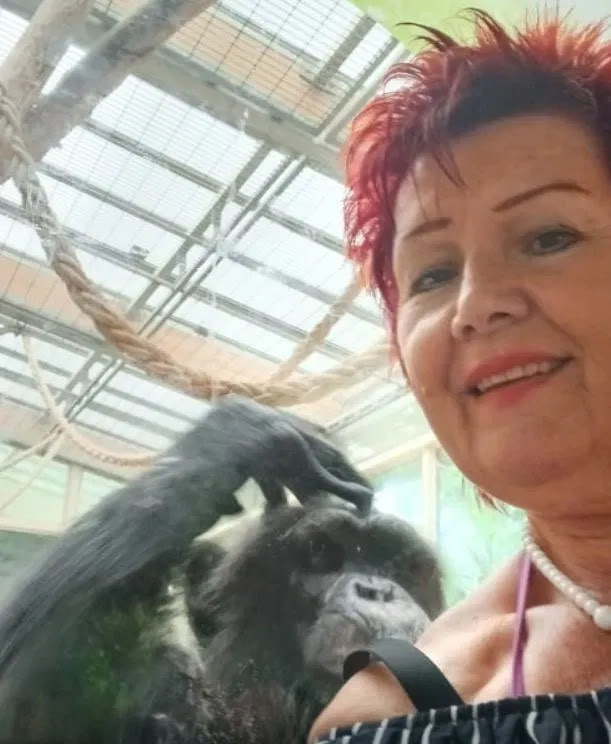
The Lady and the Chimp

Star-crossed lovers: 
Adie Timmermans and Chita the Chimp
 
 
A story that caught my eye earlier this week concerns a woman in Belgium who has been banned by a zoo in Antwerp from visiting the ape enclosure, due to the fact that she was conducting an affair with one of the residents; a chimpanzee named Chita.   
 
For the past four years, Adie Timmermans has visited Chita - who has been held captive at the zoo for thirty years - on a weekly basis and developed a close bond with him, waving and exchanging kisses through the glass (and across the species divide) that separates them. 
 
But now the zoo have stepped in, expressing concern that what they regard as an illicit relationship is negatively impacting upon Chita's natural affinity with members of his own kind; other chimps - perhaps jealous of his rapport with a human - have allegedly begun to exclude him from group activities. 
 
And so, rather cruelly I think, the zoo has banned 38-year-old Ms. Timmermans from making any further contact with Chita, breaking his heart and hers; for parting isn't such sweet sorrow when you don't know if you will ever see one another again.  
 
Keepers have been instructed to help Chita interact more with his fellow chimps. But surely they could have made alternative arrangements; building a private space, for example, in which Chita and Adie could have lived happily ever after in zoosexual bliss ...   


30 Aug 2021

Reflections on Lady Chatterley's Daughter (Part II: Chapters 12-22)

 
Cover of the first US edition 
(Ace Books, 1962) [a]
 
 
V. Chapters 12-14

Chapter twelve picks up where chapter eleven left off, with Clare still musing on her encounter with a kindly lesbian, called Jo. Receiving a note from the latter, Clare tears it up; "she felt no sympathy for Jo [and] certanly did not intend to see her" [139], despite feeling desperately lonely and unhappy:
 
"She began to be morbid. She might die in a raid - die never having found the true perfect love that the poets wrote about. She found herself praying with a kind of despair that she would meet the right man soon and that all her present bitterness and doubt would be swept aside." [139]
 
Then along comes Jacques ... A piano playing Frenchman with a penchant for redheads. Oh how she enjoys dancing with him at the Savoy and accepting his kisses at the end of the evening:

"She felt a new person - full of the joy of life [...] He was so masculine and so right after the episode with Jo Albiss which had left an unpleasant taste in her mouth." [145]

And so, one night, Clare agrees to return to the house in Chelsea that Jacques is staying in, so she might listen to him play Chopin and Debussy, whilst lying stretched out on the sofa with her eyes closed. Soon, the conversation turns to sex. Clare confesses her lack of feeling, but Jacques refuses to accept the possibility of asexuality: "'I do not believe that there lives or breathes a man or woman who is quite sexless'" [147]
 
Well Jacques, mon ami, I suggest you click here ... Although, maybe he's right; for suddenly, Clare decides she wants him to fuck her: "Her whole mind suddenly demanded surrender. It would be such a blessed relief to know that she was not neurotic or cold or abnormal in some way like Jo." [147]
 
Jacque lets down Clare's hair and even manages to quickly and skilfully remove her dress. But then he makes the fatal error of leaving the room for a few moments. For when he returns, wearing only his silk dressing gown: "She looked up at him and in an instant the old horror gripped her, completely smothering all desire." [149]
 
To be fair, Jacques doesn't rage or make a scene. In fact, he comforts Clare and draws from her the following confession ... When she was 13 - thus a year younger than when she discovered she was born out of wedlock - she came across a young couple fucking behind a haystack and this so upset her that she ran off and hid in a hedge until dark, crying her eyes out. 

When she tells her mother, the latter calls her a silly goose for getting upset, and explains that such things are (a) perfectly natural and (b) even beautiful. To make matters worse, Clare later discovers her parents at it, after entering their bedroom to look for a hair-slide. 
 
Jacques, for all his knowledge of l'amour, doesn't quite know what to say: "He had a kindly heart and he knew that something was very wrong with this young girl's outlook." [153] So he tells her to get dressed, then drives her home. 
 
Shortly afterwards, Clare has a nervous breakdown and ends up in hospital for a month:
 
"She felt nothing, and nothing mattered - not Robin or Jacques or Jo - nor her parents, the past, present or future. Just nothing. She lay in a corner of the busy ward, sometimes sleeping, sometimes watching drowsily the activities in the long brightly-painted ward, but always remote, withdrawn, as though in a secret uncaring world of her own.
      She wished she could remain in this void for ever. It was wonderful not to mind - not to feel. [...]
      She was not, however, allowed to remain in this apathy too long." [156-57] 

The psychiatrist assigned to her case tells her to pull herself together and to trust that one day she'll find the right man and all will be well: "'You must wait, Clare, quietly, patiently, until it happens to you. Love will come quite suddenly, and out of the blue, I promise you, but wait for it.'" [160]
 
Funnily enough, this little talk results in a strange new peace coming over Clare and her health begins to rapidly improve: "She was able to smile again." [160] (Who needs Freud?)

Post-recovery, Clare heads off to see her parents once more, down on the farm. Her father drives to the station to pick her up - yes, that's right! Oliver Mellors who, at one time, would rage about how "mechanised greed, sparkling with lights and [...] roaring with traffic" [b] would lead to the destruction of the natural world, is now happy to motor around in a car! 

According to Robins, even whilst driving Mellors was "able to distract his thoughts [...] and lose himself in an ecstatic acceptance of the beauties of nature" [163], but I think we all know that's bullshit; much the same kind of thing that is said by those eco-hypocrites today who express their concern about the environment and global warming, but still drive their gas-guzzling 4x4s to the supermarket to do the weekly shop, or take their precious darlings to football practice. 
 
Whilst alone with her mother, Clare reveals her plan to complete her convalescence with her friend Liz at the latter's home, Long Endon, five miles from Wragby. She also says with sudden complete frankness that she intends to call upon Sir Clifford. Connie thinks this is an act of peculiar disloyalty: 
 
"Why, why did her daughter want to resuscitate the past like this? What strange malicious fascination drew her towards Cliffird Chatterley?" [171]
 
 
VI. Chapters 15-17      
 
Whatever her motivation, Clare visists Wragby Hall: "She felt her cheeks colour. Also her heart beat in a curiously quick, uneven fashion." [172] Her friend Liz (and her parents), didn't know she was the love-child of Constance Chatterley. And Clare still wasn't sure whether she would reveal her maternal origin to Sir Clifford.  
 
Now a mature gentleman with beautifully-brushed white hair, Clifford still looked the part, handsome and well-dressed as always; some might even call him a silver fox. Clare is immediately very fond of him; Clifford seemed suave and sophisticated, yet also rather vulnerable and sensitive. Despite it feeling a bit strange to be drinking tea with her mother's first husband, she was excited to be with him.
 
And Clifford, of course, is smitten by Clare:
 
"This was a very beautiful girl, he thought. His interest in her was purely aesthetic. He admired her fine bones, her long slim figure, her narrow aristocratic ankles. [...] He could see that she had taste. He admired her very simply, well-cut, grey linen dress with its white collar and bolero-coat to match. He always liked a well-tailored woman." [176] (Who doesn't?)
 
Clare reminds Clifford of Connie (though she was slimmer and more graceful than the latter). And Clare could have sat listening to Clifford talk for ever: "It was utter bliss to [...] converse with a man like this who had so much to teach her - to give to a woman, mentally." [178] 
 
She realises that she has to tell him who she is; that it would be unfair to go on accepting his kindness and hospitality without doing so. And so the big reveal: she tells him who her parents are and apologises for visiting under false pretences: 
 
"'I suppose I should have told you at once. It was awful of me. [...] But I wanted so much to meet you. My mother has so often spoken of you, and Wragby [...] I felt I must see you. It wasn't just idle curiosity. It was a sort of compulsion ...'" [180]
 
Clifford receives this revelation in silence, like a figure made of stone. 
 
Finally, he is able to speak and express his astonishment. Obviously, he has mixed feelings about the situation he has been placed in and the young woman before him. Nevertheless, he behaves with perfect decency and, rather than throw her out, as might have been expected, he allows her to stay and even invites Clare to visit him again the following day.

She leaves Wragby strangely elated: 
 
"It was as though with this elderly paralysed man who had once been her mother's husband, she found a deep bond ... a more spiritual and intelligent understanding ... than she had received from any of the younger men. [...]
     She had no wish to be disloyal to her parents, but she had to admit she found Sir Clifford a fascinating character, His concise brain - his interest in learning - in all the things of the mind, had given her an exact answer to her desire to ignore the physical and live on a more intelligent plane." [186]
 
To which we can only ask: what would her parents think - and what would Lawrence make of this? I suspect that the latter would be spinning in his grave, if Frieda hadn't had his corpse exhumed and cremated. Because this is a real turn up for the books - and, if I were Robins, I would have Connie marry Clifford and thus square the love triangle that existed between him and her parents. (Spoiler: this isn't going to happen.)  

For Clare, Wragby has everything that her parents home - Swanningdean - lacks:

"There, her mother and father lived in the little snug farmhouse more or less in each other's arms, oblivious to anything that went on around them; not caring particularly what had been done in the past and what might happen in the future. Only the present mattered to them, within the narrow confines of their egotistical passion." [188]
 
Wragby has grandeur and a rich history and belonged to no one individual, but to generations past and generations to come: 

"At Wragby [Clare] found the strength, the vision and above all the restraint which appealed to everything fundamental in her. [...]
      Here, at Wragby, she could feel her own views vindicated. Passion played no part in Sir Clifford's life and yet his mind was free to roam at will over every aspect of living - enriched by past generations, by beauty, art, and an intellect far beyond her own." [188]
 
Of course, this is Clare's take on things: it would never be Connie's. For her mother is one of those women who believes in love über alles and that, for a woman, biology is a destiny: "that aesthetic pleasures could not bring complete fulfilment to a woman; nature did not fashion a woman's body for procreation, nor endow her with the desire to love and be loved to no purpose" [188-89].

Ultimately, for Connie (and I suspect for Robins): "No matter how Clare might try to run away from this basic truth, she would realize it in the end [...]" [189]
 
God save us all from basic truths ...!
 
Clare agrees to sit for Liz's brother, Francis, who fancies himself as a portrait artist. Of course he falls in love with her and even asks for her hand in marriage. She turns him down [c]. Which was just as well, for shortly afterwards he develops leukaemia and dies (see chapter 18, pp. 216-17). 
 
Clare spends more time with Clifford, talking about English architecture and the beauty of fireplaces. On the last night but one, they dine together and then watch a film; Henry V, starring and directed by Laurence Olivier (1944) [d]
 
When the time comes to say goodbye, Clifford extracts a promise from Clare that she'll return one day (a promise he'd also once extracted from her mother of course): "She had brought him great joy in a fashion which he found hard to explain to himsef." [201]      
 
Annoyingly, even Clifford can't resist saying something stupid at the end:
 
"'Your mother wasn't altogether wrong, you know - about the need of men and women for love. Few people can live altogether on an intellectual plane. There can be no survival for life without the attraction of male and female and vice versa.'" [201-02]    

Clare - like the rest of us - was deeply shaken by this: "Here was Sir Clifford, of all people, advocating her mother's way of life [...]" [202] and seemingly ignorant of the fact that life would continue just fine without 'the attraction of male and female'; that asexual reproduction is the primary form of reproduction for single-celled organisms and that many eukaryotic organisms (including plants, animals, and fungi) can also reproduce asexually.

Anyway, after leaving Wragby, Clare heads off to visit her parents. She finds Connie in the kitchen "making a bacon and cheese pie for her husband's supper" [203] - what a life! It turns out Gloria has done a bunk and abandoned her baby boy, even though he had "a profound, primeval wisdom in his round blue eyes" - or maybe because he had "a profound, primeval wisdom in his round blue eyes" [210].  
 
As Clare sits feeding the baby - whom Connie and Mellors plan to raise as their own - she ponders again on Clifford's final words to her.
 
 
VII. Chapters 18-22 
   
We pick up the tale on January 4th - three days after Clare's twenty-first birthday ... 
 
Apart from the odd date, Clare has managed to avoid getting entangled in any new love affairs, though has become caught up in the lives of Colin Talbot (a former patient) and his wife, Evelyn. Colin has been injured again in the war, this time suffering terrible facial wounds, much to Evelyn's horror: "Try as she might, she could not stop trembling when she was anywhere near him." [219]
 
Of course, Clare isn't very understanding of the young wife; she found Evelyn's physical revulsion pathetic and thought that "when a woman loved a man, facial disfigurement or any other kind of disablement could not possibly alter her feelings towards him" [219]
 
In private, however, Clare too "felt depressed [...] when she saw Colin's once delightful face so fearfully altered and scarred" [219]. Who wouldn't? For as he himself acknowledges, he resembles a gargoyle and it's not a sign of superficiality or lack of character to find such monstrousness problematic. 
 
That is to say, there's a reason why healthy people feel repulsed by sickness or injury; why disfigurement and disability disconcerts. And the reason is one that Nietzsche reminds us of in Twilight of the Idols: "Physiologically, everything ugly weakens and oppresses human beings. It reminds them of decay, danger, powerlessness; it actually makes them lose strength." [e] 
 
Clare's judgement of Evelyn - that she is of a shallow nature and therefore "incapable of strong enduring love" [226] - simply displays her own lack of depth and sound instinct. 
 
Clare's moralistic nastiness is arguably reflected in the author's decision to pass a death sentence on Evelyn - although perhaps this was just a fast and convenient method to advance the plot and clear the way for Clare and Colin to finally recognise their feelings for one another ... (As we will see later, a second fatality will prove even more advantageous to the couple.)   
 
Anyway, poor Evelyn dies - aboard a ship headed for Malta which is torpedoed by a German U-boat. Clare tries to make Colin forget that his wife is lying in a cold sea grave and look on the bright side. After all, he's still alive and "should be glad" [229]. On the train home she congratulates herself on her caring nature: "It's funny [...] that I should do people good [...] and can give them so much more of myself." [229]

Months pass, and Colin eventually stops talking about Evelyn and concentrates on his own recovery. Via extensive plastic surgery, he slowly has his face rebuilt and although still badly scarred, he no longer looks monstrous. Clare is pleased to see him doing so well: "Not for the first time she felt that it was a good thing Fate had removed Evelyn from his life. She might have found even this new face difficult to accept without a tremor of distaste." [231]

In the summer of 1945, the war in Europe ends. Clare is still visiting Colin regularly in the hospital. When he is given permission to leave for a weekend, Clare takes him to meet her parents. Mellors likes him and Connie adores him: "'I think he's so nice, so sweet. It doesn't seem to matter at all about his poor face'" [234],  she said, indicating that, actually, it is an issue for her. 

She and Mellors thinks Colin is in love with their daughter and advise her to marry him. So too does Clifford Chatterley, with whom Clare has continued to correspond. Eventually, Clare comes to the same conclusion: that it's Colin she loves; not his appearance, but the fact that he so reminds her of herself. She tells him:

"'Colin, it is no sacrifice for me to be with you. You're everything I've ever wanted in a companion. We think the same way about life, enjoy the same kind of entertainments, read the same books. When I'm with you it's almost like being with my twin.'" [236]

Lawrence, of course, would point out that having the same tastes and interests is an excellent basis for friendship, but disastrous grounds on which to marry [f]. I don't think narcissism much helps matters either.
 
Anyway, Colin decides that the love between him and Evelyn hadn't been the real thing after all; merely an attraction of the senses. Besides, she's dead. And so he and Clare agree to marry. But she feels she has to warn him about her little problem, i.e., her coitophobia. Colin realises that "it was essential for him to deal with all her complexities with the utmost tact" [242] - and so immediately asks her if she's seen a shrink.  
 
They decide not to worry - that it'll be alright on the wedding night. In fact, Clare feels so grateful that Colin is so understanding that she decides she wants to fuck him there and then on the sunlit South Downs: 
 
"Clare found herself able to surrender almost completely to the call of the blood that now moved hotly through her veins. [...] She believed in that moment that she would find nothing but joy in their ultimate union.
      Now, at last, she felt she understood the power of the love that had made her mother leave everything for the man she loved." [246]
 
Colin, however, the perfect getleman, decides not to take advantage of the moment, but to display perfect self-control. And so, instead of fucking, they sit up and enjoy a non-postcoital cigarette, before returning to the farm to inform her parents of their decision to wed.

Unfortunately, things, initially, do not go well ... Clare remains stupidly afraid on the first night of her honeymoon: "Lying in the big double bed, waiting for him to join her, she had felt her whole body cold with fear [...]" [245]

But she needn't have worried. For when Colin comes to bed he yawns and says: "'I'm tired - aren't you poppet? Weddings are frightful affairs. It's always the poor bride and bridegroom who come out of 'em exhausted.'" [246] Then he goes to sleep. 
 
This amazes - and relaxes - Clare: "He was so sweet and understanding [...]" [246] But when after several nights of lying like two children beside each other all through the night - "secure in each other's intimate presence" [247], yet passionless - she begins to worry; maybe he didn't want her? She began to wonder just how long they could go on living with a "strange, unnatural, unmentioned barrier between them" [248].   

Her mother advises her that she must totally surrender herself to Colin: "Perfect fulfilment can never be attained without this complete giving." [250] And this seems to do the trick; for apparently, this was what he had indeed been waiting for all along. And so, finally, Colin does the deed and Clare was lifted "into a new world, a new deeper understanding, a new life" [252]

But as happy as this makes her, I suspect it doesn't come close to the joy she feels when she learns of Sir Clifford's sudden death and the fact that he has left his entire estate, including Wragby Hall, to her. She and Colin immediately put their mews cottage up for sale and make plans to move in to the above as soon as possible (with the intention, apparently, of turning it into the Glyndebourne of the North). 
 
This news makes Connie shake with laughter: '"Oh, Clare, Clare, we must go and tell your father,' she said, gasping, 'he'll be so amused!'" [256]
 
And on that note ends the story of Lady Chatterley's daughter - surely one of the most objectionable figures in English fiction ...    
 
 
Notes
 
[a] The edition I'm reading is the original UK edition, published by Consul Books, 1961. Page references given in the post above are to this edition - not the first US edition published by Ace Books (1962).

[b] D. H. Lawrence, Lady Chatterley's Lover, ed. Michael Squires, (Cambridge University Press, 1993), p. 119. 

[c] Shortly afterwards, poor Francis develops leukaemia and dies: 
      "Clare had cried quite unashamedly over this. It seemed awful that Francis had to die without even the glory of being killed in defence of his country. And it made her feel almost guilty because she hadn't been able to love him as he had loved her." [216] 
      She really is a stupid girl and as self-absorbed as her mother.
 
[d] Unless Clifford had managed to get hold of a pre-release print of the film, there is no way he and Clare could have watched Henry V in the summer of 1944; it was released in British cinemas on 22 November of that year. Robins's claim that this movie was an old favourite of Clifford's and that Clare had also seen it before, when much younger, is simply careless on her part.
 
[e] Nietzsche, Twilight of the Idols, trans. 'Skirmishes of an Untimely Man', §20. 

[f] See D. H. Lawrence, A Propos of 'Lady Chatterley's Lover', in Lady Chatterley's Lover and A Propos of 'Lady Chatterley's Lover', ed. Michael Squires, (Cambridge University Press, 1993), pp. 325-26, where he writes:

"Modern people are just personalities, and modern marriage takes place when two people are 'thrilled' by each other's personality: when they have the same tastes in furniture or books or sport or amusement, when they love 'talking' to one another, when they admire one another's 'minds'. Now this, this affinity of mind and personality is an excellent basis of friendship between the sexes, but a disastrous basis for marriage. Because marriage inevitably starts the sex activity, and the sex activity is, and always was and will be in some way hostile to the mental, personal relationship between man and woman. It is almost an axiom, that the marriage of two personalities will end in a startling physical hatred. People who are personally devoted to one another at first end by hating one another with a hate which they cannot account for [...]"
 

To read the first part of this post - on chapters 1-11 of Lady Chatterley's Daughter - click here